Puns have been called “the lowest form of humor” but they’ve also made Shakespeare immortal, powered advertising campaigns worth billions, and sparked more groans and giggles than almost any other kind of wordplay. So what exactly makes a pun work, and why can’t we stop making them?
Whether you’re a writer looking to add wit to your content, a teacher searching for engaging classroom material, a social media manager hunting for the perfect caption, or just someone who loves a good groan-worthy joke, you’ve come to the right place. This guide covers everything from ancient history to modern memes, plus hundreds of ready-to-use examples.
What Is a Pun? (Simple Definition + Quick Examples)
A pun (also called paronomasia in linguistics) is a form of wordplay that exploits multiple meanings of a word, or words that sound similar but have different meanings, for humorous or rhetorical effect. In other words, a pun takes advantage of ambiguity in language to surprise your brain — and that surprise is what makes you laugh or groan.
Puns usually work by:
- Playing with words that sound alike (homophones).
- Using words with multiple meanings.
- Combining familiar phrases with unexpected twists.
Quick examples:
- “I’m reading a book on anti-gravity. It’s impossible to put down!”
- “Did you hear about the mathematician who’s afraid of negative numbers? He’ll stop at nothing to avoid them.”
- “Time flies like an arrow; fruit flies like a banana.”
- “I stayed up all night wondering where the sun went. Then it dawned on me.”
- “A boiled egg every morning is hard to beat.”
- “I used to play piano by ear, but now I use my hands.”
- “I wasn’t going to get a brain transplant, but then I changed my mind.”
- “The rotation of the Earth really makes my day.”
These jokes create a small “mental jolt” as your brain realizes there’s a second meaning hiding behind the first.
The Fascinating History of Puns (From Ancient Egypt to Modern Memes)
Ancient Origins (3000 BCE – 500 CE)
Puns aren’t a modern invention — they’re as old as written language itself. Some of the earliest recorded wordplay appears thousands of years ago:
- Ancient Egypt (around 3000 BCE): Egyptian hieroglyphs sometimes used symbols with multiple meanings, creating layered religious and political messages that functioned as puns.
- Sanskrit poetry: Classical Indian epics and religious texts used complex wordplay, including puns, as a way to encode philosophical and theological ideas.
- Greek and Roman rhetoric: Writers like Plato and orators like Cicero employed puns and double meanings in speeches and dialogues to persuade and entertain.
- Hebrew Bible/Torah: Biblical scholars have identified many instances where Hebrew words are chosen for their double meanings, creating theological puns.
From the beginning, puns weren’t just jokes — they were tools for storytelling, persuasion, and spiritual teaching.
Shakespeare and the Golden Age of Puns (1500s–1700s)

William Shakespeare is often considered the king of puns. Scholars estimate that his plays and poems contain over 3,000 puns, woven into dialogue, titles, and character names.
A few famous examples:
- In Romeo and Juliet, as Mercutio dies, he says: “Ask for me tomorrow, and you shall find me a grave man.” Here “grave” means both serious and dead.
- In Hamlet, the line “A little more than kin, and less than kind” plays on “kin” (family) and “kind” (type and kindness).
- The title Much Ado About Nothing itself is a pun — “nothing” was pronounced similarly to “noting,” meaning gossip or observation in Elizabethan English.
During Shakespeare’s era, clever wordplay was considered a mark of education and wit, not lowbrow humor.
Victorian Era and the Rise of “Punishment” (1800s)

In the 19th century, puns became so popular that they inspired clubs and competitions — and also backlash:
- Pun clubs in London held contests where members tried to outdo one another with increasingly elaborate wordplay.
- The modern term “pun” became standardized, replacing older labels like “quibble.”
- Writers like Oscar Wilde and Lewis Carroll used puns extensively; Carroll’s Alice’s Adventures in Wonderland is packed with linguistic nonsense and wordplay.
Around this time, critics began calling puns “the lowest form of humor,” partly because they were so common and often used in cheap jokes.
20th Century to Modern Day (1900s–Present)

In the 20th century, puns adapted to new media:
- Vaudeville and radio: Comedians such as Groucho Marx relied heavily on one-liners and fast wordplay.
- Advertising’s golden age (1950s–1980s): Marketers discovered that punny slogans stick in people’s minds, helping brands stand out.
- Internet age: Memes, “dad jokes,” and social media captions have turned puns into a daily part of online culture.
There’s even a dedicated annual competition: the O. Henry Pun-Off World Championship in Austin, Texas, where punsters battle live on stage. Today, puns are part of everything from stand-up comedy to corporate and political communication.
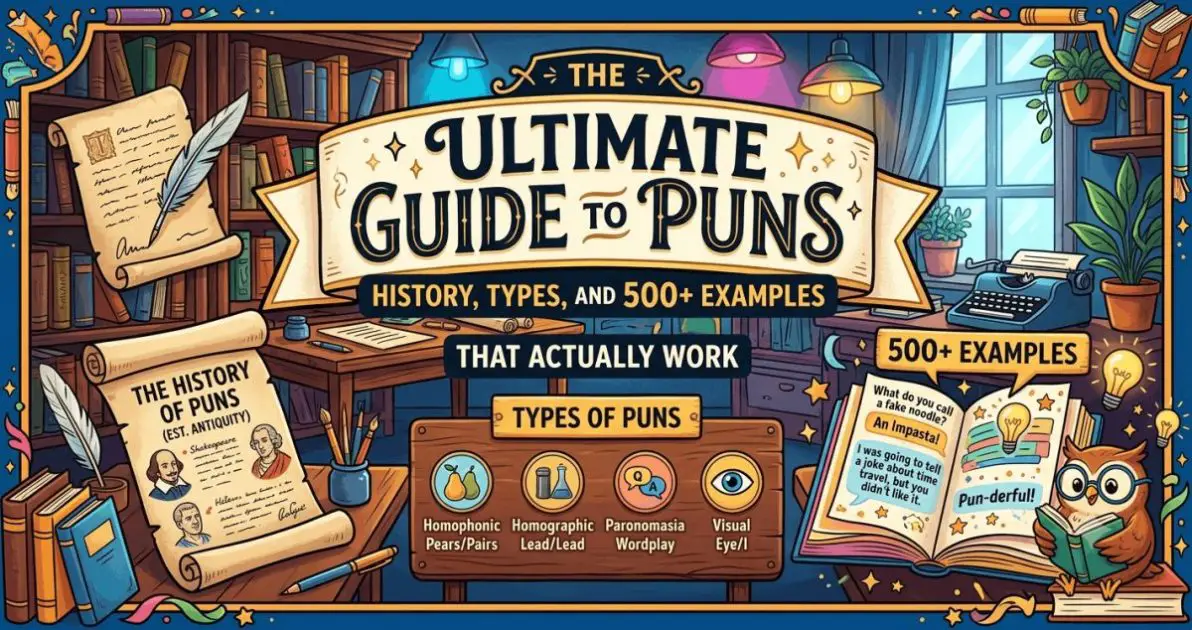
The 10 Main Types of Puns Explained (With 50+ Examples Each)
Not all puns work the same way. Linguists and humor writers often group puns into several types based on how they use language. Understanding these makes it much easier to write your own.
Below are 10 major types, with explanations and lots of examples.
1. Homophonic Puns (Same Sound, Different Meaning/Spelling)
What they are: Homophonic puns use words that sound the same but have different meanings and often different spellings (homophones).
Examples:
- “Denial is not just a river in Egypt.” (denial / the Nile)
- “I used to be a baker, but I couldn’t make enough dough.” (dough = bread mixture / money)
- “A bicycle can’t stand on its own because it’s two-tired.” (two-tired / too tired)
- “What do you call a fake noodle? An impasta!” (impasta / imposter)
- “I’m on a seafood diet. I see food and I eat it.”
- “What do you call a bear with no teeth? A gummy bear.”
- “Why don’t oysters donate to charity? Because they’re shellfish.”
- “What do you call a lazy kangaroo? A pouch potato.”
- “What do you call a cow with no legs? Ground beef.”
- “What do you call a dog magician? A labracadabrador.”
- “What do you call cheese that isn’t yours? Nacho cheese.”
- “I couldn’t figure out how to put my seatbelt on. Then it clicked.”
- “What do you call a sleeping dinosaur? A dino-snore.”
- “I’m friends with 25 letters of the alphabet. I don’t know Y.”
- “What do you call a can opener that doesn’t work? A can’t opener.”
Homophonic puns are especially effective in spoken language and casual writing because they depend on sound rather than spelling.
Best uses: Conversation, social media captions, speeches, icebreakers.
2. Homographic Puns (Same Spelling, Different Meaning)
What they are: Homographic puns use words that are spelled the same but have different meanings (homographs).
Examples:
- “A dog had puppies near the road and was ticketed for littering.” (litter = trash / group of puppies)
- “The boxer was so good, he could punch a clock.” (punch = hit / time card)
- “The tear in the fabric made me tear up.” (tear = rip / cry)
- “The match was so exciting, it lit up the stadium.” (match = game / fire starter)
- “The dove dove into the water.” (dove = bird / past of ‘dive’)
- “I had to record the record.” (record = capture / vinyl or achievement)
- “She found the content of the book very content.” (content = subject / satisfied)
- “He saw a bear bear the weight of the situation.” (bear = animal / tolerate)
- “The wind wind around the corner.” (wind = air / twist)
- “The project began to project a different image.” (project = undertaking / cast outward)
- “The bandage was wound around the wound.” (wound = wrapped / injury)
- “I did not object to the object on the table.” (object = protest / thing)
- “The invalid claim was later ruled invalid.” (invalid = person unwell / not valid)
- “The old sailor decided to desert his post in the desert.” (desert = abandon / arid land)
- “They refuse to pick up the refuse left on the street.” (refuse = decline / garbage)
These puns work best in written language, where the spelling is visible and the double meaning becomes clear.
Best uses: Essays, literature, witty emails, jokes relying on written form.
3. Homonymic Puns (Same Sound AND Spelling, Different Meaning)
What they are: Homonymic puns use “true homonyms”: words that have the same spelling and pronunciation but different meanings.
Examples:
- “I used to be a banker, but I lost interest.” (interest = stake / curiosity)
- “The farmer was outstanding in his field.” (outstanding = excellent / literally standing outside)
- “He was so broke, he couldn’t even pay attention.” (broke = no money / broken)
- “The artist can really draw a crowd.” (draw = sketch / attract)
- “The math teacher has acute angles.” (acute = sharp / clever)
- “That argument doesn’t hold water.” (hold water = be valid / contain liquid)
- “She has a lot on her plate.” (plate = dish / responsibilities)
- “The comedian left everyone in stitches.” (stitches = sewing / fit of laughter)
- “He gave a rock-solid rock performance.” (rock = stone / music)
- “She can really light up a room.” (light up = illuminate / bring joy)
- “The novelist has a great deal of plot.” (plot = storyline / land)
- “The runner was really in the race for a good cause.” (race = competition / cause loosely tied to identity of event)
- “He can’t bank on the river bank holding steady.” (bank = rely on / riverbank)
- “The tailor’s business is really sew-so.” (sew / so)
- “The boxer’s story really packed a punch of its own.” (punch = hit / impact)
Homonymic puns often show up in idioms and fixed expressions because many common phrases use words with multiple meanings.
Best uses: Smart one-liners, speeches, slogans, everyday talk.
4. Compound Puns (Multiple Puns in One Sentence)
What they are: Compound puns contain two or more puns layered together in a single sentence, often chaining different wordplay devices.
Examples:
- “Where do you find a cow with no legs? Right where you left it.” (left / no legs)
- “Why did the bicycle fall over? It was two-tired — and frankly, it had no handle on the situation.”
- “Why did the coffee file a police report? It got mugged and couldn’t espresso itself.”
- “I told my wife she was drawing her eyebrows too high. She looked surprised and said I was drawing conclusions.”
- “Why did the scarecrow win an award? He was outstanding in his field and had plenty of corn-credibility.”
- “The baker kneaded a break, so he loafed around and made some dough on the side.”
- “The electrician was shocked to be fired — he thought the job had real potential.”
- “The photographer’s business was developing nicely, and he really had an eye for the picture.”
- “The gardener planted a rumor and watched it grow into quite a thorny issue.”
- “The clock maker’s business was ticking along, and he always had time on his side.”
Because they pack several jokes into one, compound puns can hit harder — but they also risk feeling “too much” if overused.
Best uses: Stand-up comedy, social posts designed to go viral, playful writing.
5. Recursive Puns (Puns That Depend on Another Pun)
What they are: Recursive puns are puns whose second part only makes sense if you’ve already understood the first pun. They’re “meta” jokes for people who like layers.
Examples:
- “A Freudian slip is when you say one thing but mean your mother.” (requires knowing Freudian theory)
- “I used to hate facial hair, but then it grew on me.” (grew on me = became likeable / literally grew)
- “I had a dream I was a muffler. I woke up exhausted.” (muffler = exhaust part / very tired)
- “The reverse of ‘the early bird gets the worm’ is ‘the early worm gets eaten.'”
- “I’m reading a book on anti-gravity. It’s impossible to put down — and that idea is really starting to lift me up.”
- “I used to be a locksmith, but I lost the key to my own success, which really unlocked a new level of irony.”
- “A pun about time travel is timeless, because it always comes back around.”
- “I told a joke about amnesia, but I forgot the punchline — which, if you think about it, was the punchline.”
- “The pun about infinity never really ends, and neither does this sentence about it.”
- “I made a joke about a broken pencil, but it was pointless, so I had to sharpen my delivery.”
These jokes reward people who recognize references and are comfortable juggling multiple meanings.
Best uses: Intellectual humor, niche communities, clever writing for readers who enjoy puzzles.
6. Visual Puns (Wordplay in Images)
What they are: Visual puns rely on pictures, symbols, or design elements combined with text to create wordplay. They’re extremely common in memes, cartoons, and advertising.
Examples (described):
- An owl with the caption “Who’s there?” — the owl’s “who” sound plays on the question “Who’s there?”
- A bee next to the words “Bee yourself” — image of a bee standing in for “be.”
- A wine glass and clock with “Time to wine down” — mixing “wind down” with “wine.”
- A cat lying on a keyboard captioned “Cat-astrophic typing.”
- A bear on a phone with “Bear with me.”
- A pair of scissors next to “Cutting it close,” shown right beside a deadline calendar.
- A snail on a race track labeled “Slow and steady wins the escar-go.”
- A stack of pancakes shaped like a smiley face captioned “Batter days ahead.”
- A pea sitting alone on a plate captioned “Just pea myself.”
- A pair of shoes on a chessboard captioned “Sole survivor.”
Visual puns are powerful because they’re instantly shareable and don’t require long explanations.
Best uses: Social media (Instagram, Pinterest), marketing campaigns, greeting cards, merch.
7. Idiom-Based Puns (Twisting Common Phrases)
What they are: Idiom-based puns take well-known sayings and twist them with a new context, usually by swapping one word or concept.
Examples:
- “I’m on a seafood diet. I see food and I eat it.” (twist on “seafood diet”)
- “The early bird gets the worm, but the second mouse gets the cheese.”
- “You can’t have your cake and eat it too — but you can order two cakes.”
- “When life gives you lemons, make lemonade — then sell it at the farmers’ market.”
- “A picture is worth a thousand words, but a GIF is worth a thousand pictures.”
- “Actions speak louder than words, but a well-timed pun speaks loudest of all.”
- “Don’t count your chickens before they hatch — or your puns before they land.”
- “The grass is always greener on the other side, especially if you overwater your side.”
- “Better late than never, but better on time and never late.”
- “When one door closes, another opens — unless it’s a revolving door, in which case, good luck.”
These work because audiences instantly recognize the original idiom and enjoy the unexpected twist.
Best uses: Speeches, social commentary, blogs, educational content illustrating idioms.
8. Double Entendre (Two Meanings, One Often Suggestive)
What they are: A double entendre is a phrase with two interpretations, one straightforward and one more suggestive or risqué. They’re common in adult humor, advertising, and pop culture.
Examples (kept PG):
- “I’m excellent in bed: I can sleep for hours.”
- “That’s a nice package you’ve got there.” (could refer to a gift, product, etc.)
- “It’s not the size, it’s how you use it.” (could refer to tools or skills)
- “I’m good with my hands.” (could refer to crafting or manual work)
- “I like my coffee strong and dark.” (surface meaning about taste)
- “He really knows how to handle his tools.” (could refer to a workshop or a general skill set)
- “She’s got a firm grip on the situation.” (could refer to leadership or literally holding something)
- “That’s quite a spread you’ve laid out.” (could refer to a buffet table)
- “I prefer things a little rough around the edges.” (could refer to furniture or design style)
- “He’s always looking for a good opening.” (could refer to a job opportunity or a chess move)
Used well, double entendres can be clever and memorable; used poorly, they can feel crude or inappropriate.
Best uses: Carefully targeted marketing, adult comedy, informal conversations among friends.
9. Tom Swifties (Adverb-Driven Puns)
What they are: Tom Swifties are sentences where the speaking verb and adverb pun on the content of the quote. They’re named after the Tom Swift adventure novels.
Examples:
- “I’m hungry,” said Tom ravenously.
- “I’m cold,” said Tom icily.
- “I’m confused,” said Tom puzzlingly.
- “I’m broke,” said Tom pennilessly.
- “I’m tired,” said Tom exhaustedly.
- “I love gardening,” said Tom, without missing a beet.
- “I need a pencil sharpener,” said Tom bluntly.
- “This elevator is stuck,” said Tom, in a lift.
- “I dropped the toothpaste,” said Tom, crestfallen.
- “I’ll take the small piece,” said Tom, in a small voice.
They’re simple but fun exercises in matching adverbs to statements in humorous ways.
Best uses: Writing exercises, playful literature, word games.
10. Antanaclasis (Repeating a Word with Different Meanings)
What it is: Antanaclasis is a rhetorical device where a word is repeated, but its meaning changes each time. It’s common in speeches, slogans, and literature.
Examples:
- “Your argument is sound, nothing but sound.” (sound = valid / noise)
- “We must all hang together, or we shall all hang separately.” (hang = unite / be executed)
- “I’m not a shopaholic, I’m just helping the shop a lot.” (shop = store / shop)
- “You can tune a guitar, but you can’t tuna fish.” (tune / tuna)
- “The pen is mightier than the sword, but only if the sword isn’t nearby.”
- “If you don’t learn to pace yourself, you’ll never win the pace of the race.”
- “Time will tell, but time never tells the same story twice.”
- “The bank will not bank on a loan without collateral.”
- “You have to book the book before it sells out.”
- “The judge will judge the case, but who will judge the judge?”
Antanaclasis gives punchy, memorable emphasis in very few words.
Best uses: Headlines, slogans, speeches, epigrams.
How to Write Your Own Puns: A Step-by-Step Guide
You don’t have to wait for inspiration — you can systematically create puns. Here’s a simple process you can reuse for any topic.
Step 1: Pick a Specific Topic
Specific is better than vague. Instead of “animals,” pick “cats.” Instead of “food,” pick “coffee.”
Examples: Cats, coffee, weather, sports, work, travel.
Let’s use coffee as a running example.
Step 2: Brainstorm Related Words
Write down everything you associate with that topic.
Coffee word list:
- brew, bean, cup, mug, espresso, latte, cappuccino, mocha
- caffeine, morning, energy, bitter, sweet, hot, steam
- grind, roast, pour, drip, filter, barista, café, coffee shop
- idioms: “wake up and smell the coffee,” “percolating ideas,” “brewing trouble”
- aroma, foam, crema, bold, single-origin
The longer your list, the more material you’ll have to play with.
Step 3: Look for Homophones & Multiple Meanings
Identify words that sound like other words or have more than one meaning.
For coffee:
- grounds = coffee residue / reasons (“on what grounds…”)
- roast = cook / make fun of
- grind = work hard / crush
- latte ~ “lately”
- espresso ~ “express so”
- perk = perk up / percolate
- blend = mix / fit in
- press = French press / apply pressure
- pour-over ~ “pour it over”
- drip ~ “drip-feed of information”
These are prime pun ingredients.
Step 4: Twist Idioms and Common Phrases
Take a familiar phrase and swap one word with your topic or associated word.
Examples with coffee:
- “I’m running on empty” → “I’m running on espresso.”
- “Wake up and smell the coffee” → “Wake up and smell the opportunities.”
- “Brewing trouble” → “Brewing coffee and trouble.”
- “Actions speak louder than words” → “Actions speak louder than lattes.”
- “Don’t cry over spilled milk” → “Don’t cry over spilled cream in your coffee.”
- “Keep calm and carry on” → “Keep calm and carry on brewing.”
- “Time is money” → “Time is coffee.”
Step 5: Combine Techniques
Layer homophones, idioms, and double meanings.
Examples:
- “I’m not addicted to coffee. We’re just in a very committed relationship.”
- “I’m on a coffee diet. I see coffee and I drink it.”
- “My ideas are still percolating — I haven’t fully brewed the plan yet.”
- “Life without coffee would be grounds for divorce.”
- “I like my coffee like I like my mornings — bold, dark, and a little bitter.”
- “That barista really knows how to espresso himself.”
- “Our relationship has really been perking up lately.”
Step 6: Test the Pun
Say it out loud. If you need more than a short sentence of explanation, it’s probably too complicated.
Ask:
- Does the wordplay feel natural?
- Will the average person recognize the second meaning?
- Does it make people groan or smile in under two seconds?
Step 7: Polish It
Make the wording short, clear, and punchy. Great puns are usually concise:
- Long: “I really love coffee so much that you might say we’re in a relationship.”
- Short: “I’m not addicted to coffee — we’re in a relationship.”
Try it yourself: Pick one topic (cats, weather, work, food, travel) and write 5 short puns using this process.
Common Pun Mistakes (And How to Avoid Them)
Even good writers can make weak puns. Here are typical pitfalls and fixes.
1. Overexplaining
If you have to say “Get it?” and then unpack the whole thing, the joke loses power.
Fix: Aim for puns that people understand immediately or within a beat.
2. Obscure References
Puns based on very niche knowledge can leave most people confused.
Fix: Use references your audience is likely to know (popular movies, common phrases, everyday objects).
3. Forcing It
Sometimes, the wordplay just doesn’t fit naturally.
Fix: If it feels shoehorned in, cut it. A clean line is better than a strained pun.
4. Ignoring Context
A pun that’s great in a casual chat might be inappropriate in a serious meeting or sensitive situation.
Fix: Read the room. Puns are best in light, informal contexts unless you know your audience very well.
5. Using Too Many Puns
“Pun overload” can make writing or conversation feel gimmicky.
Fix: Treat puns like spice. A little can transform the dish; too much ruins it.
The Science of Why We Love (and Hate) Puns
The Brain’s “Aha!” Moment
Psychologists and neuroscientists have found that humor, including puns, often activates reward circuits in the brain when we resolve a surprising ambiguity. Your brain first interprets a sentence one way, then quickly reinterprets it when you notice the second meaning — that flip triggers a small burst of satisfaction.
Groaning vs. Laughing
Many people groan at puns, but that groan usually signals that they “got” the joke — it’s a mix of mild frustration at being tricked and appreciation for the cleverness. That’s why punsters often say that groans are compliments in disguise.
Cognitive and Language Benefits
Because puns rely on vocabulary, multiple meanings, and flexible thinking, engaging with them can:
- Strengthen language skills and vocabulary.
- Encourage creative thinking by forcing your brain to connect unrelated concepts.
- Help learners notice nuances in grammar and pronunciation.
Teachers and language coaches often use puns to help students better understand homophones, idioms, and figurative language.
Puns in Popular Culture: From Shakespeare to Memes
Classic Literature
We’ve already mentioned Shakespeare, but many other writers embraced puns:
- Lewis Carroll in Alice’s Adventures in Wonderland uses countless pieces of nonsense wordplay.
- Oscar Wilde’s plays and epigrams often hinge on doubles of meaning and ironic twists.
Advertising and Branding
Brands use puns to create memorable slogans and campaigns. A clever play on words:
- Sticks in people’s minds more easily.
- Signals creativity and personality.
- Encourages sharing and conversation.
Think of punny headlines in print ads, store names, and taglines. They’re everywhere.
Internet Culture
On social media, puns thrive because they’re:
- Short and shareable.
- Easy to turn into memes or image macros.
- Great hooks for captions, tweets, and comment threads.
Subreddits and various social accounts keep pun culture alive and evolving.
500+ Bonus Puns by Category (Quick-Reference)
To make this guide genuinely useful, here is a compact selection of puns across popular categories. You can expand these lists over time.
- “What do you call a bear with no teeth? A gummy bear.”
- “Why don’t oysters donate to charity? Because they’re shellfish.”
- “Why did the scarecrow become a successful neurosurgeon? He was outstanding in his field.”
- “What do you call a fish with no eyes? Fsh.”
- “Why couldn’t the leopard play hide and seek? He was always spotted.”
- “What do you call an alligator in a vest? An investigator.”
- “Why did the chicken join a band? Because it had the drumsticks.”
- “What do you call a pig that does karate? A pork chop.”
- “Why are fish so smart? Because they live in schools.”
- “What do you call a snake that works for the government? A civil serpent.”
- “I’m on a seafood diet. I see food and I eat it.”
- “What do you call a fake noodle? An impasta.”
- “Lettuce celebrate this salad.”
- “You’re one in a melon.”
- “You bake me crazy.”
- “Donut worry, be happy.”
- “I’m kind of a big dill around here.”
- “Cheese to meet you.”
- “Olive you very much.”
- “This is a grate way to end the meal.”
Work & Office Puns (Sample)
- “My boss told me to have a good day — so I went home.”
- “I’m great at multitasking: I can waste time, be unproductive, and procrastinate all at once.”
- “I used to be a banker but I lost interest.”
- “Writing with a broken pencil is pointless.”
- “I got fired from the orange juice factory — lack of concentration.”
- “I quit my job at the shoe factory. It just wasn’t the right fit.”
- “The stationery store must have moved. It’s not in the same place.”
- “I used to work at a calendar factory, but I got fired for taking a few days off.”
- “Being a paper salesman is boring, but at least it’s never bland.”
- “My job at the keyboard factory really requires a lot of shift work.”
Tech & Science Puns (Sample)
- “Why don’t scientists trust atoms? Because they make up everything.”
- “I would tell you a UDP joke, but you might not get it.”
- “Never trust a math teacher who’s afraid of negative numbers. They’ll stop at nothing.”
- “I told a chemistry joke — there was no reaction.”
- “The Wi-Fi went down at home; I had to talk to my family. They seem like nice people.”
- “Why do programmers prefer dark mode? Because light attracts bugs.”
- “I had a great joke about UDP, but I’m not sure you’ll get it.”
- “Parallel lines have so much in common. It’s a shame they’ll never meet.”
- “Why was the computer cold? It left its Windows open.”
- “I’m reading a book about anti-gravity — it’s impossible to put down, and neither is this science joke.”
Final Thoughts
Puns have survived thousands of years of language evolution, from hieroglyphs and scripture to Shakespearean drama and TikTok captions. They blend logic, surprise, and sound in a way that lights up the brain — even when they make us groan.
Now that you understand the history, the main types, and a repeatable method for creating your own, you’re ready to:
- Add smarter humor to your writing.
- Craft more engaging social media captions.
- Build pun-rich content pillars for your own site.
Use this guide as your foundation, and keep layering in new examples and categories to turn your content into the go-to authority on puns and wordplay.
FAQ: Your Pun Questions Answered
Q.1 What’s the difference between a pun and a joke?
A pun is a specific type of joke that relies on wordplay — usually ambiguity in sound or meaning. Jokes can be stories, one-liners, observations, or puns. So all puns are jokes, but not all jokes are puns.
Q.2 Are puns really “the lowest form of humor”?
The quote often attributed to various writers calling puns “the lowest form of humor” is partly tongue-in-cheek. Historically, many great writers, including Shakespeare, Wilde, and Carroll, used puns extensively. They can be simple or very sophisticated depending on context.
Q.3 Why do people groan at puns?
Groans usually mean the pun landed — the listener recognized the trick and is reacting with mock annoyance. It’s part of the fun: puns play with expectations, and the groan is like a theatrical eye-roll.
Q.4 Can I use puns in professional writing?
Yes, but carefully. In branding, presentations, and content marketing, puns can:
- Make titles and slogans more memorable.
- Break the ice in talks and workshops.
- Humanize a brand voice.
Avoid overdoing them in formal or serious contexts, and steer clear of double entendres that might offend.
Q.5 How do I get better at making puns?
Practice spotting:
- Homophones and homonyms.
- Idioms you can twist.
- Words with multiple meanings.
Reading pun collections, playing word games, and deliberately brainstorming word lists (as we did with coffee) will improve your “pun sense” over time.

William is a Master’s degree holder in English Language and Literature, a passionate word enthusiast, and the founder of PunandPuns.com. He loves exploring creative wordplay and sharing humorous content that brings joy, laughter, and a fresh perspective to everyday language.


