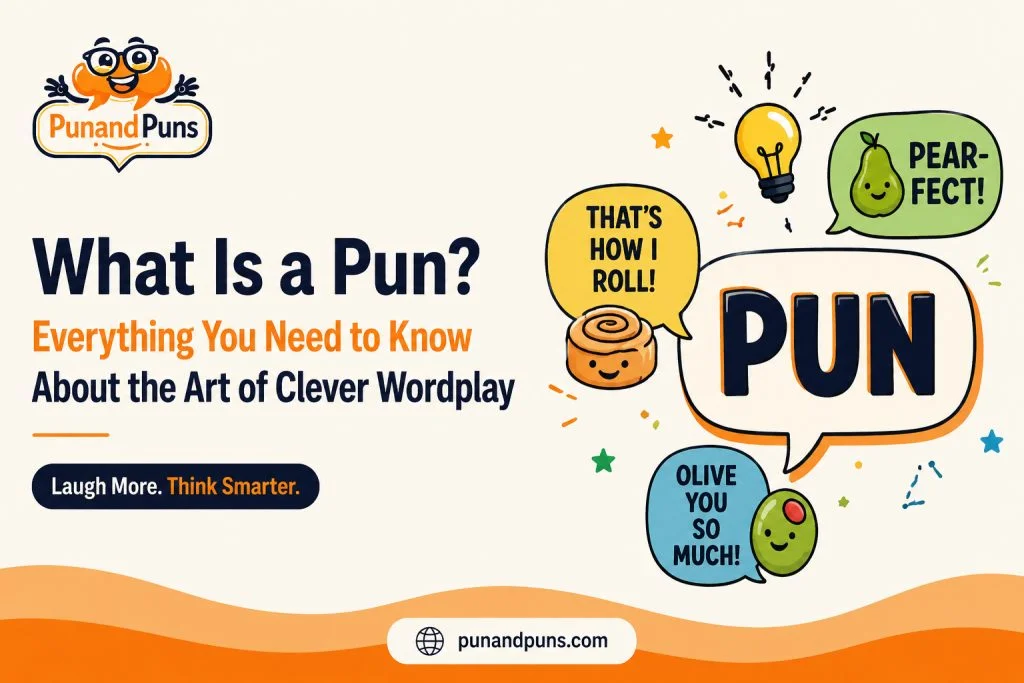
Language is a playground, and few forms of wordplay demonstrate that better than puns. A pun is a clever use of words that creates humor through different meanings, similar sounds, or unexpected interpretations.
From literature and comedy to advertising and everyday conversation, puns have entertained people for centuries. Whether you love clever wordplay or enjoy an eye-roll-worthy joke, understanding what puns mean, how they work, and why they are funny can make you appreciate this playful side of language even more. Let’s explore the art of puns with some memorable pun examples along the way.
So, What Is a Pun, Exactly?
A pun is a form of wordplay that exploits a word’s multiple meanings, or the close similarity between two different words, to create humour, irony, or a double layer of meaning. The technical term for this is paronomasia — from the Greek para (beside) and onomazein (to call by name).
In plain terms: a pun says one thing and means two.
The word “pun” itself is believed to have entered English around the 17th century, possibly derived from the Italian puntiglio, meaning a fine or petty point. Even the origin of the word carries a hint of precision — which is exactly what a great pun requires.
What Does “Puns” Mean?
Puns are a form of wordplay that uses words with multiple meanings, similar sounds, or clever combinations to create humor or a surprising idea. A pun is the singular form, while puns refers to more than one example. Puns can be short and simple, or they can be built into longer jokes, captions, headlines, and everyday conversations. What makes a pun special is that the humor usually comes from the way a word can be understood in two different ways.
Examples of Puns
- I wanted to become a gardener, but I needed to grow into the role.
The phrase “grow into” works both literally for plants and figuratively for developing skills. - The calendar got promoted because it had a lot of good dates.
“Dates” can mean days on a calendar or romantic meetings. - I opened a bakery because I kneaded a change.
“Kneaded” sounds like “needed,” while also referring to kneading dough. - The musician couldn’t find his keys, so he had to improvise.
“Keys” can mean musical keys or physical objects used to unlock something. - The fisherman was hooked on his new hobby.
“Hooked” literally relates to fishing and figuratively means strongly interested or addicted.
What Are Pun Examples?
Pun examples are sentences, jokes, or expressions that demonstrate how wordplay can create humor. They often rely on homophones, words with multiple meanings, similar-sounding phrases, or unexpected interpretations. A good pun usually makes the reader recognize one meaning first and then notice a second meaning that changes the way the sentence is understood. This simple switch in meaning is what gives many puns their clever punch.
Pun Examples
- The electrician was shocked when he received the bill.
“Shocked” can describe an electrical experience as well as being surprised. - The chef quit his job because he couldn’t handle the pressure.
“Pressure” can refer to cooking conditions or emotional/work stress. - The photographer was great at focusing on the bright side.
“Focusing” relates to photography and concentrating attention on something. - The mathematician was afraid of negative numbers because they were too divisive.
“Divisive” suggests causing disagreement while also connecting humorously to mathematical division. - The tailor always knew how to make a good impression.
“Make” can connect to creating clothing, while “impression” refers to the effect someone has on others.
Puns work by creating a connection between different meanings, sounds, or uses of words. The reader initially interprets a sentence in one way, but a second interpretation suddenly becomes apparent. That unexpected shift creates the humorous effect. Some puns use words that sound alike, while others use a single word that has two meanings. Because puns depend on language itself, their humor can sometimes be subtle, clever, or even intentionally groan-worthy.
Examples of How Puns Work
- The librarian had a novel idea.
“Novel” can mean something new and original, or a book. - The tree couldn’t keep up with the competition because it was rooted in place.
“Rooted” has a literal connection to trees and a figurative meaning of being unable to move. - The dentist finally got to the root of the problem.
“Root” refers to a part of a tooth and also means the fundamental cause of something. - The banker lost interest in the conversation.
“Interest” can mean curiosity or the money earned on financial accounts. - The baker was on a roll all morning.
“Roll” can refer to baked bread and also to being successful or productive.
The Main Types of Puns You Should Know
- Homophonic Puns These play on words that sound alike but have different meanings. Example: “I used to be a banker, but I lost interest.” (Interest = financial interest AND personal enthusiasm.)
- Homographic Puns These use a single word that has two distinct meanings. Example: “Time flies like an arrow; fruit flies like a banana.” — Groucho Marx (Flies as a verb meaning to move, and flies as a noun — the insect.)
- Compound Puns These layer two or more wordplays into a single statement — riskier, but more rewarding when they land.
- Visual Puns Found in logos, memes, and advertising — where the image and the text together create the double meaning.
When and Where Are Puns Used?
Puns appear across a surprisingly wide range of contexts — but at its core, what is a pun if not a topic deeply rooted in literature itself? From classic plays to modern poetry, puns have always found a natural home on the page.
- Literature and poetry — to create irony, foreshadowing, or comic relief
- Advertising — to make slogans memorable (think “Time to get grilling” for a BBQ brand)
- Headlines — tabloids are notorious for punny headlines
- Social media — pun memes dominate platforms like Instagram and X (Twitter)
- Everyday conversation — dad jokes are puns in their most natural habitat
How to Make a Pun (Without Forcing It)
Crafting a pun is part instinct, part wordsmithery. Here’s a simple method:
Pick your subject — what topic are you working with?
- List related words — brainstorm the vocabulary of that topic
- Hunt for doubles — which of those words sounds like, or means, something else?
- Build the sentence — frame it so both meanings are plausible at first read
- Deliver with a straight face — the best puns land like an ambush
Puns in Literature: From Shakespeare to Modern Masters
Shakespeare and the Art of the Pun
William Shakespeare was perhaps the greatest punster in the English literary tradition. He used puns not merely for laughs, but to deepen tragedy, foreshadow death, and reveal character.
In Romeo and Juliet, the dying Mercutio delivers one of the most famous puns in all of literature:
“Ask for me tomorrow and you shall find me a grave man.”
Here, grave means both serious — Mercutio finally being earnest — and the grave, as in death. It is simultaneously his darkest joke and his final farewell. The pun does emotional double duty.
In Richard III, Shakespeare opens with:
“Now is the winter of our discontent / Made glorious summer by this sun of York.”
Sun and son were homophones in Elizabethan English — a deliberate play on Richard’s lineage as the son of the House of York.
Oscar Wilde — Puns as Social Critique
Oscar Wilde weaponised the pun with elegance. In The Importance of Being Earnest, the entire plot pivots on the name Ernest — both a man’s name and the adjective earnest, meaning sincere. The play’s title is itself a compound pun, and Wilde sustains it for three acts, using wordplay to mock Victorian society’s obsession with appearances over substance.
Charles Dickens and Punning Character Names
Dickens embedded puns directly into his characters. Mr. Murdstone in David Copperfield — a murderous stone of a man. Ebenezer Scrooge — a name that sounds like scrouge, an archaic word meaning to squeeze or crowd. Even character names carried punning intent.
Pun vs. Joke: What’s the Difference?
A pun and a joke can both make people laugh, but they are not exactly the same thing. A joke is generally designed around a setup and punchline, while a pun specifically depends on wordplay. A pun can be part of a joke, but it can also stand alone as a clever sentence, caption, headline, or one-liner. In other words, a joke describes a broader form of humor, while a pun describes a particular technique involving language.
Examples That Show the Difference
Pun:
The bicycle couldn’t stand up because it was two-tired.
The humor depends on the wordplay between “two-tired” and “too tired.”
Pun:
The orange stopped halfway because it ran out of juice.
“Juice” has both a literal and figurative interpretation.
Joke:
Why did the student bring a ladder to school? Because they wanted to go to high school.
The humor comes from interpreting “high school” literally.
Joke with a pun:
Why did the tomato blush? Because it saw the salad dressing.
The joke uses “dressing” as both clothing and salad topping.
Simple pun:
I’m friends with all electricians because we have great connections.
“Connections” refers both to relationships and electrical connections.
Pun vs. Wordplay
Pun and wordplay are closely related, but they aren’t exactly the same. Wordplay is the broader use of language in a clever or creative way, while a pun is a specific type of wordplay that usually plays on similar sounds, multiple meanings, or different interpretations of words.
Examples:
- Pun: “I’m reading a book about anti-gravity. It’s impossible to put down.”
- Wordplay: “The bicycle couldn’t stand on its own because it was two-tired.”
- Wordplay without a traditional pun: “The math teacher has too many problems.”
Famous Pun Examples
Famous puns appear everywhere—from literature and advertising to movies, headlines, and everyday jokes. Their appeal comes from making readers or listeners notice a second meaning and enjoy the clever connection.
Examples:
- “Time flies like an arrow; fruit flies like a banana.” — The word “flies” changes meaning to create the joke.
- “A boiled egg is hard to beat.” — “Beat” refers both to defeating something and beating an egg.
- “The future, the present, and the past walked into a bar. It was tense.” — “Tense” connects grammar with the situation.
Pun vs. Irony: Where Do They Diverge?
Irony occurs when the intended meaning is the opposite of the literal meaning — often to highlight contradiction or absurdity.
A pun offers two meanings simultaneously — both are present, both are valid.
Irony says one thing, means another. A pun says one thing and also means another. The distinction is whether the surface meaning is true or a disguise.
Pun vs. Satire: Not the Same Animal
Satire is a mode of writing — it uses humour, exaggeration, and irony to criticise people, institutions, or society. Jonathan Swift’s A Modest Proposal is satire. The Daily Show is satire.
Puns can appear inside satire as a tool, but satire is a whole genre with social and political intent. A pun is a single linguistic move. Think of satire as the meal and the pun as one of the spices.
Conclusion
A pun is far more than a groan-inducing dad joke. It is a clever tool of language that can create humor, surprise, and even deeper meaning. Shakespeare used puns to add layers to his plays, while writers such as Oscar Wilde and Charles Dickens used wordplay to entertain, challenge, and make their writing more memorable.
Puns work because language is naturally full of multiple meanings and unexpected connections. Whether you’re writing an advertising copy, preparing a speech, creating social media content, or simply looking for a clever joke, understanding what a pun is and how pun examples work can help you use wordplay more effectively. After all, mastering a pun means discovering the playful gap between what words say and what they can secretly mean.
Frequently Asked Questions (FAQs)
What Is a Simple Example of a Pun?
A simple example of a pun is “The bicycle couldn’t stand up because it was two-tired.” The sentence plays on the similarity between “two-tired” and “too tired.” The bicycle has two tires, but the phrase also suggests that it is extremely tired. This combination of literal and figurative meaning is a classic example of how puns create humor through wordplay.
Simple Pun Examples
- I’m reading a book about glue. I just can’t seem to put it down.
- The clock was hungry, so it went back four seconds.
- The mushroom was invited because he was a fun guy.
- The banana went to the doctor because it wasn’t peeling well.
- The cow became an artist because she loved drawing attention.
2. Are Puns Considered Good Writing?
Yes, puns can be a sign of creative and skillful writing when they are used naturally. Good puns show an understanding of language, multiple meanings, and timing. Writers such as Shakespeare, Oscar Wilde, and Charles Dickens used wordplay to add humor, emphasis, and cleverness to their work. However, using too many puns can make writing feel forced. The best pun examples fit the topic and add something meaningful rather than simply trying to make the reader laugh.
Example: “The musician had a sharp sense of humor.”
Here, “sharp” can refer to a musical note and also describe someone who is clever or quick-witted.
3. What Is the Difference Between a Pun and Wordplay?
Wordplay is the broader concept of using language in a clever, unusual, or humorous way, while a pun is one specific type of wordplay. Puns usually depend on words with multiple meanings, similar sounds, or different interpretations. Other forms of wordplay can include anagrams, spoonerisms, rhymes, and clever rearrangements of words. In simple terms, every pun is a form of wordplay, but not every example of wordplay is a pun.
Example of a pun: “The baker always kneaded a break.”
The word “kneaded” sounds like “needed” while referring to working with dough, making it a clear example of pun-based wordplay.
4. Why Do Puns Make People Groan?
Puns often make people groan because the humor comes from an unexpected or deliberately obvious connection between words. When someone recognizes the second meaning, the reaction may be a laugh, smile, eye-roll, or classic “dad joke” groan. This is part of what makes pun humor unique: the joke can be both clever and intentionally cheesy at the same time. A well-timed pun can create a quick moment of surprise while encouraging the reader to appreciate the language behind it.
Example: “I used to be a banker, but I lost interest.”
The word “interest” refers to both financial earnings and personal curiosity, creating the double meaning that makes the pun work.
5. Can Puns Be Used in Formal Writing?
Yes, puns can be used in formal writing when they are relevant and carefully chosen. They can work particularly well in article titles, section headings, advertising copy, speeches, creative essays, and conclusions. However, professional or academic writing should prioritize clarity, so a pun should support the message rather than make it confusing. When used with purpose, a clever pun can make formal content more memorable without reducing its credibility.
Example: A financial article might use the heading “Making Cents of Your Money.”
The word “cents” sounds like “sense,” connecting financial currency with the idea of understanding money.

William is a Master’s degree holder in English Language and Literature, a passionate word enthusiast, and the founder of PunandPuns.com. He loves exploring creative wordplay and sharing humorous content that brings joy, laughter, and a fresh perspective to everyday language.


