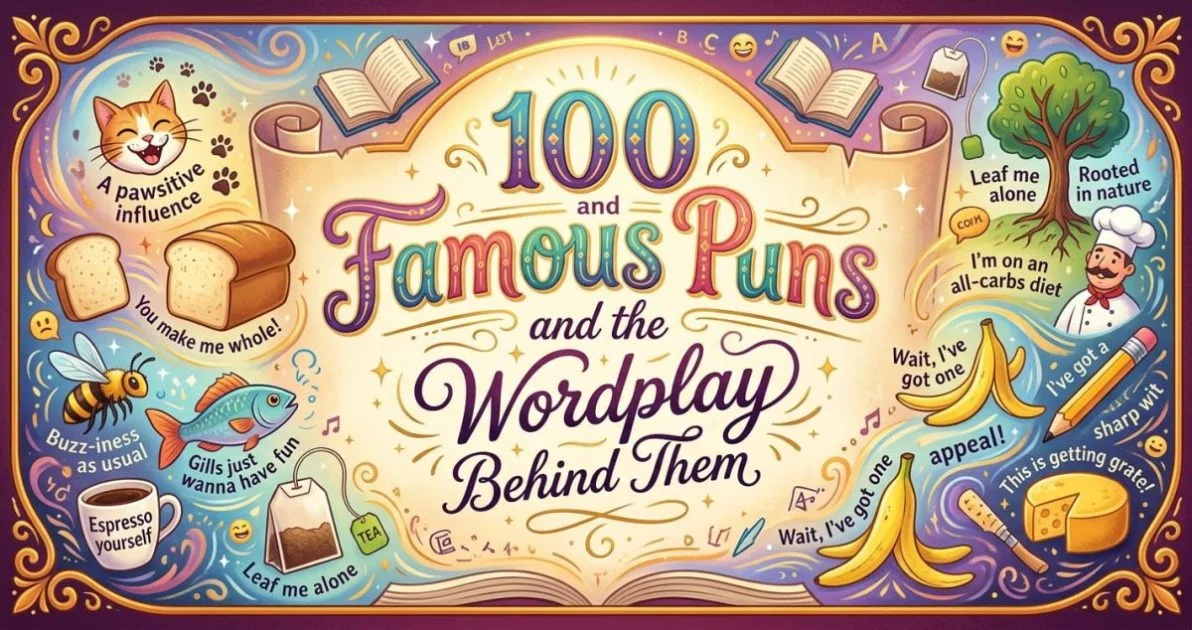
A great pun sneaks up on you. One second you’re reading a normal sentence, and the next you’re groaning and grinning at the exact same time. That’s the magic of wordplay, and it’s exactly what this list is here to celebrate.
Puns aren’t just cheap laughs, they’re tiny puzzles built from sound, meaning, and timing. Below you’ll find 100 of the most famous puns around, broken down by category, with a quick explanation of the clever wordplay that makes each one click.
What Makes a Pun Actually Work
Before diving into the list, it helps to know what’s happening under the hood. Most puns rely on one of a few tricks: homophones (words that sound alike but mean different things), double meanings (one word doing two jobs at once), or a swapped-out word that still sounds close to the original phrase.
Homophone Puns
These puns use words that sound identical or nearly identical but have completely different meanings. The humor comes from the brain doing a quick double-take between the expected word and the actual one.
Double-Meaning Puns
This style leans on a single word or phrase that genuinely has two valid meanings in context. The joke lands because both meanings make sense at the same time, which is part of what makes them so satisfying to catch.
Food Puns
Food and wordplay go together like peanut butter and jelly, mostly because ingredient names are basically begging to be punned on.
- I’m on a seafood diet. I see food and I eat it. (Homophone: “seafood” sounds like “see food.”)
- Lettuce romaine calm, it’s just a joke. (Homophone: “lettuce” sounds like “let us,” and “romaine” echoes “remain.”)
- Donut worry, be happy. (Homophone: “donut” replaces “don’t.”)
- I’m grate at making cheese puns. (Homophone: “grate” sounds like “great,” with a nod to cheese graters.)
- You’re the apple of my pie. (Twist on the phrase “apple of my eye,” swapping in a food pun.)
- Time flies like an arrow, fruit flies like a banana. (Double meaning: “flies” as a verb and as an insect.)
- I whisk you a happy day. (Homophone: “whisk” replaces “wish,” tying back to baking.)
- Lettuce turnip the beet. (Vegetable names substituted for “let us turn up the beat.”)
- Cheese to meet you. (Homophone: “cheese” replaces “pleased.”)
- I loaf you so much. (Homophone: “loaf” replaces “love,” referencing bread.)
- Olive you and that’s the truth. (Homophone: “olive” sounds like “I love.”)
- I’m kind of a big dill. (Homophone: “dill” replaces “deal,” referencing the pickled vegetable.)
- You’re one in a melon. (Homophone: “melon” replaces “million.”)
- Nacho average friend. (Homophone: “nacho” replaces “not your.”)
- I doughnut know what I’d do without you. (Homophone: “doughnut” replaces “don’t.”)
- Have a grape day. (Homophone: “grape” replaces “great.”)
- Soy happy to see you. (Homophone: “soy” replaces “so.”)
- Espresso yourself. (Homophone: “espresso” replaces “express.”)
- You’re a-peeling to me. (Homophone: “a-peeling” replaces “appealing,” referencing fruit peel.)
- You’ve got a lot of guac to be talking. (Homophone: “guac” replaces “gall,” referencing guacamole.)
Animal Puns
Animals lend themselves to puns because so many species have names that overlap with everyday English words.
- I’m owl about you. (Homophone: “owl” replaces “all.”)
- Whale, whale, whale, look who it is. (Homophone: “whale” replaces “well.”)
- You otter know better. (Homophone: “otter” replaces “ought to.”)
- Someone’s gopher it now. (Homophone: “gopher” replaces “going for.”)
- I’m fur real this time. (Homophone: “fur” replaces “for.”)
- Let’s paws and think about this. (Homophone: “paws” replaces “pause.”)
- That joke was un-fur-gettable. (Blended wordplay: “fur” inserted into “unforgettable.”)
- I’m having a moo-ving experience. (Homophone: “moo” blended into “moving.”)
- Don’t be koala-fied to judge me. (Blended wordplay: “koala” inserted into “qualified.”)
- Alpaca my bags and leave. (Homophone: “alpaca” replaces “I’ll pack a.”)
- You’re the mane attraction. (Homophone: “mane” replaces “main,” referencing a lion or horse.)
- I’m having a wheely good time. (Homophone: “wheely” replaces “really,” often paired with hamster jokes.)
- Toucan play at that game. (Homophone: “toucan” replaces “two can.”)
- I’m not lion, this is serious. (Homophone: “lion” replaces “lying.”)
- That’s ba-a-a-d, said the sheep. (Sound-based pun mimicking a sheep’s bleat inside the word “bad.”)
- Fish you were here. (Homophone: “fish” replaces “wish.”)
- I’m having a whale of a time. (Idiom-based pun using an animal to mean “a great time.”)
- Otterly ridiculous, if you ask me. (Blended wordplay: “otter” inserted into “utterly.”)
- Hedgehog my heart, you already have it. (Blended wordplay: “hedgehog” playfully replaces “steal” in a phrase about affection.)
- Deer me, what a day. (Homophone: “deer” replaces “dear.”)
Love and Relationship Puns
Romance and puns might seem like an odd pair, but a well-placed pun can be the sweetest kind of icebreaker.
- Are you a magician? Because whenever I look at you, everyone else disappears. (Double meaning built on the idea of “disappearing,” tied to magic.)
- You must be a parking ticket, because you’ve got fine written all over you. (Double meaning: “fine” as both “good-looking” and a monetary penalty.)
- I love you a latte. (Homophone: “latte” replaces “lot,” blending in a coffee reference.)
- You’re the zest thing that ever happened to me. (Homophone: “zest” replaces “best,” referencing citrus flavor.)
- We go together like peas and carrots. (Classic pairing idiom leaning on food-based wordplay for compatibility.)
- I’m falling for you, and it’s not just gravity. (Double meaning: “falling” as physical and emotional.)
- You’re pear-fect for me. (Homophone: “pear” replaces “per,” blending fruit into “perfect.”)
- I’ve got my mussels set on you. (Homophone: “mussels” replaces “muscles,” referencing the shellfish.)
- You’re the yin to my yang, and the pun to my joke. (Double meaning building on the idea of “matching” someone.)
- I’m attRACTed to you, that’s a fact. (Blended wordplay stretching “attracted” for comedic emphasis.)
- You had me at hello, and again at the pun you just made. (Callback structure referencing a famous line while adding a wordplay twist.)
- I’m not a photographer, but I can picture us together. (Double meaning: “picture” as imagining and as photography.)
- Every time I see you, my Wi-Fi connects automatically. (Modern double meaning built around instant, effortless connection.)
- You’ve stolen a pizza my heart. (Homophone: “pizza” replaces “piece of.”)
- We mustard be a great match. (Homophone: “mustard” replaces “must have,” referencing the condiment.)
Work and Office Puns
The workplace is full of routines and jargon, which makes it a goldmine for puns that hit close to home.
- I used to be a banker, but I lost interest. (Double meaning: “interest” as both a bank term and personal enthusiasm.)
- I’m reading a book on anti-gravity, it’s impossible to put down. (Double meaning: “put down” as literal placement and giving up on a task.)
- I used to work at a calendar factory, but I got fired for taking a day off. (Double meaning: “day off” as both a workplace absence and a literal calendar page.)
- I’m friends with 25 letters of the alphabet, I don’t know Y. (Homophone: “Y” replaces “why.”)
- I used to be a baker, but I couldn’t make enough dough. (Double meaning: “dough” as bread ingredient and slang for money.)
- I quit my job at the shoe factory, it just wasn’t a good fit. (Double meaning: “fit” as shoe sizing and workplace compatibility.)
- I’m reading a book about mazes, I got lost in it. (Double meaning: “lost” as physical navigation and being engrossed.)
- I used to be an electrician, but I lost my spark. (Double meaning: “spark” as electricity and enthusiasm.)
- I applied for a job at the keyboard factory, but they said I wasn’t the right type. (Double meaning: “type” as personality fit and keyboard typing.)
- I gave up my job as a chef because I couldn’t cut the mustard. (Idiom-based pun leaning on food terminology for workplace performance.)
- I used to be a tailor, but it wasn’t suitable work. (Homophone: “suitable” plays on “suit,” a tailoring reference.)
- I’m terrible at parking, but I nailed the interview. (Setup contrast pun playing on the unrelated meanings of two skills.)
- I was a mathematician, but I couldn’t count on the job lasting. (Double meaning: “count on” as trust and literal counting.)
- I got fired from the orange juice factory, I couldn’t concentrate. (Double meaning: “concentrate” as focus and juice concentrate.)
- I worked at an origami shop, but the whole business folded. (Double meaning: “folded” as origami and business failure.)
Weather and Nature Puns
There’s something oddly satisfying about a pun that plays on the elements, especially when the weather itself sets up the punchline.
- It’s raining cats and dogs, so watch out for poodles. (Homophone: “poodles” replaces “puddles.”)
- I’m not a fan of clouds, they’re always up to something. (Double meaning: “up to something” as suspicious and literally being in the sky.)
- The weather forecast is looking bright, must be sun-thing good. (Homophone: “sun-thing” replaces “something.”)
- Snow way I’m going outside today. (Homophone: “snow” replaces “no.”)
- I’m thunder your spell completely. (Homophone: “thunder” replaces “under.”)
- Autumn leaves me speechless every year. (Homophone-adjacent wordplay linking “autumn” to falling leaves and quiet awe.)
- Winter’s coming, so mitten forget your gloves. (Homophone: “mitten” replaces “don’t.”)
- I’m having a bit of a mist-ake today. (Blended wordplay: “mist” inserted into “mistake.”)
- The forecast is calling for a storm, I’m thunderstruck. (Double meaning using “thunderstruck” both literally and as surprise.)
- I’m going with the flow, just like the tide. (Idiom-based pun pairing a common phrase with a literal nature reference.)
- Every rose has its thorn, and every summer has its scorch. (Idiom-based structure building rhythm around a nature theme.)
- Leaf me alone, it’s raking season. (Homophone: “leaf” replaces “leave.”)
- I’m rooting for a sunny weekend. (Double meaning: “rooting” as supporting and plant terminology.)
- The breeze had me feeling gale-ful. (Homophone: “gale” replaces “grateful.”)
- I can’t wait to see how this storm pans out. (Idiom reused with weather-specific imagery.)
Tech and Internet Puns
Modern life runs on technology, so it’s no surprise that some of today’s funniest puns come from the digital world.
- I told my computer I needed a break, now it won’t stop sending me KitKat ads. (Double meaning: “break” as rest and the candy slogan.)
- I’m reading a book about Wi-Fi, it has no signal-ficant plot. (Blended wordplay: “signal” inserted into “significant.”)
- I have a joke about USB cables, but it doesn’t fit. (Double meaning referencing the well-known struggle of USB orientation.)
- I changed my password to “incorrect,” so whenever I forget it, the computer says “your password is incorrect.” (Double meaning built on literal versus contextual interpretation.)
- I’m friends with my Wi-Fi router, we have a strong connection. (Double meaning: “connection” as internet signal and relationship.)
- Why did the smartphone go to therapy? It lost its connection. (Double meaning applied to emotional and digital contexts.)
- I’m not a robot, but I do have a byte of personality. (Homophone: “byte” replaces “bite.”)
- My computer crashed because it couldn’t handle my drama. (Double meaning stretching “crash” from tech failure to emotional overload.)
- I clicked “update later” so many times, it became a lifestyle. (Everyday relatable exaggeration used as comedic setup.)
- I’ve got a lot of unread emails, it’s an inbox-tacle course. (Blended wordplay: “obstacle” merged with “inbox.”)
- I’m on a first-name basis with my error messages. (Double meaning built on familiarity and repetition.)
- Streaming services have really buffered my free time. (Double meaning: “buffered” as tech delay and figuratively filling time.)
- My phone battery and my patience drain at the same rate. (Comparative wordplay linking two unrelated “drains.”)
- I downloaded an app to help me stop procrastinating, I’ll open it later. (Irony-based setup relying on relatable behavior.)
- Passwords are like siblings, most of mine contain one or more numbers. (Comparative structure blending two unrelated categories for a laugh.)
Why These Puns Have Lasted So Long
The best puns tend to stick around because they’re built on ideas everyone already understands, like food, weather, animals, or a rough day at work. That shared familiarity is exactly what makes the wordplay land so quickly.
Simplicity Is the Secret Ingredient
A pun rarely needs a long explanation to be funny. The moment someone connects the two meanings on their own, the joke has already done its job, which is part of why short, punchy wordplay tends to spread the fastest.
Puns Travel Well Across Generations
Because so many puns are based on everyday words rather than trends, they don’t age the way other types of humor sometimes do. A food pun from decades ago can still get a laugh today simply because people still eat, and language hasn’t changed all that much.
How to Use Puns Without Overdoing It
A pun works best when it’s used with intention rather than crammed into every sentence. Here are a few simple ways to use wordplay effectively.
- Save your strongest pun for a caption, title, or opening line where it will actually be noticed.
- Use food or animal puns for lighthearted social posts, since they tend to be the most universally understood.
- Save relationship puns for cards, texts, or messages where a little cheesiness is welcome.
- Avoid stacking more than one or two puns in a row, since too many at once can dilute the impact.
- Read the pun out loud before sharing it, since wordplay often lands better by ear than on the page.
Frequently Asked Questions
What is the most famous type of pun?
Homophone puns tend to be the most widely recognized, since they rely on words that sound alike, like “seafood” and “see food.” This type of wordplay is easy to spot and just as easy to enjoy.
Why are puns considered funny?
Puns create a small moment of surprise when the brain expects one meaning but discovers a second, unexpected one hiding in the same words. That quick mental shift is often what triggers the laugh, or at least the groan.
Are puns considered a form of wordplay?
Yes, puns are one of the most well-known types of wordplay, alongside spoonerisms and double entendres. What sets puns apart is their reliance on sound and meaning working together at the same time.
What makes a pun “corny”?
A pun is often labeled corny when the connection between the two meanings feels obvious or overly simple, yet that predictability is usually part of the appeal rather than a flaw.
Can puns be used in professional writing?
Yes, when used sparingly, puns can make headlines, captions, and marketing copy more memorable. The key is choosing wordplay that still makes sense even if the reader misses the joke entirely.
Are food puns the most common category?
Food puns are extremely popular because ingredient names naturally overlap with common English words and phrases, making them easy to spot and even easier to create.
How do I come up with my own pun?
Start with a common phrase or idiom, then look for a word inside it that sounds similar to something else, like a food, animal, or object. Swapping that word in while keeping the phrase recognizable is the basic formula behind most puns.
Puns may be simple on the surface, but the wordplay behind them is anything but accidental. Every good pun is a small, clever collision between sound and meaning, built to make you smile before you even realize why. Keep this list handy, because a well-timed pun is always worth sharing.

William is a Master’s degree holder in English Language and Literature, a passionate word enthusiast, and the founder of PunandPuns.com. He loves exploring creative wordplay and sharing humorous content that brings joy, laughter, and a fresh perspective to everyday language.


