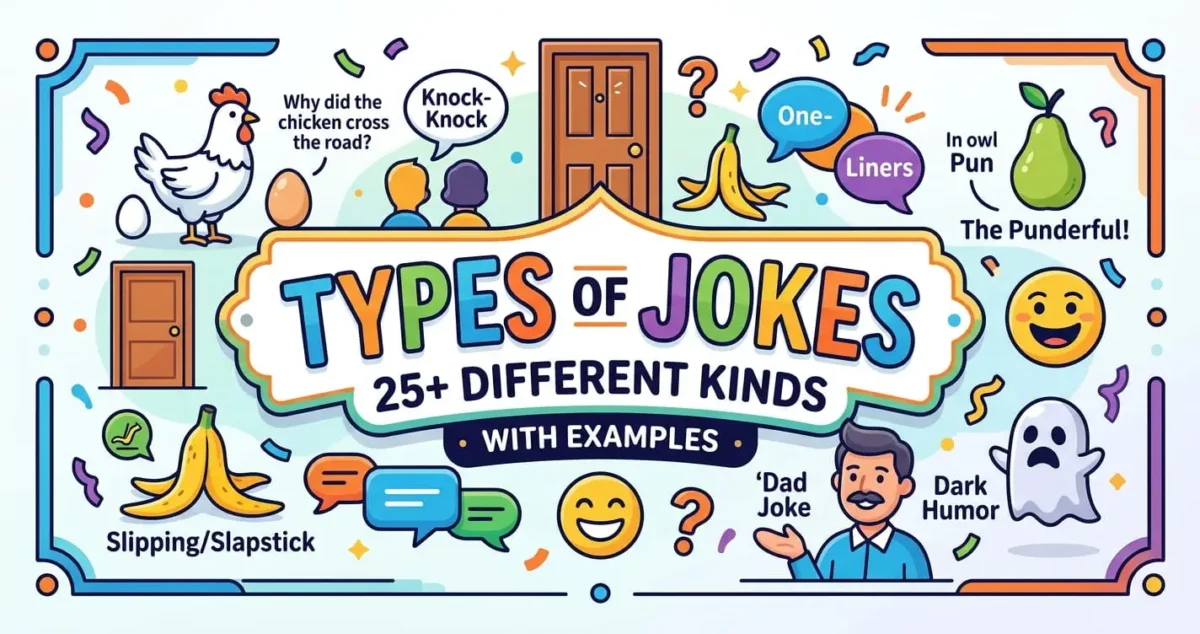
Ever noticed how one joke can make you laugh out loud while another barely gets a smile? That is because types of jokes work in different ways, from clever wordplay and silly one-liners to stories built around an unexpected punchline.
Understanding the kinds of jokes can make it easier to find the humor you enjoy most. In this guide, we will explore more than 25 different types of jokes, explain how each one works, and give you original examples to make the differences easy to understand.
What Is a Joke?
A joke is a form of humor designed to create amusement, usually by setting up an idea and delivering an unexpected or funny ending. Some jokes rely on words, while others use situations, characters, exaggeration, or surprising observations.
Not every joke follows the same structure. A pun may depend on a double meaning, while a knock-knock joke follows a familiar conversational pattern. That variety is what makes humor so flexible.
25+ Types of Jokes and Examples
Here are some of the most common and recognizable types of jokes you will come across.
1. One-Liner Jokes
A one-liner delivers the entire joke in a single sentence. The humor usually comes from a sharp observation, clever twist, or unexpected ending.
Example:
I told my suitcase there would be no vacations this year. Now it is dealing with emotional baggage.
2. Pun Jokes
Pun jokes use words with multiple meanings or words that sound alike to create humor. They are especially popular with people who enjoy clever wordplay.
Example:
I used to be a baker, but I could not make enough dough.
3. Dad Jokes
Dad jokes are usually simple, harmless, and intentionally cheesy. Their predictable punchlines are often part of the fun.
Example:
Why did the bicycle fall over? Because it was two-tired.
4. Knock-Knock Jokes
Knock-knock jokes use a short call-and-response format. They are particularly popular with children because the structure is easy to remember.
Example:
Knock, knock.
Who is there?
Lettuce.
Lettuce who?
Lettuce in; it is chilly out here!
5. Observational Jokes
Observational humor finds something funny in everyday experiences. These jokes often make people laugh because they recognize the situation immediately.
Example:
Why does the fridge always sound like it is working harder when you open it?
6. Story Jokes
Story jokes build humor through a short narrative. The setup provides context before the punchline delivers the unexpected twist.
Example:
I decided to start jogging every morning. I ran for five minutes, got tired, and realized my fitness plan had excellent goals but terrible management.
7. Anti-Jokes
An anti-joke deliberately avoids the funny or surprising ending the audience expects. The ordinary answer becomes the joke.
Example:
Why did the man cross the road?
Because he wanted to get to the other side.
8. Deadpan Jokes
Deadpan humor is delivered in a serious, emotionless way even though the statement is funny. The contrast between the delivery and the content creates the humor.
Example:
I enjoy exercising. Especially my right to avoid it.
9. Sarcastic Jokes
Sarcastic humor often says something that means the opposite of the literal words. Tone and context are important for understanding it.
Example:
Oh, wonderful. Another meeting that could have been an email.
10. Self-Deprecating Jokes
Self-deprecating jokes make the speaker the target of the humor. When used lightly, they can create a relatable and humble style.
Example:
My cooking is improving. Yesterday, the smoke alarm only complained twice.
11. Exaggeration Jokes
These jokes take an ordinary situation and make it dramatically bigger, stranger, or more extreme than reality.
Example:
I waited so long for my coffee that the beans started asking where I was.
12. Wordplay Jokes
Wordplay jokes manipulate language, meanings, sounds, spelling, or phrasing. Puns are one form of wordplay, but wordplay can take many other forms too.
Example:
The grammar teacher was very formal. She always had proper punctuation.
13. Riddle Jokes
Riddle jokes ask a question that appears to require logical thinking but ends with a humorous answer.
Example:
What has many keys but cannot open a single door?
A piano.
14. Question-and-Answer Jokes
These short jokes are built around a question followed by an unexpected answer. They are short, easy to tell, and often work well in casual conversations.
Example:
Why did the computer go to the doctor?
Because it had a virus.
15. Shaggy Dog Jokes
A shaggy dog joke is a deliberately long and often complicated story that leads to a surprisingly simple or silly punchline.
The humor can come from the length of the setup and the audience’s growing anticipation.
16. Satirical Jokes
Satire uses humor to comment on people, behavior, institutions, or social situations. Unlike a simple joke, satire often has an underlying point.
Example:
Our office introduced a productivity app that sends reminders to use the productivity app.
17. Parody Jokes
Parody humor imitates a familiar person, genre, advertisement, movie style, song format, or cultural idea and exaggerates its recognizable features.
Example:
A dramatic movie trailer for doing laundry: “One basket. Two socks. And a destiny nobody asked for.”
18. Dark Humor
Dark humor finds comedy in serious, uncomfortable, or traditionally difficult subjects. It can be highly dependent on audience, context, and personal boundaries.
Example:
My alarm clock and I have a toxic relationship. Every morning, it brings up things I would rather forget.
19. Situational Jokes
Situational humor comes from something funny happening in a particular circumstance. The situation itself creates the punchline.
Example:
I tried to quietly open a snack bag during a movie. Apparently, the entire theater was invited to the opening ceremony.
20. Physical Comedy
Physical comedy relies on actions, movement, awkwardness, or visual mishaps rather than clever wording.
Example:
Someone tries to sit down confidently, misses the chair, and then immediately checks whether anyone saw it.
21. Topical Jokes
Topical jokes refer to current events, trends, popular culture, or things people are talking about right now.
Because their relevance can fade quickly, topical humor is usually less evergreen than classic joke formats.
22. Callback Jokes
A callback refers to something mentioned earlier in a conversation or performance and brings it back later for another laugh.
Example:
If someone jokes early in a story about always losing their keys, a later punchline might unexpectedly bring the missing keys back into the story.
23. Surreal Jokes
Surreal humor places ordinary people or situations into bizarre, illogical, or impossible circumstances.
Example:
My toaster has been acting strangely ever since it started receiving letters from the moon.
24. Dry Humor
Dry humor presents something funny in an understated and matter-of-fact way. The speaker may sound completely serious.
Example:
I bought a book about how to relax. It is still unopened. I am pacing myself.
25. Clever Jokes
Clever jokes reward the audience for noticing a connection, twist, double meaning, or unusual interpretation.
Example:
I wanted to learn how to make a bicycle stand on its own, but I realized it was a two-tired problem.
26. Clean Jokes
Clean jokes avoid profanity, explicit content, and offensive material. They are suitable for family gatherings, classrooms, workplaces, and general audiences.
Example:
Why did the tomato turn red?
Because it saw the salad dressing.
27. Roasting Jokes
Roasting jokes playfully tease a person, usually by exaggerating a harmless characteristic. Good-natured roasting depends heavily on knowing the audience and keeping the humor respectful.
Example:
You are not late. You are simply committed to making every entrance memorable.
What Makes a Great Joke?
So, what is a great joke? There is no single formula that guarantees everyone will laugh, because humor depends on personality, culture, timing, and context.
However, many effective jokes share a few qualities:
- A clear setup: The audience quickly understands the situation.
- An unexpected twist: The ending goes somewhere the listener did not anticipate.
- Good timing: The punchline arrives at the right moment.
- Simple wording: The audience should not have to decode the joke.
- Strong relevance: The subject connects with the intended audience.
- Originality: A fresh angle can make a familiar idea feel new.
- Appropriate delivery: Tone, pauses, facial expressions, and timing can affect how a joke lands.
A great joke does not necessarily have to be complicated. Sometimes a simple sentence with the right twist works better than a long explanation.
How Do Different Types of Jokes Work?
Although the different types of jokes use different techniques, most depend on creating an expectation and then changing it.
For example, a pun makes you think about one meaning before revealing another. A riddle leads you toward a logical answer and then introduces a clever alternative. An observational joke highlights something familiar and gives you a new way to see it.
Here are some common humor techniques:
- Wordplay: Playing with meanings and sounds.
- Misdirection: Leading the audience toward an unexpected conclusion.
- Incongruity: Combining ideas that normally do not belong together.
- Exaggeration: Making something much bigger or stranger than reality.
- Repetition: Bringing back a phrase or idea for comic effect.
- Timing: Using pauses or delivery to increase the impact.
- Surprise: Ending with an unexpected idea.
How to Choose the Right Kind of Joke
Different audiences respond to different kinds of humor. A joke that works with close friends may not be appropriate for a classroom or professional setting.
Before telling a joke, consider:
- Know your audience. Think about their age, interests, and sense of humor.
- Match the setting. Workplace humor and party humor may require different approaches.
- Keep the joke easy to understand. Complicated setups can weaken the punchline.
- Consider the tone. Clean, playful humor is usually more flexible than edgy humor.
- Pay attention to timing. Even a good joke can fall flat if the timing is poor.
- Know when to stop. One strong joke is often better than five forced ones.
Which Types of Jokes Are Best for Kids?
Children often enjoy jokes with simple structures, familiar subjects, and easy-to-understand punchlines.
Good options include:
- Knock-knock jokes
- Animal jokes
- Riddles
- Silly question-and-answer jokes
- Clean puns
- School jokes
- Food jokes
- Dad jokes
For younger children, simple language and harmless subjects generally work better than sarcasm or humor that depends on complicated cultural references.
Which Types of Jokes Work Well on Social Media?
Short-form humor is particularly useful on social platforms because people often scan content quickly.
Some effective formats include:
- One-liners
- Puns
- Relatable jokes
- Caption jokes
- Question-and-answer jokes
- Observational humor
- Short story jokes
A social media joke should usually communicate its idea quickly. A short setup followed by a strong punchline can be easier to read and share than a long paragraph.
How to Write Your Own Joke
You do not need to be a professional comedian to create a funny joke. Start with something ordinary and look for an unexpected angle.
Try this simple process:
- Choose a topic. Pick food, school, work, relationships, animals, technology, or another familiar subject.
- Find something unusual. Think about what is strange, frustrating, surprising, or relatable about it.
- Create an expectation. Lead the reader toward an obvious conclusion.
- Add a twist. Change the meaning or direction at the last moment.
- Make the wording shorter. Remove anything that does not strengthen the joke.
- Read it aloud. A joke can sound different when spoken compared with how it looks on a screen.
For example, start with the ordinary idea that someone wants to become healthier. Add an unexpected twist, and you might get: “I started a healthy lifestyle yesterday. So far, I have successfully avoided looking at my dessert.”
A Quick List of Joke Types
If you want a simple list joke reference, here is a quick overview of the main categories covered in this guide:
- One-liner jokes
- Pun jokes
- Dad jokes
- Knock-knock jokes
- Observational jokes
- Story jokes
- Anti-jokes
- Deadpan jokes
- Sarcastic jokes
- Self-deprecating jokes
- Exaggeration jokes
- Wordplay jokes
- Riddle jokes
- Question-and-answer jokes
- Shaggy dog jokes
- Satirical jokes
- Parody jokes
- Dark humor
- Situational jokes
- Physical comedy
- Topical jokes
- Callback jokes
- Surreal jokes
- Dry humor
- Clever jokes
- Clean jokes
- Roasting jokes
Conclusion
The world of humor includes far more than a single joke format, from clever puns and one-liners to riddles, satire, observational humor, and silly dad jokes. Exploring these types of jokes can help you understand why different styles work for different audiences and situations. Try a few formats, experiment with unexpected punchlines, and you may discover your own favorite kind of humor.
Frequently Asked Questions About Types of Jokes
What are the main types of jokes?
Common types include one-liners, puns, dad jokes, riddles, knock-knock jokes, observational jokes, story jokes, satire, parody, sarcasm, and situational humor. Each format uses a different technique to create a humorous response.
How many different types of jokes are there?
There is no fixed number because humor can be classified in many ways. New formats can also develop as language, culture, entertainment, and social media change.
What is the most common type of joke?
There is no single universally accepted most common joke type. One-liners, puns, riddles, dad jokes, and question-and-answer jokes are all widely recognizable formats.
What makes a joke funny?
Humor often comes from surprise, wordplay, incongruity, exaggeration, relatable situations, or unexpected connections. Timing and the audience’s expectations can also strongly influence whether a joke works.
What is the difference between a pun and a joke?
A joke is a broad category of humorous expression, while a pun is a specific wordplay technique. A pun can be a complete joke, but puns can also appear inside longer jokes, captions, headlines, and conversations.
What is a clean joke?
A clean joke is humor that avoids profanity, explicit material, and generally offensive subjects. Clean jokes are often suitable for children, families, classrooms, and professional environments.
How can I write a better joke?
Start with a familiar idea, establish a clear expectation, and then introduce an unexpected twist. Keep the setup concise, make the punchline easy to understand, and test the joke by reading it aloud.

William is a Master’s degree holder in English Language and Literature, a passionate word enthusiast, and the founder of PunandPuns.com. He loves exploring creative wordplay and sharing humorous content that brings joy, laughter, and a fresh perspective to everyday language.


