Have you ever laughed at a clever play on words and wondered whether it was a pun or a joke? Maybe someone asked you a tricky question that made you think before revealing a surprising answer, leaving you unsure if it was a riddle. Or perhaps your dad proudly told a cheesy one-liner that made everyone groan instead of laugh. These forms of humor often overlap, making them easy to confuse.
Although puns, jokes, riddles, and dad jokes all aim to entertain, they do so in different ways. Some rely on wordplay, others use storytelling, and some challenge your thinking before delivering the payoff. Understanding the differences can help you appreciate humor more, improve your own writing, and even create funnier content for conversations, social media, or greeting cards.
What Is a Pun?
A pun is a type of wordplay that creates humor by using words with multiple meanings or words that sound alike. Instead of relying on a long story or an unexpected punchline, a pun gets its laugh from the clever use of language.
Puns have been around for centuries and appear in books, movies, advertising, and everyday conversations. Because they’re short, memorable, and witty, they’re also one of the most shared forms of humor on social media.
How Does a Pun Work?
A pun usually depends on one of these techniques:
- A word with two different meanings
- Two words that sound the same but have different meanings
- Similar-sounding phrases used in unexpected ways
- Creative twists on common sayings
The humor comes from the listener suddenly recognizing the hidden meaning behind the words.
Characteristics of Puns
- Based on wordplay rather than storytelling
- Usually short and easy to remember
- Clever instead of complicated
- Can be wholesome or witty
- Often used in headlines, captions, and greeting cards
Fresh Pun Examples
Here are some original examples:
- I opened a bakery because I kneaded a fresh start.
- The gardener’s jokes always grow on people.
- The calendar wanted a vacation because its days were numbered.
- The pencil finally found its purpose—it drew the line.
- The musician kept climbing the charts because he knew the right notes.
- My flashlight has a bright future ahead.
- The fisherman netted plenty of compliments.
- The photographer developed a positive outlook.
- The bee got promoted because it always buzzed with ideas.
- My suitcase said it was ready for emotional baggage.
Where Are Puns Commonly Used?
Puns are incredibly versatile and appear in many places:
Social Media
Short puns make excellent Instagram captions, tweets, and memes because they’re quick to read and easy to share.
Greeting Cards
Birthday, Christmas, Valentine’s Day, and Mother’s Day cards often include puns to add a lighthearted touch.
Advertising
Brands frequently use puns in slogans because they’re memorable and encourage people to remember the product.
Everyday Conversations
A well-timed pun can lighten the mood and make casual conversations more enjoyable.
Why People Love Puns
Some people laugh immediately at a clever pun, while others respond with a dramatic eye roll. Either reaction means the pun worked. The fun comes from recognizing the unexpected connection between two meanings or sounds.
Unlike many jokes, puns don’t require a long setup. A single sentence can be enough to surprise the reader and create a memorable laugh.
What Is a Joke?
A joke is any humorous statement, story, or question designed to make people laugh. Most jokes follow a simple structure: they introduce a situation, build a little expectation, and finish with a punchline that surprises the audience.
Unlike puns, jokes aren’t limited to wordplay. They can be based on funny situations, misunderstandings, exaggeration, irony, or unexpected twists. Some jokes are only one sentence long, while others tell an entire story before revealing the funny ending.
How Does a Joke Work?
Most successful jokes have three basic parts:
- The Setup – Introduces the situation or characters.
- The Build-Up – Creates an expectation in the listener’s mind.
- The Punchline – Breaks that expectation with a humorous surprise.
This element of surprise is what makes many jokes funny.
Characteristics of Jokes
- Usually include a setup and punchline
- Can be short or long
- Often rely on surprise or misdirection
- May use wordplay, but don’t have to
- Come in many different styles
Common Types of Jokes
One-Liners
Quick jokes delivered in a single sentence.
Story Jokes
Longer jokes that build toward one memorable punchline.
Knock-Knock Jokes
Interactive jokes that follow a familiar question-and-answer format.
Observational Jokes
Humor based on everyday experiences people can relate to.
Character Jokes
Jokes featuring fictional characters or exaggerated personalities.
Fresh Original Joke Examples
Here are some new examples:
- Why did the laptop bring sunglasses? Because its future looked bright.
- My alarm clock and I had an argument this morning. It won.
- I asked my mirror for advice. It told me to reflect before acting.
- The umbrella got invited everywhere because it always covered its friends.
- The chef opened a comedy club. Every performance was well-seasoned.
- Why did the library stay so calm? It knew every story has a quiet ending.
- The broom became employee of the month because it always swept the competition.
- I bought invisible ink by mistake. Now I can’t find where I wrote anything.
- The mountain started giving speeches because it had a lot to summit.
- Why don’t clouds ever lose arguments? They always have another point to make.
Pun vs. Joke: A Quick Preview
At first glance, puns and jokes may seem identical because both can make people laugh. However, their humor comes from different sources.
A pun depends on clever wordplay, while a joke usually depends on a setup and an unexpected punchline. A joke may contain a pun, but many jokes are funny without using any wordplay at all.
For example:
Pun: The bicycle couldn’t stand on its own because it was two-tired.
Joke: Why did the baker become a musician? Because he wanted to make more dough—but the band only paid in rolls.
Both are humorous, but the first relies on the double meaning of “two-tired,” while the second tells a short story with a punchline.
What Is a Riddle?
A riddle is a question, statement, or short puzzle that challenges you to think before arriving at the answer. Unlike a traditional joke, the main goal of a riddle is to test your reasoning, observation, or creativity. While some riddles are funny, many are designed simply to make people pause and solve a mystery.
Riddles have existed for thousands of years and appear in folklore, children’s books, classrooms, escape rooms, and even job interviews. They remain popular because they entertain while exercising the brain.
How Does a Riddle Work?
A good riddle hides the answer in plain sight. It gives just enough information to guide the listener while encouraging them to think beyond the obvious.
Most riddles include:
- A question or mysterious statement
- One or more hidden clues
- A logical or creative solution
- An “aha!” moment when the answer becomes clear
Unlike jokes, riddles don’t rely on a punchline. The satisfaction comes from solving the puzzle.
Characteristics of Riddles
- Encourage critical thinking
- Often contain hidden meanings
- Can be easy or challenging
- Usually have one correct answer
- Suitable for both kids and adults
Types of Riddles
Logic Riddles
These require reasoning and problem-solving skills.
Example:
A farmer has 17 sheep. All but nine run away. How many are left?
Answer: Nine.
Word Riddles
These play with language and meanings.
Example:
What has many keys but can’t open a single door?
Answer: A piano.
Mystery Riddles
These use imagination and observation.
Example:
The more you share me, the less you have. What am I?
Answer: A secret.
Rhyming Riddles
These use rhythm and rhyme to make solving more enjoyable.
Example:
I’m light as air but hard to hold. Speak my name and I’m no longer told.
Answer: Silence.
Fresh Original Riddle Examples
Here are some brand-new riddles:
- I travel around the world without moving my feet. What am I?
Answer: A postage stamp. - I become shorter every time I help you see. What am I?
Answer: A candle. - You can hear me but never catch me. What am I?
Answer: An echo. - I have pages but no story until you write one. What am I?
Answer: A notebook. - The more you erase me, the more I disappear. What am I?
Answer: Pencil writing. - I’m full of numbers but never solve math. What am I?
Answer: A calendar. - I carry your memories without having a brain. What am I?
Answer: A photo album. - I can open your mind without opening a door. What am I?
Answer: A book.
Where Are Riddles Commonly Used?
Riddles are popular in many settings:
- Classroom activities
- Family game nights
- Escape rooms
- Treasure hunts
- Quiz competitions
- Children’s books
- Brain-training apps
They are especially useful because they entertain while encouraging problem-solving and creative thinking.
What Is a Dad Joke?
A dad joke is a simple, clean, and intentionally cheesy joke that often makes people laugh and groan at the same time. Dad jokes are famous for their predictable punchlines and wholesome humor. They’re called “dad jokes” because they’re stereotypically the kind of jokes fathers enjoy telling, especially when their children roll their eyes.
Although many dad jokes use puns, not every dad joke is a pun. Some rely on obvious observations, exaggerated situations, or playful misunderstandings.
What Makes a Dad Joke Different?
Dad jokes are less about being clever and more about being charmingly corny. They don’t try to shock the audience—they embrace simplicity.
The goal isn’t always a huge laugh. Sometimes the perfect response is a smile, a sigh, or a playful groan.
Characteristics of Dad Jokes
- Family-friendly
- Easy for all ages to understand
- Short and memorable
- Often based on wordplay
- Predictable in a funny way
- Usually free of offensive language
Fresh Original Dad Joke Examples
Here are some original dad jokes:
- Why did the orange stop halfway across the road?
It ran out of juice. - Why don’t ladders ever get lonely?
They’re always looking up to someone. - Why did the notebook blush?
Because everyone kept reading its diary. - Why did the cookie visit the doctor?
It felt a little crumby. - What do you call a sleepy bicycle?
A tired cycle. - Why did the scarecrow get promoted?
He was outstanding in every field. - Why did the sock join the band?
It wanted to rock the footnotes. - What do trees do after a long day?
They branch out and relax. - Why don’t eggs tell scary stories?
They might crack themselves up. - What did the pencil say after finishing the test?
“That was write on time.”
Why Dad Jokes Are So Popular
Dad jokes have become a global internet trend because they’re relatable, harmless, and easy to share. Social media pages, family gatherings, classrooms, and greeting cards all feature these groan-worthy one-liners.
Unlike edgy comedy, dad jokes are designed for everyone. Kids enjoy their simplicity, while adults appreciate their nostalgic charm.
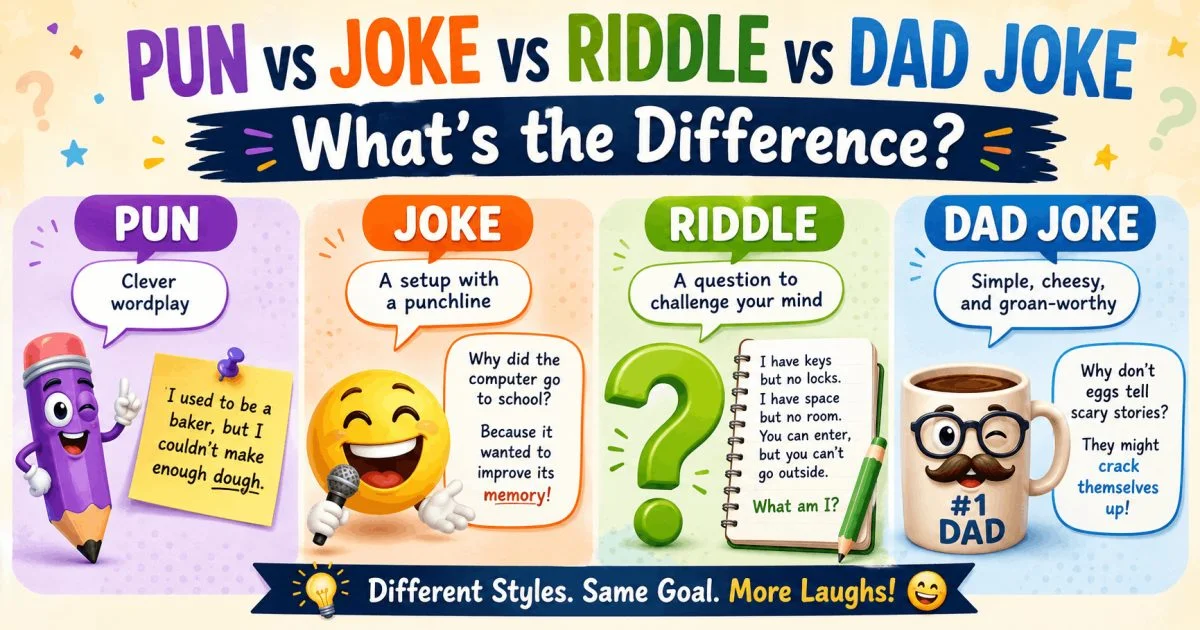
Pun vs Joke vs Riddle vs Dad Joke (Quick Comparison)
| Feature | Pun | Joke | Riddle | Dad Joke |
| Main Purpose | Clever wordplay | Make people laugh | Challenge thinking | Make people laugh and groan |
| Uses Wordplay | Almost always | Sometimes | Occasionally | Often |
| Has a Punchline | Usually | Yes | No | Yes |
| Requires an Answer | No | No | Yes | No |
| Focus | Language | Humor | Problem-solving | Lighthearted humor |
| Typical Length | Very short | Short to long | Short | Short |
| Family-Friendly | Usually | Depends | Usually | Almost always |
Key Differences Explained
Understanding the distinctions becomes much easier when you compare each style directly.
Pun vs. Joke
The biggest difference is how the humor is created.
A pun makes people laugh through clever language, double meanings, or similar-sounding words. A joke, however, usually follows a setup-and-punchline structure that surprises the audience.
Example of a Pun:
I used to be a baker, but I couldn’t make enough dough.
The humor comes from the word dough, which can mean bread mixture or money.
Example of a Joke:
Why did the computer go to school? Because it wanted to improve its memory.
This joke doesn’t rely on double meanings. Instead, it creates humor with a playful idea and an unexpected answer.
Pun vs. Dad Joke
These two categories overlap quite often.
Many dad jokes are built around puns, but not every pun is a dad joke.
A dad joke is known for being:
- Clean
- Predictable
- Cheesy
- Family-friendly
A pun, on the other hand, can be clever, sophisticated, sarcastic, or even used in advertising without sounding like a classic dad joke.
Joke vs. Riddle
The purpose of each is completely different.
A joke aims to make you laugh immediately.
A riddle asks you to think before revealing the answer.
If you’re trying to solve it, it’s probably a riddle.
If you’re simply waiting for the funny ending, it’s probably a joke.
Riddle vs. Dad Joke
A riddle invites curiosity.
A dad joke invites eye rolls.
Riddles reward correct answers.
Dad jokes reward terrible puns and predictable punchlines.
While both are suitable for families, they create entertainment in completely different ways.
Can One Joke Be More Than One Type?
Absolutely! Humor doesn’t always fit neatly into one category. A single piece of comedy can combine elements of a pun, joke, riddle, or dad joke. Understanding these overlaps helps explain why people sometimes disagree about what to call a funny line.
A Dad Joke Can Also Be a Pun
Many classic dad jokes rely on wordplay.
Example:
“I’m reading a book about anti-gravity. It’s impossible to put down.”
This is a dad joke because it’s clean and intentionally cheesy, but it’s also a pun because “put down” has two meanings.
A Joke Can Include a Pun
Some jokes tell a short story before ending with a clever play on words.
Example:
“The gardener started a podcast because he wanted to plant new ideas.”
The setup creates a joke, while the ending uses wordplay.
A Riddle Can Be Funny
Not every riddle is serious.
Example:
What gets wetter the more it dries?
Answer: A towel.
The answer surprises people and often makes them smile, blending problem-solving with humor.
Some Humor Doesn’t Fit Any Category Perfectly
Modern internet memes, funny quotes, and observational comedy often mix different styles. That’s one reason humor remains fresh and creative.
The important thing isn’t the label—it’s whether the audience enjoys it.
Which Type of Humor Is Best?
There isn’t a single “best” type of humor. Each style shines in different situations.
For Social Media
Best Choice: Puns
Short, clever puns grab attention quickly and work well as captions, tweets, memes, and Instagram posts.
For Family Gatherings
Best Choice: Dad Jokes
They’re wholesome, easy to understand, and appropriate for almost every age group.
For Classrooms
Best Choice: Riddles
Teachers often use riddles to encourage critical thinking while making learning more enjoyable.
For Stand-Up Comedy
Best Choice: Jokes
Traditional jokes allow comedians to build suspense and surprise audiences with memorable punchlines.
For Greeting Cards
Best Choice: Puns
Birthday cards, Valentine’s Day messages, Christmas greetings, and thank-you notes often become more memorable with a clever pun.
For Icebreakers
Both dad jokes and short jokes work well because they’re simple, lighthearted, and help people relax.
Tips for Creating Your Own Humor
Whether you’re writing for friends, social media, or your own website, these tips will help you craft stronger humor.
How to Write Better Puns
- Look for words with multiple meanings.
- Explore homophones (words that sound alike).
- Twist common sayings into something unexpected.
- Keep your wording short and easy to understand.
- Avoid overcomplicating the joke.
Example
Instead of saying:
“The chef is good at cooking.”
Turn it into:
“The chef always serves food for thought.”
How to Write Better Jokes
A great joke follows a simple structure.
- Create an interesting setup.
- Lead the audience toward one expectation.
- Surprise them with an unexpected punchline.
The bigger the surprise (while still making sense), the stronger the laugh.
How to Write Better Riddles
Good riddles don’t hide the answer completely—they hide it cleverly.
Remember to:
- Use subtle clues.
- Avoid making the answer impossible to guess.
- Keep the wording simple.
- Reward logical thinking.
How to Write Better Dad Jokes
The secret ingredient is confidence.
Dad jokes are supposed to be delightfully predictable.
Don’t worry if people groan—that often means you’ve told a successful dad joke.
Common Mistakes People Make
Even experienced writers sometimes confuse these humor styles.
Calling Every Pun a Joke
Every pun is humorous, but not every humorous sentence is a joke.
A pun specifically relies on wordplay.
Assuming Every Dad Joke Is a Pun
Many dad jokes use puns, but some rely on obvious observations or simple misunderstandings instead.
Confusing Riddles With Trick Questions
A good riddle gives fair clues.
A trick question usually tries to fool the listener without offering a logical path to the answer.
Believing Longer Means Funnier
Some of the funniest puns are only one sentence long.
Likewise, many memorable jokes are under twenty words.
Humor depends on timing and creativity—not length.
Forgetting the Audience
A joke that’s perfect for adults may not work in a classroom.
Always match your humor to the people you’re entertaining.
Final Thoughts
Puns, jokes, riddles, and dad jokes all bring laughter in their own unique ways, but they achieve it differently. Puns rely on clever wordplay, jokes build toward a punchline, riddles challenge your thinking, and dad jokes embrace simple, wholesome, and wonderfully cheesy humor. Knowing these distinctions not only helps you appreciate comedy but also makes it easier to choose the right style for conversations, writing, or social media.
The next time someone delivers a funny one-liner or asks a brain-teasing question, you’ll know exactly what kind of humor you’re enjoying. Better yet, try creating your own! Whether you’re crafting a witty pun, telling a classic joke, inventing a clever riddle, or proudly sharing a groan-worthy dad joke, the best humor is the kind that brings people together and leaves them smiling.
Frequently Asked Questions
What is the biggest difference between a pun and a joke?
A pun creates humor through clever wordplay, while a joke usually uses a setup and punchline to surprise the audience. Although some jokes include puns, many jokes don’t rely on wordplay at all.
Are all dad jokes puns?
No. Many dad jokes contain puns, but others use simple observations, predictable punchlines, or silly situations instead.
Can a riddle also be funny?
Yes. Many riddles include humorous answers that make people laugh after solving the puzzle.
Which type of humor is easiest to write?
Puns are often the quickest to write because they’re short and based on language. Traditional jokes usually require more planning to create an effective setup and punchline.
Why do dad jokes make people groan?
Dad jokes intentionally use obvious or cheesy punchlines. The playful predictability is part of what makes them entertaining.
Are riddles considered jokes?
Not usually. A riddle’s main purpose is to challenge the listener to find an answer, while a joke’s main purpose is to make people laugh.
Can one sentence be both a pun and a dad joke?
Yes. Many classic dad jokes are built around puns, making them both at the same time.
Which type of humor works best on social media?
Puns and short one-liners tend to perform best because they’re quick to read, easy to share, and memorable.

William is a Master’s degree holder in English Language and Literature, a passionate word enthusiast, and the founder of PunandPuns.com. He loves exploring creative wordplay and sharing humorous content that brings joy, laughter, and a fresh perspective to everyday language.


