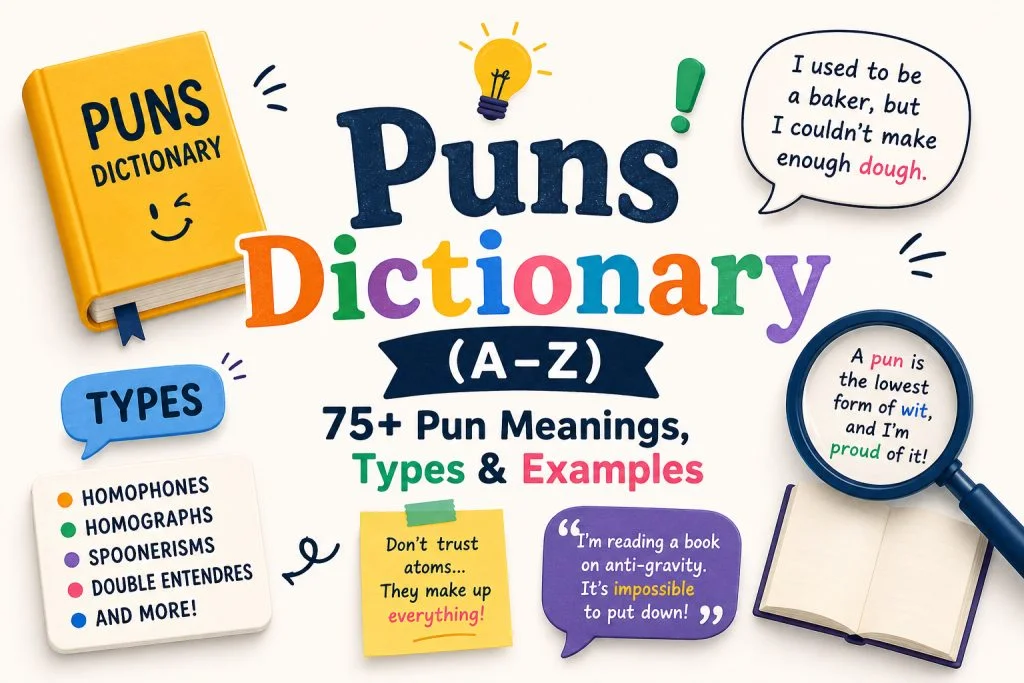
Words can be funny, clever, and surprisingly powerful—and that’s exactly what makes puns so enjoyable. Whether you’re a student studying pun literary terms, a writer looking for better wordplay, or simply someone who loves a clever joke, understanding the language behind puns can make every witty expression more entertaining.
Welcome to the Dictionary of Puns from PunAndPuns.com, your growing reference guide to pun terminology, literary devices, wordplay terms, types of puns, and pun examples. From ambiguity and homophones to metaphor, zeugma, and other literary techniques, this guide explains how different forms of language can create humor and multiple meanings.
What Is a Pun?
A pun is a form of wordplay that uses words with multiple meanings, similar sounds, or related interpretations to create humor or a clever effect.
For example:
“I used to be a banker, but I lost interest.”
The word interest can refer to money earned from an account or to curiosity and enthusiasm. The humor comes from bringing those two meanings together.
Another classic example is:
“The bicycle couldn’t stand because it was two-tired.”
Here, two-tired sounds like too tired, creating a humorous connection between the bicycle’s two tires and the expression “too tired.”
Puns can be short jokes, clever captions, literary devices, headlines, character names, or even entire comic situations.
Types of Puns
Understanding the types of puns makes it easier to recognize how different forms of wordplay work.
Homophonic Puns
Homophonic puns use words that sound alike but have different meanings or spellings.
Example:
“I sea what you mean.”
The word sea replaces see to create the joke.
Homographic Puns
Homographic puns use words with the same spelling but different meanings or pronunciations.
Example:
“The bass was beside the bass.”
One bass refers to a fish, while the other refers to a low musical sound or instrument.
Double-Meaning Puns
These puns use a word or phrase with two meanings.
Example:
“The baker makes plenty of dough.”
Dough can mean bread mixture or money.
Visual Puns
Visual puns combine an image with a word or phrase to create a second interpretation. They are especially common in advertisements, memes, signs, cartoons, and social media.
Compound Puns
Compound puns combine two or more wordplay ideas to produce a longer humorous expression.
Recursive Puns
A recursive pun depends on understanding another joke, phrase, reference, or pun before its meaning becomes clear.
Malapropistic Wordplay
This type of humor uses a wrongly substituted word that sounds similar to the intended word.
Example:
“He’s the pineapple of politeness.”
The intended word is pinnacle, but the incorrect substitution creates humor.
Pun Literary Terms
If you’re studying pun literary terms, it helps to understand that a pun is connected to a much wider family of linguistic and rhetorical techniques.
Some important terms include:
- Ambiguity — language with more than one possible interpretation.
- Antanaclasis — repeating a word with a different meaning.
- Double entendre — an expression with two possible interpretations.
- Homophone — words that sound alike but have different meanings.
- Homograph — words with the same spelling but different meanings.
- Polysemy — one word having multiple related meanings.
- Zeugma — one word applying to two other words in different ways.
- Malapropism — using an incorrect word because it sounds similar to the intended word.
- Spoonerism — switching sounds between words.
- Paraprosdokian — an unexpected ending that changes the interpretation of what came before.
- Metaphor — describing one thing as another to create comparison.
- Irony — a contrast between literal words and intended meaning or between expectation and reality.
These wordplay terms help explain why a pun works rather than simply identifying the joke.
Puns and Figurative Language
The relationship between puns and figurative language can sometimes be confusing.
A pun is primarily a form of wordplay, while figurative language is a broader category that includes techniques such as metaphor, simile, personification, irony, hyperbole, and symbolism.
However, these techniques can work together.
For example:
“The classroom was a zoo.”
This is a metaphor because the classroom is compared with a zoo.
Now consider:
“The math teacher has too many problems.”
The word problems can mean mathematical exercises as well as personal difficulties. This is wordplay based on multiple meanings.
A sentence can therefore contain both figurative language and pun-based wordplay, depending on how the language is constructed.
Figurative Language Puns
Figurative language puns become especially interesting when a phrase can be understood both literally and figuratively.
Consider:
“The gardener had growing concerns.”
The word growing works literally with plants and figuratively with concerns that are increasing.
Another example:
“The politician had a lot of issues to address.”
The word address can relate to dealing with problems as well as a physical location or speech context.
These examples demonstrate how multiple interpretations can make language more memorable.
Literary Puns and Puns in Literature
Literary puns have been used for centuries because writers can use wordplay to create humor, irony, characterization, symbolism, and multiple layers of meaning.
When studying puns in literature, readers may encounter wordplay based on:
- Double meanings
- Homophones
- Names
- Idioms
- Metaphors
- Ambiguity
- Cultural references
- Sound patterns
- Contrasting interpretations
Shakespeare is particularly well known for using wordplay and puns in dialogue. Writers can use a single word to create humor while also advancing a scene or revealing something about a character.
Puns can therefore serve more than one purpose. They may entertain readers while simultaneously contributing to tone, characterization, irony, or theme.
Pun Examples
Here are a few simple pun examples that demonstrate different techniques:
Meaning-Based Pun
“I wondered why the baseball was getting bigger. Then it hit me.”
The phrase hit me works both literally and figuratively.
Homophone Pun
“I used to be a baker, but I couldn’t make enough dough.”
Dough refers to bread mixture while sounding like the broader concept of money.
Double-Meaning Pun
“The fisherman was hooked.”
Hooked can refer to catching something with a hook or becoming fascinated.
Word Substitution Pun
“Lettuce celebrate!”
Lettuce replaces let us to create a food-related pun.
Idiom-Based Pun
“The early bird catches free Wi-Fi.”
The familiar proverb is modified to create a modern joke.
The A–Z Dictionary of Puns and Wordplay Terms
The following section forms the core of this puns dictionary, bringing together literary terms, linguistic concepts, rhetorical devices, and techniques that can help readers understand how wordplay works.
A — Alliteration
Definition
Alliteration is the repetition of the same or similar beginning consonant sounds in nearby words. It is not a pun by itself, but writers frequently use it to make wordplay catchy and memorable.
Examples
“Seven silly squirrels searched for shiny sunflower seeds.”
“Busy bees baked buttery biscuits before breakfast.”
“Funny frogs found fresh French fries.”
Related Terms
Ambiguity | Anagram | Assonance
Ambiguity
Definition
Ambiguity occurs when a word, phrase, or sentence has more than one possible meaning. It is one of the most important ingredients in clever wordplay.
Examples
“The fisherman was hooked.”
“The banker lost interest.”
“The artist drew attention before drawing a portrait.”
Related Terms
Alliteration | Double Meaning | Homonym
Anagram
Definition
An anagram is a word or phrase created by rearranging the letters of another word or phrase.
Examples
Listen → Silent
Elbow → Below
Save → Vase
Related Terms
Ambiguity | Wordplay | Spoonerism
Antanaclasis
Definition
Antanaclasis repeats the same word while using it with a different meaning. It is closely associated with punning.
Examples
“Time flies like an arrow; fruit flies like a banana.”
“Your argument is sound, but sound arguments need evidence.”
“We must all hang together, or we shall all hang separately.”
Related Terms
Pun | Polysemy | Double Entendre
Aphorism
Definition
An aphorism is a short, memorable statement that expresses a general truth or observation. Clever aphorisms may use wordplay to become more memorable.
Examples
“Actions speak louder than words.”
“Knowledge is power.”
“Practice makes progress.”
Related Terms
Proverb | Quip | Wit
Assonance
Definition
Assonance is the repetition of similar vowel sounds in nearby words. It adds rhythm and musicality to language.
Examples
“Go slow over the road.”
“Hear the mellow wedding bells.”
“The rain stayed late.”
Related Terms
Alliteration | Consonance | Rhyme
B — Bathos
Definition
Bathos occurs when serious or elevated language suddenly shifts toward something ordinary, trivial, or humorous.
Examples
“He gave his life for his country—and forgot his lunch.”
“The king faced his greatest battle before realizing he left the oven on.”
“She delivered an inspiring speech, then tripped over the microphone cable.”
Related Terms
Hyperbole | Irony | Understatement
Buzzword
Definition
A buzzword is a fashionable word or expression that becomes popular within a particular industry, culture, or period.
Examples
“Let’s leverage our synergy.”
“This app is truly game-changing.”
“We’re building a next-generation solution.”
Related Terms
Catchphrase | Cliché | Neologism
Broken Idiom
Definition
A broken idiom modifies a familiar expression to create a new, unexpected, or humorous meaning.
Examples
“Don’t count your chickens before brunch.”
“The early bird catches free Wi-Fi.”
“When life gives you lemons, make lemon pie.”
Related Terms
Idiom | Pun | Cliché
C — Cacophony
Definition
Cacophony uses harsh, clashing, or unpleasant sounds to create tension, noise, or dramatic effect.
Examples
“Crash! Clang! Crack!”
“The clattering carts crashed through crowded streets.”
“Broken bricks banged beneath boots.”
Related Terms
Consonance | Alliteration | Onomatopoeia
Catchphrase
Definition
A catchphrase is a memorable expression strongly associated with a person, character, brand, or cultural moment.
Examples
“I’ll be back.”
“To infinity and beyond!”
“Winter is coming.”
Related Terms
Phrase | Slogan | Quip
Cliché
Definition
A cliché is an expression that has been used so frequently that it may sound predictable or unoriginal.
Examples
“Better late than caffeinated.”
“Every cloud has a coffee lining.”
“Home is where the pizza is.”
Related Terms
Broken Idiom | Idiom | Pun
Clang Association
Definition
Clang association connects words primarily because of their sound rather than their meaning.
Examples
“Cat, hat, bat, chat.”
“Flip, slip, trip.”
“Funny, bunny, sunny.”
Related Terms
Rhyme | Assonance | Alliteration
Connotation
Definition
Connotation refers to the emotional, cultural, or associated meaning attached to a word beyond its basic dictionary definition.
Examples
“Home” can suggest comfort and belonging.
“Snake” can suggest dishonesty in figurative contexts.
“Diamond” can suggest value or love.
Related Terms
Denotation | Semantics | Figurative Language
Consonance
Definition
Consonance is the repetition of similar consonant sounds within nearby words.
Examples
“Pitter patter.”
“Stroke of luck.”
“Blank and think.”
Related Terms
Alliteration | Assonance | Rhyme
D — Deadpan
Definition
Deadpan humor delivers a funny statement in a deliberately serious or emotionless manner.
Examples
“I only burned the toast a little. The smoke alarm was just applauding.”
“Everything is under control,” he said while holding an upside-down map.
“I’m an excellent driver,” she said after parking across two spaces.
Related Terms
Irony | Understatement | Wit
Denotation
Definition
Denotation is the direct, literal, or dictionary meaning of a word.
Examples
Rose means a flowering plant.
Dog refers to a domesticated canine.
Book refers to a written or printed work.
Related Terms
Connotation | Literal Meaning | Semantics
Double Entendre
Definition
A double entendre is an expression with two possible meanings, often producing a clever or humorous interpretation.
Examples
“The carpenter nailed every job.”
“She’s outstanding in her field.”
“The baker makes plenty of dough.”
Related Terms
Double Meaning | Pun | Ambiguity
Double Meaning
Definition
Double meaning occurs when a word or expression can be understood in two different ways.
Examples
“The math teacher has too many problems.”
“The gardener has growing concerns.”
“The musician hit the right note.”
Related Terms
Double Entendre | Homonym | Pun
E — Euphemism
Definition
A euphemism replaces a potentially harsh or unpleasant expression with a milder one.
Examples
“He passed away.”
“She’s between jobs.”
“The company is rightsizing.”
Related Terms
Understatement | Irony | Figurative Language
Etymology
Definition
Etymology is the study of the origin and historical development of words.
Examples
Salary has a historical connection to the Latin word associated with salt.
Robot comes from the Czech word robota.
Sandwich is associated with the Earl of Sandwich.
Related Terms
Neologism | Vocabulary | Wordplay
Exaggeration
Definition
Exaggeration intentionally makes something seem larger, stronger, or more dramatic than it really is.
Examples
“I’m so hungry I could eat a mountain.”
“That backpack weighs a ton.”
“I’ve told you a million times.”
Related Terms
Hyperbole | Understatement | Humor
F — Figurative Language
Definition
Figurative language uses words beyond their straightforward literal meanings to create imagery, comparison, emotion, emphasis, or humor.
Examples
“Time is a thief.”
“The classroom was a zoo.”
“Ideas blossomed during the meeting.”
Related Terms
Metaphor | Simile | Personification
Foreshadowing
Definition
Foreshadowing provides hints about events that may happen later in a story.
Examples
“Dark clouds gathered before the journey began.”
“The old bridge creaked with every step.”
“She ignored the warning sign outside the cave.”
Related Terms
Irony | Symbolism | Plot
Freudian Slip
Definition
A Freudian slip is an accidental verbal mistake in which a speaker says something different from what they intended.
Examples
“I’m glad to beat you—I mean meet you.”
“Pass the salt—I mean the sugar.”
“Happy birthday, Dad—I mean boss.”
Related Terms
Malapropism | Spoonerism | Wordplay
G — Grammar Pun
Definition
A grammar pun creates humor through punctuation, grammar rules, sentence structure, or grammatical mistakes.
Examples
“Let’s eat, Grandma!”
“I love cooking my family and my friends.”
“Apostrophes don’t mean plural’s.”
Related Terms
Pun | Syntax | Wordplay
Groaner
Definition
A groaner is a predictable or deliberately cheesy joke that makes listeners laugh, sigh, or literally groan.
Examples
“I used to be a baker, but I couldn’t make enough dough.”
“I’m reading a book about anti-gravity. It’s impossible to put down.”
“I know a lot of jokes about construction, but I’m still working on them.”
Related Terms
Pun | Joke | Punchline
Gag
Definition
A gag is a short joke, comic action, or humorous moment.
Examples
“The magician pulled a rabbit out of an empty pizza box.”
“A waiter tripped but never dropped the tray.”
“The scarecrow won an award for being outstanding in his field.”
Related Terms
Joke | Punchline | Wit
Green’s Dictionary
Definition
Green’s Dictionary of Slang is a reference work focused on slang and informal language. Such resources can help writers explore historical and contemporary expressions.
Related Terms
Slang | Etymology | Vocabulary
H — Homograph
Definition
A homograph is a word that shares its spelling with another word but differs in meaning and sometimes pronunciation.
Examples
“The bass was painted beside the bass.”
“The wind was too strong to wind the kite.”
“She shed a tear after finding a tear in her shirt.”
Related Terms
Homonym | Homophone | Polysemy
Homonym
Definition
A homonym is a word that shares spelling or pronunciation with another word but has a different meaning.
Examples
“The bat flew past the baseball bat.”
“The bark was louder than the tree’s bark.”
“The crane watched the construction crane.”
Related Terms
Homograph | Homophone | Pun
Homophone
Definition
A homophone is a word that sounds the same as another word but has a different spelling and meaning.
Examples
“I sea what you mean.”
“Their dog is over there.”
“The knight rode into the night.”
Related Terms
Homonym | Homograph | Double Meaning
Hyperbole
Definition
Hyperbole is deliberate exaggeration used for emphasis or humor.
Examples
“I’ve waited a thousand years.”
“This suitcase weighs a ton.”
“I’m so hungry I could eat an elephant.”
Related Terms
Exaggeration | Understatement | Irony
I — Idiom
Definition
An idiom is an expression whose overall meaning cannot always be understood by interpreting each word literally.
Examples
“Break the ice.”
“Hit the sack.”
“Spill the beans.”
Related Terms
Broken Idiom | Phrase | Cliché
Innuendo
Definition
Innuendo is an indirect expression that hints at another meaning without stating it openly.
Examples
“He certainly knows how to handle a tool.”
“She’s very experienced after dark.”
“That’s quite an impressive package.”
Related Terms
Double Entendre | Ambiguity | Pun
Irony
Definition
Irony involves a contrast between what is said and what is meant, or between expectations and reality.
Examples
“The fire station burned down.”
“The lifeguard needed rescuing.”
“The traffic officer got a parking ticket.”
Related Terms
Verbal Irony | Understatement | Satire
J — Joke
Definition
A joke is a humorous statement, story, question, or situation designed to entertain. Puns are one of the most recognizable forms of word-based humor.
Examples
“Why don’t skeletons fight each other? They don’t have the guts.”
“What do you call fake spaghetti? An impasta.”
“Why did the golfer bring two pairs of pants? In case he got a hole in one.”
Related Terms
Pun | Punchline | Wit
Juxtaposition
Definition
Juxtaposition places contrasting ideas, objects, or situations next to one another.
Examples
“The tiny mouse stood beside the giant elephant.”
“He wore a tuxedo while everyone else wore pajamas.”
“The noisy city surrounded a peaceful garden.”
Related Terms
Irony | Contrast | Bathos
K — Knock-Knock Joke
Definition
A knock-knock joke follows a familiar question-and-answer structure and usually ends with a pun or wordplay twist.
Examples
“Lettuce who?” — “Lettuce in!”
“Olive who?” — “Olive you!”
“Tank who?” — “You’re welcome!”
Related Terms
Joke | Pun | Punchline
Keyword Pun
Definition
A keyword pun centers on one important word that has multiple meanings or resembles another word.
Examples
“The bicycle couldn’t stand because it was two-tired.”
“I used to be a banker, but I lost interest.”
“The cookie went to the doctor because it felt crummy.”
Related Terms
Homophone | Double Meaning | Pun
L — Lexical Ambiguity
Definition
Lexical ambiguity occurs when one word has multiple possible meanings.
Examples
“The crane lifted another crane.”
“The bark was louder than the bark.”
“The bat slept beside the baseball bat.”
Related Terms
Ambiguity | Polysemy | Homonym
Literal Meaning
Definition
Literal meaning refers to the straightforward dictionary meaning of a word or expression.
Examples
“He kicked the bucket.”
“The cat is on the table.”
“The glass is full.”
Related Terms
Denotation | Figurative Language | Idiom
Litotes
Definition
Litotes expresses an idea through a deliberate negative or understatement.
Examples
“That’s not a bad idea.”
“She is no ordinary singer.”
“The movie wasn’t half bad.”
Related Terms
Understatement | Irony | Hyperbole
Loanword
Definition
A loanword is a word adopted from another language into English.
Examples
Café
Piano
Safari
Related Terms
Etymology | Vocabulary | Xenonym
M — Malapropism
Definition
A malapropism occurs when someone mistakenly uses a word that sounds similar to the intended word but has a different meaning.
Examples
“He’s the pineapple of politeness.”
“Please pacify the report.”
“She’s suffering from a nervous contradiction.”
Related Terms
Spoonerism | Freudian Slip | Wordplay
Metaphor
Definition
A metaphor directly compares two different things by saying one thing is another.
Examples
“Time is a thief.”
“The classroom was a zoo.”
“Her smile was sunshine.”
Related Terms
Simile | Figurative Language | Personification
Metonymy
Definition
Metonymy replaces one word or concept with another closely associated with it.
Examples
“The White House announced new policies.”
“Hollywood loves superhero movies.”
“The crown approved the decision.”
Related Terms
Synecdoche | Figurative Language | Symbolism
Mixed Metaphor
Definition
A mixed metaphor combines images or expressions from unrelated metaphors, sometimes creating accidental humor.
Examples
“We’ll burn that bridge when we get to it.”
“He’s skating on thin ice while climbing the corporate ladder.”
“Let’s hit the ground swimming.”
Related Terms
Metaphor | Cliché | Figurative Language
Mondegreen
Definition
A mondegreen is a phrase that is misheard and interpreted as something different from the original wording.
Examples
“Sweet dreams are made of cheese.”
“Excuse me while I kiss this guy.”
“There’s a bathroom on the right.”
Related Terms
Homophone | Wordplay | Malapropism
N — Neologism
Definition
A neologism is a newly created word or expression that enters or gains recognition in a language.
Examples
Selfie
Staycation
Hangry
Related Terms
Portmanteau | Vocabulary | Etymology
Non Sequitur
Definition
A non sequitur is a statement or conclusion that does not logically follow what came before it.
Examples
“I love pizza. Penguins are excellent swimmers.”
“The meeting ended. Purple tastes better on Tuesdays.”
“I’m going shopping because clouds are fluffy.”
Related Terms
Absurdity | Humor | Joke
O — Onomatopoeia
Definition
Onomatopoeia uses words that imitate or resemble natural sounds.
Examples
“Buzz.”
“Splash.”
“Bang!”
Related Terms
Cacophony | Alliteration | Consonance
Oxymoron
Definition
An oxymoron combines apparently contradictory words to create a memorable expression.
Examples
“Seriously funny.”
“Bittersweet.”
“Deafening silence.”
Related Terms
Paradox | Irony | Figurative Language
P — Palindrome
Definition
A palindrome is a word, phrase, or number that reads the same forward and backward.
Examples
level
madam
racecar
Related Terms
Anagram | Wordplay | Neologism
Paradox
Definition
A paradox is a statement that appears contradictory but may communicate a deeper or meaningful idea.
Examples
“Less is more.”
“The only constant is change.”
“I know one thing: I know nothing.”
Related Terms
Oxymoron | Irony | Figurative Language
Paraprosdokian
Definition
A paraprosdokian is an expression with an unexpected ending that causes the reader or listener to reinterpret the earlier part of the sentence.
Examples
“I want to die peacefully in my sleep—not screaming like his passengers.”
“The last thing I want to do is hurt you—but it’s still on my list.”
“Light travels faster than sound. That’s why some people appear bright until they speak.”
Related Terms
Punchline | Joke | Wit
Parody
Definition
A parody imitates the style of a person, work, genre, or format for humorous or critical effect.
Examples
A superhero who panics whenever danger appears.
A detective who solves every mystery by guessing.
A cooking show where every recipe ends with burnt toast.
Related Terms
Satire | Irony | Humor
Personification
Definition
Personification gives human characteristics to animals, objects, or abstract ideas.
Examples
“The wind whispered through the trees.”
“The sun smiled across the valley.”
“Opportunity knocked on the door.”
Related Terms
Metaphor | Figurative Language | Simile
Phrase
Definition
A phrase is a group of words that functions together as part of a sentence. Familiar phrases are often adapted to create puns.
Examples
“Piece of cake.”
“Out of the blue.”
“On cloud nine.”
Related Terms
Idiom | Catchphrase | Cliché
Polysemy
Definition
Polysemy occurs when one word has multiple related meanings.
Examples
“She opened a new branch.”
“He sat by the bank.”
“The newspaper is on the table.”
Related Terms
Homonym | Ambiguity | Lexical Ambiguity
Portmanteau
Definition
A portmanteau is a word formed by blending parts of two existing words.
Examples
Brunch = breakfast + lunch
Smog = smoke + fog
Mockumentary = mock + documentary
Related Terms
Neologism | Anagram | Vocabulary
Proverb
Definition
A proverb is a traditional saying that expresses practical wisdom or a commonly recognized truth.
Examples
“A stitch in time saves nine.”
“Practice makes perfect.”
“Honesty is the best policy.”
Related Terms
Aphorism | Idiom | Cliché
Pun
Definition
A pun is a form of wordplay that uses multiple meanings, similar sounds, or different interpretations to create humor or cleverness.
Examples
“I’m reading a book on anti-gravity. It’s impossible to put down.”
“The bicycle couldn’t stand because it was two-tired.”
“I used to be a banker, but I lost interest.”
Related Terms
Wordplay | Homophone | Double Meaning
Punchline
Definition
A punchline is the final part of a joke that delivers the main humorous twist.
Examples
“Then it hit me.”
“I see food, and I eat it.”
“Then it dawned on me.”
Related Terms
Joke | Pun | Paraprosdokian
Q — Quibble
Definition
A quibble focuses on a minor detail or precise wording rather than the main point. Taking language overly literally can create humor.
Examples
“I said I’d arrive in a minute—not exactly sixty seconds.”
“Technically, a tomato is a fruit.”
“You asked me to open the window, not the curtains.”
Related Terms
Literal Meaning | Ambiguity | Wordplay
Quip
Definition
A quip is a short, clever, and often humorous remark.
Examples
“So far, so good.”
“Experience is something you get right after you needed it.”
“Common sense is like deodorant. The people who need it most never use it.”
Related Terms
Wit | Joke | Aphorism
Quotation Twist
Definition
A quotation twist changes a familiar quotation or expression to create a humorous new meaning.
Examples
“To bean or not to bean.”
“May the forks be with you.”
“Frankly, my deer, I don’t give a dam.”
Related Terms
Parody | Pun | Catchphrase
R — Red Herring
Definition
A red herring is a misleading clue or distraction that directs attention away from the main issue.
Examples
A detective investigates the wrong suspect.
A seemingly important clue turns out to be irrelevant.
A story makes readers suspect one character before revealing another explanation.
Related Terms
Foreshadowing | Irony | Plot
Repetition
Definition
Repetition intentionally reuses words or phrases to create emphasis, rhythm, or memorability.
Examples
“Never, never, never give up.”
“Again and again, the waves returned.”
“Practice, practice, practice.”
Related Terms
Alliteration | Assonance | Rhyme
Rhetorical Device
Definition
A rhetorical device is a language technique used to emphasize, persuade, entertain, or create a particular effect.
Examples
“Ask not what your country can do for you.”
“If not now, when?”
“Knowledge is power.”
Related Terms
Figure of Speech | Metaphor | Irony
Rhyme
Definition
Rhyme involves matching or closely matching sounds, especially at the ends of words.
Examples
“Bright light.”
“Fun in the sun.”
“See the bee.”
Related Terms
Alliteration | Assonance | Consonance
S — Satire
Definition
Satire uses humor, irony, exaggeration, or parody to comment on people, behaviors, institutions, or society.
Examples
A comedy program exaggerates corporate language.
A cartoon shows smartphones controlling humans.
A fictional newspaper reports absurd stories about everyday life.
Related Terms
Parody | Irony | Humor
Semantic Shift
Definition
Semantic shift occurs when the meaning or use of a word changes over time.
Examples
Mouse can refer to an animal or a computer device.
Cloud can refer to a weather formation or online computing.
Tablet can refer to medicine or an electronic device.
Related Terms
Etymology | Polysemy | Vocabulary
Simile
Definition
A simile compares two different things using like or as.
Examples
“As busy as a bee.”
“He runs like the wind.”
“Her smile was as bright as the sun.”
Related Terms
Metaphor | Figurative Language | Personification
Slang
Definition
Slang consists of informal words and expressions commonly associated with particular groups, cultures, or periods.
Examples
Cool can mean excellent or fashionable.
Ghosting can mean suddenly ending communication.
Flex can mean showing off.
Related Terms
Neologism | Vocabulary | Green’s Dictionary
Spoonerism
Definition
A spoonerism swaps sounds between nearby words, producing an unintended or humorous phrase.
Examples
“You have hissed all my mystery lectures.”
“It’s roaring with pain.”
“A blushing crow.”
Related Terms
Malapropism | Wordplay | Freudian Slip
Syllogism
Definition
A syllogism is a logical argument in which a conclusion follows from two related premises.
Example
All birds have wings. Sparrows are birds. Therefore, sparrows have wings.
Related Terms
Logic | Rhetoric | Argument
Synonym
Definition
A synonym is a word with the same or a closely related meaning as another word.
Examples
Happy → Joyful
Fast → Quick
Begin → Start
Related Terms
Antonym | Vocabulary | Semantics
Syntax
Definition
Syntax refers to the rules governing how words are arranged in sentences.
Examples
“The dog chased the cat.”
“Chased the cat the dog.”
“Only she said he lied.”
Related Terms
Grammar | Phrase | Wordplay
T — Tom Swiftie
Definition
A Tom Swiftie is a type of pun in which an adverb humorously relates to the preceding statement.
Examples
“I love hot weather,” Tom said warmly.
“I lost my crutches,” Tom said supportively.
“This elevator is amazing,” Tom said upliftingly.
Related Terms
Pun | Wordplay | Quip
Tongue Twister
Definition
A tongue twister is a phrase designed to be difficult to pronounce because of repeated or similar sounds.
Examples
“She sells seashells by the seashore.”
“Peter Piper picked a peck of pickled peppers.”
“Red lorry, yellow lorry.”
Related Terms
Alliteration | Assonance | Consonance
Transferred Epithet
Definition
A transferred epithet describes one thing using an adjective that logically belongs to another.
Examples
“He spent a sleepless night.”
“She walked along the lonely road.”
“They enjoyed a carefree vacation.”
Related Terms
Personification | Metaphor | Figurative Language
U — Understatement
Definition
Understatement deliberately describes something as less important or dramatic than it really is.
Examples
“The hurricane was a bit windy.”
“That mountain is fairly tall.”
“Winning the lottery was quite fortunate.”
Related Terms
Hyperbole | Irony | Litotes
V — Verbal Irony
Definition
Verbal irony occurs when the speaker’s intended meaning differs from the literal words being spoken.
Examples
“What lovely weather!” during a thunderstorm.
“Fantastic job!” after someone breaks a plate.
“That was quick.” after waiting an hour.
Related Terms
Irony | Sarcasm | Satire
Vocabulary
Definition
Vocabulary is the collection of words a person knows or uses. A strong vocabulary gives writers more options for creative wordplay.
Examples
Learning one new word every day expands vocabulary.
Reading regularly introduces unfamiliar words.
Keeping a word journal can improve retention.
Related Terms
Etymology | Synonym | Neologism
Voice
Definition
Voice is the distinctive personality or style expressed through writing or speaking.
Examples
A comedian may use a playful voice.
A mystery writer may use a suspenseful voice.
A blogger may use a friendly conversational voice.
Related Terms
Tone | Style | Wit
W — Wit
Definition
Wit is the ability to express clever and amusing ideas through language.
Examples
“I can resist everything except temptation.”
“If at first you don’t succeed, skydiving isn’t for you.”
“Age is merely the number of years the world has been enjoying you.”
Related Terms
Quip | Pun | Humor
Word Association
Definition
Word association connects words through meaning, sound, experience, or memory.
Examples
Cat → Mouse
Sun → Summer
Book → Library
Related Terms
Semantics | Vocabulary | Wordplay
Wordplay
Definition
Wordplay is the creative use of language to create humor, cleverness, ambiguity, or multiple meanings. Puns are one of the most popular forms of wordplay.
Examples
“Orange you glad I didn’t say banana?”
“Lettuce celebrate!”
“Donut worry, be happy.”
Related Terms
Pun | Homophone | Double Meaning
X — Xenonym
Definition
A xenonym is a term associated with a name or expression from another language or culture. Borrowed expressions demonstrate how languages influence one another.
Examples
“Déjà vu”
“Bon appétit”
“Hasta la vista”
Related Terms
Loanword | Etymology | Vocabulary
Y — Yoking
Definition
Yoking is a rhetorical technique that links two ideas or expressions to create emphasis, contrast, or a memorable combination.
Examples
“Hope and courage carried the team.”
“Coffee and confidence started the morning.”
“Dreams and determination built success.”
Related Terms
Juxtaposition | Zeugma | Figurative Language
Z — Zeugma
Definition
Zeugma is a figure of speech in which one word applies to two or more other words in different ways.
Examples
“She opened her mind and the window.”
“He stole my wallet and my heart.”
“She broke his car and his confidence.”
Related Terms
Syllepsis | Pun | Wordplay
A Pun About Puns
If you’re looking for a pun about puns, here’s one:
“I wanted to write a book about puns, but I couldn’t find the right words.”
And another:
“Puns are my favorite kind of humor—they always have a point.”
One more:
“I tried to avoid making a pun, but the opportunity was too pun-avoidable.”
That’s part of the fun of puns: the joke often works because the language itself becomes the punchline.
Why Learn Pun Terminology?
Learning pun terminology helps you understand why a particular joke works.
Instead of simply thinking, “That’s clever,” you can identify the linguistic mechanism behind it.
For example:
- A joke based on sound may involve a homophone.
- A joke using two meanings may involve polysemy or ambiguity.
- A joke that changes a familiar saying may be a broken idiom.
- A joke that unexpectedly changes direction may use paraprosdokian.
- A sentence using one word in two different ways may involve zeugma or antanaclasis.
- A humorous comparison may involve metaphor or another form of figurative language.
This makes the study of puns useful for students, writers, teachers, comedians, copywriters, and anyone interested in language.
Why Puns Matter in Writing
Puns can make writing more memorable because they encourage readers to notice language closely.
Writers can use wordplay in:
- Blog headlines
- Social media captions
- Advertising
- Poetry
- Fiction
- Comedy
- Speeches
- Character names
- Newspaper headlines
- Children’s writing
- Creative essays
The best puns usually feel natural. They don’t need excessive explanation, and they work because the reader notices an unexpected connection between words or meanings.
Final Thoughts
Puns are much more than simple jokes. They demonstrate the creativity, flexibility, ambiguity, and humor of language itself.
By exploring this Dictionary of Puns, you can learn about types of puns, pun literary terms, figurative language puns, literary puns, puns in literature, and other important wordplay terms in one place.
Whether you’re studying English, writing a story, creating a funny caption, developing jokes, or simply looking for clever language, understanding pun terminology can help you recognize why wordplay works and create more effective examples of your own.
Language is constantly changing, so this A–Z resource can continue to grow with new terms, examples, and explanations. Keep exploring PunAndPuns.com for more puns, jokes, captions, and creative wordplay.
Frequently Asked Questions
What is a dictionary of puns?
A dictionary of puns is a reference resource that explains words, concepts, literary devices, and techniques connected with puns and wordplay. It can include definitions, examples, related terms, and explanations of how different forms of wordplay work.
What are the main types of puns?
Common types of puns include homophonic puns, homographic puns, double-meaning puns, compound puns, visual puns, and idiom-based puns. Different types rely on sound, spelling, multiple meanings, or familiar expressions.
Are puns a form of figurative language?
Puns are primarily a form of wordplay, rather than a single category of figurative language. However, puns can work alongside figurative language such as metaphor, irony, personification, and hyperbole.
What are literary puns?
Literary puns are examples of wordplay used in literature to create humor, irony, ambiguity, characterization, or multiple layers of meaning. Writers may use puns in dialogue, titles, character names, poetry, and other literary contexts.
What are puns in literature used for?
Puns in literature can entertain readers, reveal character, create irony, emphasize themes, introduce ambiguity, or give a passage more than one possible interpretation.
What are some examples of pun literary terms?
Important pun literary terms include ambiguity, antanaclasis, double entendre, homophone, homograph, polysemy, zeugma, malapropism, spoonerism, and paraprosdokian. These concepts help explain different mechanisms of wordplay.
How can learning wordplay terms improve writing?
Learning wordplay terms gives writers a better understanding of how sound, meaning, sentence structure, ambiguity, and figurative language can affect readers. This can help with jokes, headlines, captions, poetry, stories, speeches, and creative writing.
Can I use this puns dictionary for studying?
Yes. This resource can be useful for students learning literary devices, language concepts, rhetoric, vocabulary, and wordplay. The simple definitions and examples are designed to make the terminology easier to understand.
What is a pun based on?
A pun can be based on multiple meanings, similar sounds, identical spellings, word substitutions, idioms, or other linguistic relationships. The key feature is that the connection between meanings or sounds creates a clever or humorous effect.

William is a Master’s degree holder in English Language and Literature, a passionate word enthusiast, and the founder of PunandPuns.com. He loves exploring creative wordplay and sharing humorous content that brings joy, laughter, and a fresh perspective to everyday language.


