Puns are one of the simplest forms of wordplay, but they can also be surprisingly clever. A single word can carry two meanings, sound like another word, or create an unexpected connection—and suddenly an ordinary sentence becomes a joke.
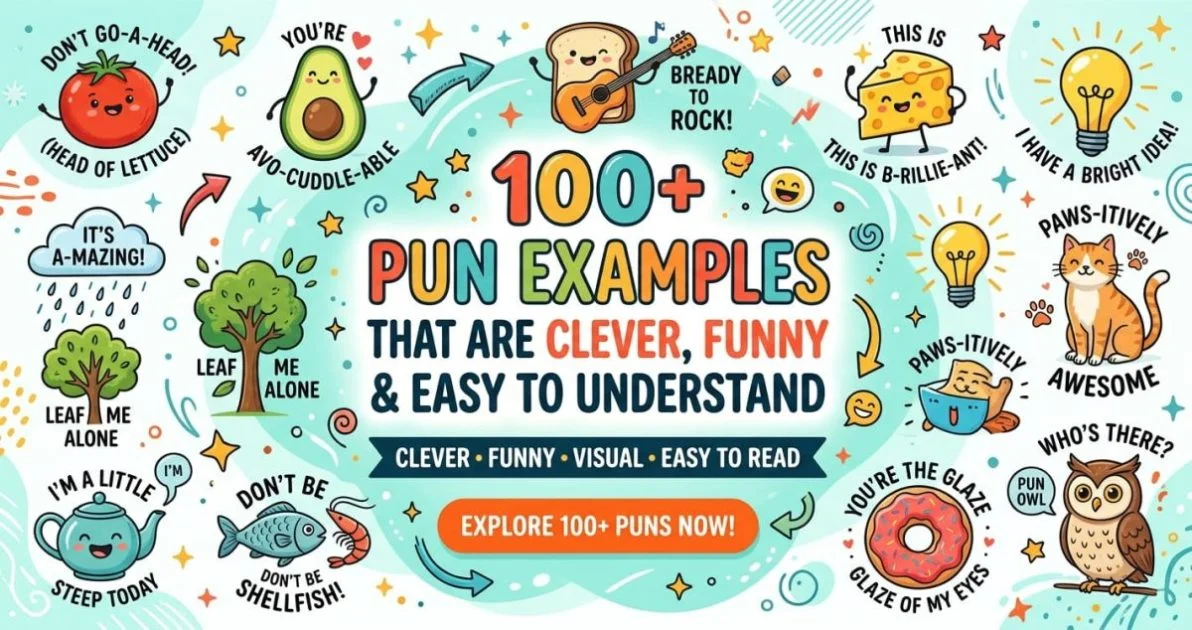
If you have ever wondered what are pun examples, you’re in the right place. This guide explores more than 100 original pun examples, explains why they work, and covers different types of puns so you can recognize, enjoy, and even create your own.
What Is a Pun?
A pun is a form of wordplay that uses words with multiple meanings, similar sounds, or different interpretations to create humor or a clever effect. Puns can be found in jokes, books, advertisements, movie titles, social media captions, headlines, and everyday conversations.
For example:
The electrician had a shocking day at work.
The word “shocking” has a literal connection to electricity and a figurative meaning related to surprise. That double meaning is what makes the sentence a pun.
Puns can be short and simple or more elaborate, but the basic idea remains the same: one word or phrase does more than one job.
What Are Pun Examples?
Pun examples are sentences or jokes that demonstrate this type of wordplay in action. They often use homophones, words with multiple meanings, similar sounds, or phrases that can be interpreted in two ways.
Here are five simple examples:
- The baker needed a break, so he took a roll.
- The fisherman was hooked on his new hobby.
- The calendar had a lot of dates to remember.
- The musician had perfect pitch but a terrible attitude.
- The gardener decided to branch out into landscaping.
Each example connects a word to two related meanings, creating the playful twist that makes a pun work.
100 Pun Examples
Ready for the good stuff? Here are more than 100 fresh pun examples organized by category.
Funny Pun Examples
- I wanted to learn how to juggle, but I couldn’t handle all the balls.
- The electrician was shocked by how high the bill was.
- The chef became a comedian because he had great timing and plenty of thyme.
- The photographer was always focused on the bright side.
- The mathematician had too many problems to solve.
- The tailor had a great career because he knew how to fit in.
- The gardener was outstanding in his field.
- The clock was hungry, so it went back four seconds.
- The musician got fired because he couldn’t face the music.
- The detective had a nose for trouble.
Short Pun Examples
- I’m friends with all electricians—we have great connections.
- The broom got promoted because it swept the competition.
- The computer needed a byte to eat.
- The pencil had a pointless argument.
- The shoe store had a sole-searching problem.
- The tree had a lot of branch managers.
- The chef was on a roll.
- The student was grounded for poor conduct.
- The battery was exhausted.
- The scarecrow was outstanding in his field.
Food Pun Examples
- The baker was on a roll all morning.
- The vegetable refused to argue because it didn’t want to stir things up.
- The chef had a lot on his plate.
- The orange couldn’t concentrate because it was always getting squeezed.
- The potato was a great conversationalist because it was so a-peel-ing.
- The bread broke up with the butter because things were getting too spread out.
- The mushroom was invited because he was a fun guy.
- The corn farmer was outstanding because he was all ears.
- The pancake was flipping out before breakfast.
- The coffee bean had a lot to brew about.
Fruit Pun Examples
- The banana went to the doctor because it wasn’t peeling well.
- The grape stopped in the middle of the road because it ran out of juice.
- The apple was popular because it was the core of the group.
- The melon had a wonderful weekend because it had a great time to rind.
- The pear made a perfect pair with its best friend.
- The orange stayed positive because it always looked on the bright citrus side.
- The strawberry was berry excited about the party.
- The lemon was feeling sour after a difficult day.
- The kiwi had a fuzzy personality.
- The watermelon had a rind-blowing personality.
Animal Pun Examples
- The cat became a musician because it had perfect mew-sic.
- The cow became an artist because she loved drawing attention.
- The duck was a great comedian because he always quacked everyone up.
- The horse opened a stable business.
- The dog became a detective because he was great at sniffing out clues.
- The owl became a professor because he was very wise.
- The fish avoided arguments because he didn’t want to get caught in a net of problems.
- The sheep became a barber because he was great at giving wool cuts.
- The bee started a business because he wanted to make a little buzz.
- The rabbit became a comedian because he had a real hare-raising sense of humor.
School Pun Examples
- The student brought a ladder because he wanted to reach a higher level of education.
- The math teacher had a problem with everything.
- The history student knew the past was behind him.
- The geography teacher had the world at his fingertips.
- The chemistry student got a reaction from everyone.
- The librarian was booked all week.
- The student was outstanding in class because he had a high degree of concentration.
- The music student got in trouble because he couldn’t conduct himself properly.
- The biology student had a natural talent for the subject.
- The pencil was always under pressure because it had too much to draw on.
Work and Office Pun Examples
- The employee was promoted because he had outstanding attendance.
- The accountant always knew how to balance things out.
- The manager had a great sense of direction but still couldn’t find the office.
- The employee quit because he couldn’t handle the workload.
- The printer had a paper trail to follow.
- The office chair was tired of being pushed around.
- The meeting was productive, but it needed more breaks.
- The spreadsheet had too many cells to handle.
- The secretary was always on point with her notes.
- The computer programmer had a byte-sized workload.
Technology Pun Examples
- The computer went to the doctor because it had a virus.
- The smartphone needed some space, so it deleted a few apps.
- The computer took a break because it needed to reboot.
- The keyboard was tired of being pressed all day.
- The programmer didn’t get lost because he always knew the right direction to code.
- The Wi-Fi went to therapy because it had connection issues.
- The laptop was exhausted after a long day of processing.
- The mouse didn’t say much because it was a little click-shy.
- The website went offline because it needed some personal space.
- The programmer had a great relationship with his computer—they had good compatibility.
Coffee Pun Examples
- The coffee bean stayed positive because every day was a brew beginning.
- I tried to tell my coffee a secret, but it spilled the beans.
- The barista was great at handling pressure.
- Coffee and I have a strong relationship—it keeps me grounded.
- The coffee shop was always busy because it had a latte customers.
- The espresso had an intense personality because it was highly concentrated.
- The coffee bean couldn’t sleep because it was too grounded.
- The barista told a joke, but it wasn’t very well brewed.
- Coffee is my daily mug-nificent motivation.
- The coffee lover didn’t panic because everything would espresso itself eventually.
Nature and Weather Pun Examples
- The tree couldn’t keep a secret because it always branched out.
- The gardener had a growing reputation.
- The cloud was feeling down because it had a gloomy outlook.
- The wind had a blowing career ahead of it.
- The rain was popular because it always made a splash.
- The mountain had a peak personality.
- The river was confident because it always went with the flow.
- The gardener stayed calm because he knew things would grow on him.
- The storm was a terrible guest because it always made a scene.
- The flower couldn’t stop smiling because life was looking rosy.
Extra Pun Examples
- The dentist always got to the root of the problem.
- The astronaut needed more space in the relationship.
- The fisherman had a reel talent for storytelling.
- The musician couldn’t find his keys, so he improvised.
- The tailor knew exactly how to make a good impression.
- The runner was always ahead of the curve.
- The photographer developed a good reputation.
- The gardener decided it was time to turn over a new leaf.
- The baker knew how to rise above difficult situations.
- The detective followed every lead until he got to the point.
Types of Puns With Examples
Not every pun works in exactly the same way. Understanding the different types of puns can help you recognize the wordplay more easily.
1. Homophonic Puns
Homophonic puns use words that sound alike or nearly alike but have different meanings or spellings.
Example:
The baker kneaded a break.
“Kneaded” refers to working dough, while “needed” would mean required.
2. Homographic Puns
Homographic puns use words that are spelled the same but have different meanings.
Example:
The fisherman sat by the bank and waited for a bite.
“Bank” can mean the side of a river or a financial institution.
3. Double-Meaning Puns
These puns use a word with two meanings to create an unexpected interpretation.
Example:
The dentist finally got to the root of the problem.
“Root” can refer to the root of a tooth and the fundamental cause of an issue.
4. Compound Puns
Compound puns combine multiple words or phrases to create the humorous connection.
Example:
The vegetable farmer was outstanding in his field because he was all ears.
The expression “all ears” means listening carefully, while ears are also part of corn.
5. Visual Puns
Visual puns combine words with images or visual concepts to create humor. They are especially common in advertisements, memes, signs, and social media.
Example:
A picture of a tired-looking battery captioned:
“I’m completely drained.”
The image and phrase reinforce two meanings of “drained.”
Pun Examples in Everyday Conversation
Puns are not limited to traditional jokes. They can appear naturally in conversations when someone notices an opportunity for wordplay.
For example:
Friend: “Why are you carrying a ladder?”
You: “I’m trying to take my career to the next level.”
The phrase “next level” works literally with climbing and figuratively with career advancement.
Other conversational pun examples include:
- “That idea has a lot of potential.”
- “I’m really digging this gardening project.”
- “You’re looking sharp today.”
- “Let’s stick with this plan.”
- “I think we’re on the same wavelength.”
Pun Examples in Advertising
Brands often use puns because clever wordplay can make advertisements more memorable. A short pun can communicate a product benefit while also giving the audience a reason to smile.
For example:
A bakery:
“Our prices are on a roll.”
A shoe store:
“Put your best foot forward.”
A coffee shop:
“Espresso yourself.”
A gardening store:
“Watch your business grow.”
A seafood restaurant:
“Our prices are a great catch.”
These examples show why puns are useful beyond comedy: they can make ordinary messages more memorable.
Pun Examples for Social Media Captions
Short puns work particularly well in social media captions because they are quick to understand and easy to remember.
Here are five examples:
- “Donut worry, be happy.”
- “Having a berry good day.”
- “Life is better with a little zest.”
- “Just roll with it.”
- “Feeling paws-itively fantastic.”
The best social media puns are short, relevant to the image, and easy for people to understand without additional explanation.
Pun Examples for Kids
Puns can also be a fun way for children to learn about language. Simple wordplay helps kids notice how the same word can have different meanings or how two words can sound alike.
Here are five clean examples:
- Why was the math book sad? Because it had too many problems.
- Why did the banana go to the doctor? Because it wasn’t peeling well.
- Why did the teddy bear skip dessert? Because it was stuffed.
- Why did the bicycle fall over? Because it was two-tired.
- Why did the golfer bring two pairs of pants? In case he got a hole in one.
How to Create Your Own Pun
Creating a pun becomes easier when you start looking for words with multiple meanings or similar sounds. Begin with an ordinary subject such as food, animals, sports, school, work, or technology. Then make a list of words associated with that subject and look for alternative meanings.
For example, suppose your subject is coffee.
You might think of:
- brew
- grounds
- bean
- cup
- mug
- roast
- shot
Then look for words or expressions that can be interpreted differently.
Grounds can refer to coffee grounds or a piece of land.
That could lead to:
“The coffee shop had excellent grounds for success.”
The more you practice noticing these connections, the easier it becomes to create original pun examples.
What Makes a Good Pun?
Not every attempt at wordplay becomes a good pun. The strongest puns usually have a few things in common:
1. The Meaning Is Easy to Recognize
A reader should be able to understand the wordplay without needing a long explanation.
2. The Twist Is Unexpected
The second meaning should create a small moment of surprise.
3. The Words Fit Naturally
A pun shouldn’t make a sentence sound awkward simply to force the joke.
4. The Topic Supports the Wordplay
A food pun works best when the subject is actually related to food.
5. The Joke Is Short
Many effective puns work in one sentence because the wordplay delivers the punch quickly.
Pun vs. Joke: What’s the Difference?
A pun and a joke are related, but they are not identical. A joke is a broader form of humor that often contains a setup and punchline. A pun is a specific form of wordplay that relies on multiple meanings, similar sounds, or clever interpretations of words.
For example:
Pun:
The bicycle couldn’t stand because it was two-tired.
The humor depends on the wordplay between “two-tired” and “too tired.”
Joke:
Why did the student bring a ladder to school? Because he wanted to go to high school.
This joke uses a literal interpretation of “high school,” but its main structure is a joke rather than a single wordplay construction.
In short, a pun can be part of a joke, but not every joke is a pun.
Why Are Pun Examples So Popular?
Pun examples remain popular because they are quick, accessible, and easy to share. Unlike humor that depends heavily on cultural references or complicated stories, many puns can be understood in just a few seconds.
They also work across many formats, including:
- Blog headlines
- Social media captions
- Birthday cards
- Advertisements
- Speeches
- School projects
- Text messages
- Memes
- Product names
- Everyday conversations
A clever pun can make otherwise ordinary content more memorable.
Final Thoughts
Pun examples show just how flexible and playful language can be. A single word can create two meanings, turn an ordinary sentence into a joke, or make a headline much more memorable.
Whether you enjoy short one-liners, clever advertising, silly dad jokes, or sophisticated literary wordplay, puns offer something for everyone. The trick is not simply finding words with double meanings—it’s finding the moment where those meanings meet naturally.
So go ahead and experiment with your own wordplay. After all, once you start looking for puns, you’ll find that they’re pun-avoidable.
And if you’re still wondering what puns mean or how they work, our complete guide to What Is a Pun? takes a deeper look at the meaning, history, types, and art of clever wordplay.
Frequently Asked Questions About Pun Examples
What is a simple example of a pun?
A simple pun is “The bicycle couldn’t stand because it was two-tired.” The phrase “two-tired” sounds like “too tired,” while “two” also refers to the bicycle’s two tires. This makes it an easy example of how wordplay can create humor from two related meanings.
What are some funny pun examples?
Some funny pun examples include “The baker needed a break, so he took a roll,” “The electrician had a shocking day,” and “The fisherman was hooked on his hobby.” Each uses a word with a literal and figurative meaning to create a humorous twist.
What are the different types of puns?
Common types of puns include homophonic puns, homographic puns, double-meaning puns, compound puns, and visual puns. They differ mainly in how the wordplay is created, whether through similar sounds, multiple meanings, spelling, combinations of words, or visual elements.
What is the difference between a pun and wordplay?
Wordplay is the larger category of creative language techniques, while a pun is one particular form of wordplay. Puns usually depend on multiple meanings or similar-sounding words. Other forms of wordplay can include anagrams, spoonerisms, rhymes, and other linguistic tricks.
Why do puns make people groan?
Puns can cause groans because their humor often depends on an obvious or unexpected connection between words. The reaction is part of the fun. Even when someone calls a pun “terrible,” recognizing the clever wordplay often means the pun has successfully done its job.
Can puns be used in formal writing?
Yes. Puns can work in formal writing when they are used carefully and support the subject. They are especially useful in titles, headings, advertising, speeches, and creative writing. However, they should never make an important message confusing or unclear.
Are puns suitable for children?
Absolutely. Clean, simple puns can be excellent for children because they introduce vocabulary, multiple meanings, and language-based humor in an entertaining way. Animal, food, school, and everyday-object puns are especially easy for younger readers to understand.
How can I make my own pun?
Start by choosing a subject and listing words associated with it. Look for words that have multiple meanings or sound similar to other words. Then create a sentence that naturally connects those meanings. Keep the final line short and make sure the wordplay is easy to recognize.

William is a Master’s degree holder in English Language and Literature, a passionate word enthusiast, and the founder of PunandPuns.com. He loves exploring creative wordplay and sharing humorous content that brings joy, laughter, and a fresh perspective to everyday language.


