If you’ve ever laughed at a clever play on words while reading a novel, watching a movie, or scrolling through social media, you’ve probably encountered either a pun or another form of wordplay. These two terms are often used interchangeably, but they aren’t the same. In fact, one is a specific literary device, while the other is a much broader category that includes several techniques used to make language more engaging, memorable, and entertaining.
Understanding the difference between pun vs wordplay in literature is valuable for more than just literature students. Writers use these techniques to add humor, strengthen dialogue, create memorable characters, and encourage readers to think beyond the literal meaning of words. From classic plays to modern advertising slogans, wordplay has remained one of the most effective tools for capturing attention and making ideas stick.
In this guide, we’ll break down what puns and wordplay really mean, compare their key differences, explore how they function in literature, and use fresh, original examples to make each concept easy to understand. Whether you’re a curious reader, a teacher, a student, or an aspiring writer, this article will help you recognize these literary devices and use them more effectively in your own writing.
What Is a Pun?
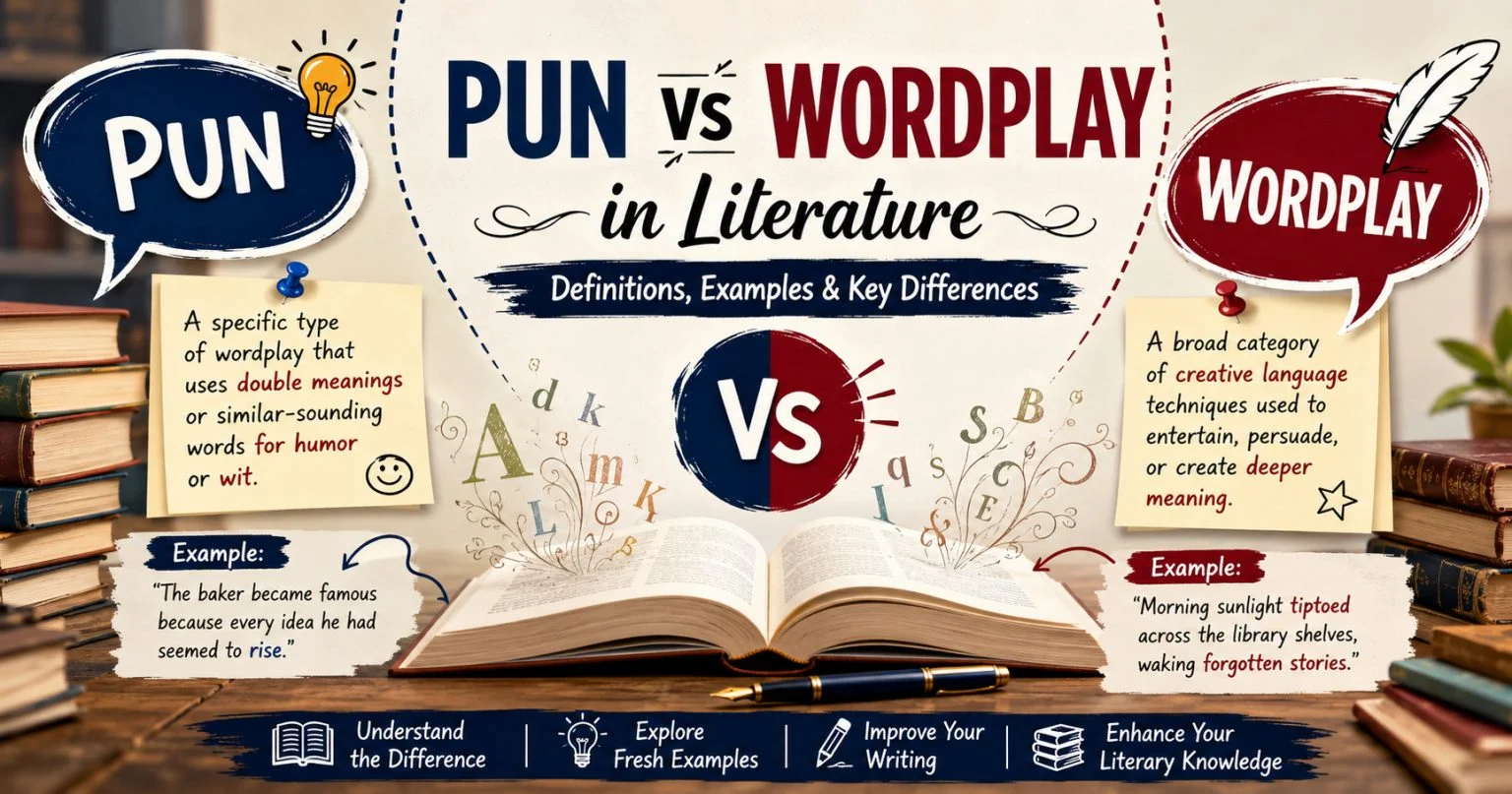
A pun is a literary device that creates humor, wit, or cleverness by taking advantage of words that have more than one meaning or words that sound alike but have different meanings.
Unlike a traditional joke, a pun asks the reader to recognize two interpretations of the same word or phrase at once. That moment of realization is what makes a pun satisfying and memorable.
Puns are commonly used in:
- Literature
- Movies
- Advertisements
- Headlines
- Greeting cards
- Everyday conversations
A well-crafted pun doesn’t simply make people laugh—it also demonstrates creativity and a deep understanding of language.
Fresh Examples of Puns
Example 1
The florist’s business continued to bloom after she planted the right ideas.
The word bloom refers both to flowers opening and to the business becoming successful.
Example 2
After opening his telescope shop, Noah said his future was finally looking bright.
The word bright describes both stars and a promising future.
Example 3
The mountain guide always reached the peak of every conversation.
The word peak refers to mountain summits and achieving the highest point in a discussion.
Example 4
The beekeeper’s career was creating quite a buzz around town.
The word buzz refers both to the sound bees make and the excitement people feel.
Example 5
The tailor stitched together a successful career one thread at a time.
The word stitched together refers both to sewing fabric and gradually building success.
These examples rely on double meanings rather than simply telling a funny joke.
Characteristics of a Pun
Most puns share several common features:
- They use words with multiple meanings.
- They may rely on similar pronunciation.
- They encourage readers to interpret language in more than one way.
- They are usually short and easy to remember.
- They often add humor without requiring a long setup.
What Is Wordplay?
Wordplay is the creative use of language to entertain, persuade, surprise, or encourage deeper thinking. Rather than referring to a single literary device, wordplay describes an entire category of techniques that manipulate words, sounds, meanings, or sentence structures.
Think of it this way:
Every pun is wordplay, but wordplay includes much more than puns.
Authors use wordplay to create:
- Humor
- Suspense
- Rhythm
- Symbolism
- Emotional impact
- Memorable dialogue
Because wordplay is so broad, it appears in nearly every form of writing—from poetry and novels to speeches, advertisements, and song lyrics.
Common Types of Wordplay
Wordplay includes many literary techniques, such as:
- Puns
- Alliteration
- Assonance
- Anagrams
- Palindromes
- Spoonerisms
- Double entendre
- Oxymorons
- Malapropisms
- Rhyming expressions
Each technique plays with language differently, but all share the goal of making communication more creative and engaging.
Pun vs Wordplay: Quick Comparison
| Feature | Pun | Wordplay |
| Definition | A literary device using multiple meanings or similar-sounding words | A broad category of creative language techniques |
| Purpose | Humor, wit, or cleverness | Humor, creativity, emphasis, style, persuasion, or artistic effect |
| Scope | One specific literary device | An umbrella term covering many literary devices |
| Common Uses | Jokes, headlines, dialogue, captions | Literature, poetry, speeches, advertising, storytelling |
| Requires Double Meaning | Usually | Not always |
| Includes Other Literary Devices | No | Yes |
The Key Differences Between Pun and Wordplay
Although people often use the terms interchangeably, they serve different purposes.
1. Scope
A pun represents just one technique within the much larger world of wordplay.
Imagine wordplay as a toolbox.
A pun is simply one of the many tools inside it.
2. Purpose
Puns are usually written to surprise readers and create humor.
Wordplay, however, can also:
- Strengthen storytelling
- Add poetic rhythm
- Build suspense
- Reveal personality
- Encourage readers to think more deeply
Humor is only one possible outcome.
3. Structure
Puns generally depend on:
- Double meanings
- Similar pronunciation
- Ambiguous wording
Wordplay may involve:
- Sound patterns
- Sentence structure
- Letter arrangements
- Symbolism
- Creative phrasing
This makes wordplay much more flexible than puns alone.
4. Reader Experience
When readers discover a pun, they usually smile because they suddenly recognize the hidden meaning.
When readers encounter broader wordplay, they may experience:
- Admiration
- Curiosity
- Emotional impact
- Surprise
- Reflection
Not every piece of wordplay is designed to make people laugh.
Is Every Pun Wordplay?
Yes.
Every pun qualifies as wordplay because it creatively manipulates language to produce multiple meanings.
However, the opposite isn’t true.
Many forms of wordplay don’t involve puns at all.
For example, a poet might repeat sounds to create rhythm, while a novelist might rearrange words for dramatic effect. Both examples use wordplay, even though neither relies on double meanings.
Types of Wordplay Found in Literature
Literary authors use a wide range of wordplay techniques to enrich their writing.
Here are some of the most common.
Alliteration
Alliteration repeats the same consonant sound at the beginning of nearby words.
Fresh Example
Brave birds balanced beneath bright blue branches.
The repeated B sound creates rhythm and makes the sentence easier to remember.
Anagram
An anagram rearranges letters to create a new word or phrase.
Fresh Example
Secure → Rescue
The same letters create a completely different word.
Palindrome
A palindrome reads the same forwards and backwards.
Examples include:
- Refer
- Rotor
- Civic
- Redder
These are examples of wordplay because they manipulate letter order rather than word meanings.
Spoonerism
A spoonerism swaps sounds between words.
Fresh Example
Instead of saying:
“Pack the lunch.”
Someone accidentally says:
“Lack the punch.”
The humor comes from switching the initial sounds.
Double Entendre
A double entendre is a phrase with two possible interpretations.
One meaning is straightforward.
The second meaning is often humorous, clever, or subtly implied.
Unlike puns, not every double entendre depends on similar-sounding words.
Malapropism
A malapropism occurs when someone accidentally replaces a word with another that sounds similar.
Fresh Example
Someone says:
“Let’s preserve our patients.”
Instead of:
“Let’s preserve our patience.”
The mistake creates unintended humor.
Why Authors Use Puns in Literature
Writers don’t include puns simply to make readers laugh.
A clever pun can:
- Reveal a character’s intelligence.
- Make dialogue more natural.
- Highlight important themes.
- Add hidden meanings.
- Make memorable scenes even more enjoyable.
Because puns reward attentive readers, they often create a stronger connection between the writer and the audience.
Why Wordplay Matters in Literature
Wordplay transforms ordinary sentences into memorable ones.
Instead of simply delivering information, it encourages readers to slow down, notice patterns, and think about language from different perspectives.
Whether it’s humorous, poetic, or symbolic, wordplay helps writing feel more vivid and engaging.
Many of the world’s most celebrated books continue to be studied not only because of their stories, but because of the creative ways their authors used language.
Famous Examples of Puns and Wordplay in Literature
One of the easiest ways to understand the difference between pun vs wordplay in literature is by examining how celebrated authors have used these techniques. Great writers rarely include puns or wordplay just for laughs—they often use them to reveal character, reinforce themes, foreshadow events, or make their writing more memorable.
Let’s explore how puns and broader forms of wordplay appear in literature.
Puns in Classic Literature
For centuries, playwrights and novelists have used puns to entertain audiences while adding extra layers of meaning to their stories.
Unlike modern internet jokes, literary puns often serve several purposes at once.
They can:
- Reveal a character’s intelligence
- Create dramatic irony
- Break tension
- Hint at future events
- Give readers multiple interpretations of the same dialogue
Because puns reward careful reading, they remain one of the most respected forms of literary humor.
Shakespeare: The Master of Puns
No discussion of literary puns would be complete without mentioning William Shakespeare.
His plays contain hundreds of puns, many of which still fascinate readers today.
Rather than using simple one-line jokes, Shakespeare often built entire conversations around double meanings.
For example, characters frequently used words related to:
- Time
- Death
- Love
- Fortune
- Light and darkness
- Nature
These layered meanings allowed audiences to interpret scenes differently depending on their understanding of the language.
Why Shakespeare Used Puns
He used puns to:
- Entertain audiences.
- Differentiate clever characters from foolish ones.
- Add emotional complexity.
- Balance comedy and tragedy.
- Keep dialogue memorable.
Even serious scenes sometimes contain subtle puns that reward attentive readers.
Wordplay in Poetry
Poets often rely on wordplay more than straightforward humor.
Instead of creating jokes, they use language creatively to produce rhythm, emotion, and symbolism.
For example, poets may combine:
- Repeated sounds
- Symbolic words
- Unexpected comparisons
- Multiple interpretations
- Carefully chosen word order
This allows readers to discover new meanings every time they revisit a poem.
Wordplay in Modern Novels
Modern authors continue to use wordplay in different ways.
Rather than focusing solely on puns, they often create:
- Character names with hidden meanings.
- Dialogue containing subtle double meanings.
- Symbolic descriptions.
- Clever chapter titles.
- Recurring phrases that gain new meaning throughout the story.
Readers may not even realize they’re experiencing wordplay until they finish the book and connect earlier clues.
Wordplay in Children’s Literature
Children’s books frequently introduce readers to language through playful expressions.
Authors use wordplay because it:
- Builds vocabulary.
- Encourages creative thinking.
- Makes reading enjoyable.
- Helps children recognize patterns in language.
Many educational books intentionally include simple puns to demonstrate how one word can carry multiple meanings.
Wordplay in Advertising
Some of the world’s most memorable advertising campaigns rely on wordplay.
Brands use clever language because it helps consumers remember products more easily.
Examples include:
- Creative slogans
- Rhyming taglines
- Double meanings
- Product-related puns
- Catchy headlines
Good advertising wordplay feels natural rather than forced.
Fresh Examples of Puns
Below are original examples created specifically to demonstrate how puns work.
Example 1
The candle maker said success was finally starting to glow.
“Glow” refers to both candlelight and personal success.
Example 2
The fisherman believed every setback was just another chance to reel life back in.
“Reel” connects fishing equipment with recovering from challenges.
Example 3
The map designer finally found the right direction for his career.
“Direction” refers both to maps and career progress.
Example 4
The pianist always struck the right chord with new customers.
“Chord” describes both music and emotional connection.
Example 5
The astronomer believed every challenge was simply another star to reach.
The sentence blends literal astronomy with ambition.
Fresh Examples of Wordplay
Unlike puns, these examples don’t depend on double meanings.
Instead, they use creative language to paint vivid images.
Example 1
Morning sunlight tiptoed across the library shelves, waking forgotten stories.
Personification creates imagery rather than humor.
Example 2
The forest stitched shadows together beneath its ancient branches.
Metaphorical language creates atmosphere.
Example 3
Ideas drifted through the classroom like autumn leaves searching for a place to land.
A simile strengthens the description.
Example 4
Hope quietly unpacked its suitcase inside her heart.
Abstract ideas become human through personification.
Example 5
The city wrapped itself in golden evening light before the first streetlamp blinked awake.
This sentence creates visual imagery without using a pun.
How to Identify a Pun While Reading
Sometimes puns are obvious.
Other times they’re hidden within dialogue.
Ask yourself these questions.
Does one word have two possible meanings?
If yes, it may be a pun.
Would changing one meaning completely change the sentence?
If yes, you’re probably reading a pun.
Is the humor based on language rather than the situation?
That’s another strong clue.
Does the sentence reward careful reading?
Puns often become funnier after readers pause to think about them.
How to Recognize Wordplay
Wordplay is broader than puns.
Look for language that:
- Sounds musical.
- Creates surprising imagery.
- Rearranges familiar expressions.
- Encourages multiple interpretations.
- Uses rhythm creatively.
Not every example is funny.
Sometimes the purpose is beauty rather than humor.
How Writers Can Use Puns Effectively
Good puns feel effortless.
Poor puns feel forced.
Professional writers often follow these guidelines.
Keep Them Relevant
A pun should match the topic naturally.
If you’re writing about gardening, use plant-related language instead of unrelated wordplay.
Avoid Overloading the Reader
Too many puns in one paragraph reduce their impact.
One clever pun is usually more memorable than ten average ones.
Make Sure Both Meanings Are Clear
Readers should understand both interpretations without excessive explanation.
If a pun requires several paragraphs to explain, it probably isn’t effective.
Match the Tone
A lighthearted comedy welcomes puns.
A serious historical article may benefit from only occasional wordplay.
Common Mistakes Writers Make
Mistake 1
Confusing every joke with a pun.
Not all jokes rely on language.
Many depend entirely on situations or characters.
Mistake 2
Using complicated vocabulary just to create a pun.
Simple, natural language usually works better.
Mistake 3
Repeating the same style of pun.
Varying sentence structure keeps readers engaged.
Mistake 4
Ignoring the audience.
A pun that requires specialized knowledge may confuse general readers.
Choose examples your audience can understand immediately.
Which Is Better: Puns or Wordplay?
Neither is inherently better.
The best choice depends on your purpose.
Choose puns when you want to:
- Add humor.
- Create memorable dialogue.
- Make readers smile.
- Write entertaining headlines.
Choose broader wordplay when you want to:
- Add emotion.
- Build atmosphere.
- Create symbolism.
- Make writing more artistic.
Many excellent authors combine both techniques within the same story.
Quick Recap
Here’s an easy way to remember the difference.
| Pun | Wordplay |
| One specific literary device | A broad category of language techniques |
| Uses double meanings | May use rhythm, sounds, symbolism, or multiple literary devices |
| Usually humorous | Can be humorous, emotional, poetic, or persuasive |
| One branch of wordplay | Includes puns and many other techniques |
If you’re ever unsure, remember this simple rule:
Every pun is wordplay, but not every example of wordplay is a pun.
Final Thoughts
Although the terms are often used interchangeably, understanding pun vs wordplay in literature reveals an important distinction. A pun is a specific literary device that depends on double meanings or similar-sounding words to create humor or wit, while wordplay is the broader art of using language creatively to entertain, persuade, or inspire. Recognizing this relationship helps readers appreciate the craftsmanship behind great writing and gives writers more tools to express their ideas effectively.
From timeless classics and modern novels to speeches, advertisements, and everyday conversations, puns and other forms of wordplay continue to shape the way we communicate. They make language more memorable, encourage creative thinking, and often reward readers who look beyond the surface meaning of words.
Whether you’re studying literature, writing your own stories, or simply enjoying clever language, mastering the difference between puns and wordplay will deepen your appreciation for the power of words. Keep exploring these literary techniques, experiment with creating your own original puns, and you’ll soon discover that the most memorable writing often comes from looking at language from a fresh perspective.
If you enjoyed this guide, be sure to explore our related articles on What Is a Pun?, Types of Puns, Pun vs Joke, and Pun Examples to continue building your knowledge of clever wordplay.
Key Takeaways
- A pun is a specific type of wordplay that uses double meanings or similar-sounding words.
- Wordplay is an umbrella term that includes puns and many other literary techniques.
- Puns are commonly used to create humor, while wordplay can also build emotion, rhythm, symbolism, and imagery.
- Great writers often combine several forms of wordplay to create memorable stories and dialogue.
- Learning the difference between pun and wordplay can improve both your reading comprehension and writing skills.
Frequently Asked Questions
1. What is the main difference between a pun and wordplay?
A pun is a specific type of wordplay that creates humor by using words with double meanings or similar sounds. Wordplay is a broader category that includes puns, alliteration, anagrams, spoonerisms, double entendre, and many other creative language techniques. In simple terms, every pun is wordplay, but not every example of wordplay is a pun.
2. Are puns considered a literary device?
Yes. A pun is a recognized literary device used in literature, speeches, advertising, and everyday conversation. Writers use puns to add humor, emphasize ideas, reveal character traits, or create memorable dialogue. Many classic authors, including Shakespeare, frequently used puns to enrich their writing and engage readers on multiple levels.
3. Why do authors use wordplay in literature?
Authors use wordplay to make their writing more engaging, expressive, and memorable. Creative language can add humor, create rhythm, develop themes, build symbolism, or encourage readers to think beyond the literal meaning of words. Wordplay also helps distinguish characters and gives stories a unique voice.
4. Can a sentence contain both a pun and another form of wordplay?
Absolutely. A single sentence can combine a pun with techniques such as alliteration, rhyme, metaphor, or double entendre. Skilled writers often layer multiple literary devices together, making their writing richer and allowing readers to discover new meanings each time they revisit the text.
5. How can I improve my ability to recognize puns and wordplay?
The best way to recognize puns and wordplay is to read widely and pay close attention to how authors use language. Ask yourself whether a word has more than one meaning, whether a phrase can be interpreted differently, or whether sounds and word choices contribute to the overall effect. With practice, spotting these literary techniques becomes much easier.

William is a Master’s degree holder in English Language and Literature, a passionate word enthusiast, and the founder of PunandPuns.com. He loves exploring creative wordplay and sharing humorous content that brings joy, laughter, and a fresh perspective to everyday language.


