Texting has changed the way we communicate. Instead of typing complete sentences, people often use short abbreviations, slang, acronyms, and internet expressions to save time and make conversations more casual.
But what does “NTM,” “FR,” “ISTG,” “HMU,” or “IYKYK” actually mean? If you’ve ever received a text and had no idea what the abbreviation meant, you’re definitely not alone.
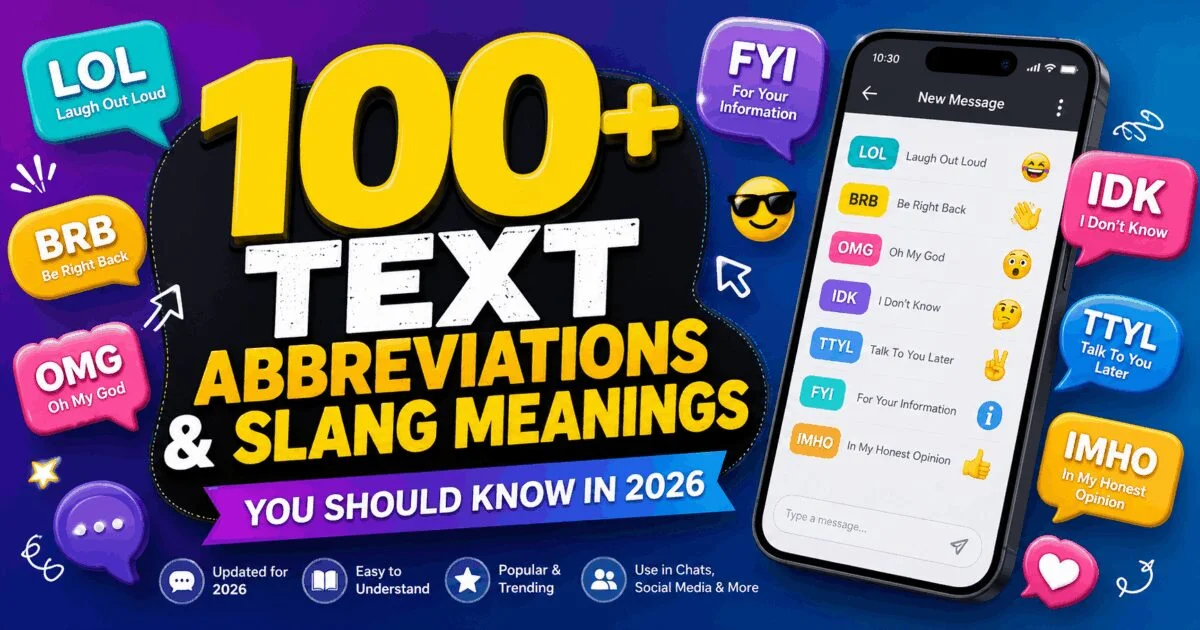
This guide explains 100+ common text abbreviations and slang meanings you should know in 2026, with simple definitions and examples showing how people actually use them in messages.
What Are Text Abbreviations and Slang?
Text abbreviations are shortened versions of words, phrases, or sentences commonly used in texting, social media, online chats, and messaging apps. They can make conversations faster and more informal.
For example, LOL means “laughing out loud,” while BRB means “be right back.”
Slang is slightly broader. It includes informal words and expressions such as sus, rizz, no cap, and lowkey, which may not have a direct connection to shortening a phrase.
Some expressions can be both slang and internet language, so the categories sometimes overlap.
100+ Text Abbreviations & Slang Meanings
Here is a quick-reference list of popular texting abbreviations and slang terms.
| # | Abbreviation / Slang | Meaning |
| 1 | LOL | Laughing Out Loud |
| 2 | LMAO | Laughing My Ass Off |
| 3 | LMFAO | Laughing My Freaking/Fucking Ass Off |
| 4 | ROFL | Rolling On the Floor Laughing |
| 5 | OMG | Oh My God |
| 6 | IDK | I Don’t Know |
| 7 | IDC | I Don’t Care |
| 8 | IMO | In My Opinion |
| 9 | IMHO | In My Humble Opinion |
| 10 | TBH | To Be Honest |
| 11 | TBF | To Be Fair |
| 12 | BTW | By The Way |
| 13 | FYI | For Your Information |
| 14 | ASAP | As Soon As Possible |
| 15 | BRB | Be Right Back |
| 16 | BBL | Be Back Later |
| 17 | GTG | Got To Go |
| 18 | G2G | Got To Go |
| 19 | TTYL | Talk To You Later |
| 20 | CYA | See You |
| 21 | NVM | Never Mind |
| 22 | NP | No Problem |
| 23 | TY | Thank You |
| 24 | TYSM | Thank You So Much |
| 25 | THX | Thanks |
| 26 | YW | You’re Welcome |
| 27 | PLZ | Please |
| 28 | PLS | Please |
| 29 | WBU | What About You? |
| 30 | HBU | How About You? |
| 31 | WYD | What You Doing? |
| 32 | WYA | Where You At? |
| 33 | HMU | Hit Me Up |
| 34 | HML | Hit My Line |
| 35 | DM | Direct Message |
| 36 | PM | Private Message |
| 37 | IRL | In Real Life |
| 38 | AFK | Away From Keyboard |
| 39 | JK | Just Kidding |
| 40 | J/K | Just Kidding |
| 41 | BFF | Best Friends Forever |
| 42 | BFFR | Be F***ing For Real |
| 43 | BF | Boyfriend |
| 44 | GF | Girlfriend |
| 45 | SO | Significant Other |
| 46 | OTP | One True Pairing / One-Time Password |
| 47 | POV | Point of View |
| 48 | FOMO | Fear Of Missing Out |
| 49 | YOLO | You Only Live Once |
| 50 | GOAT | Greatest Of All Time |
| 51 | FR | For Real |
| 52 | FRFR | For Real, For Real |
| 53 | RN | Right Now |
| 54 | NGL | Not Gonna Lie |
| 55 | IKR | I Know, Right? |
| 56 | ICYMI | In Case You Missed It |
| 57 | IIRC | If I Remember Correctly |
| 58 | AFAIK | As Far As I Know |
| 59 | OMW | On My Way |
| 60 | ETA | Estimated Time of Arrival |
| 61 | LMK | Let Me Know |
| 62 | LYK | Let You Know |
| 63 | DW | Don’t Worry |
| 64 | NBD | No Big Deal |
| 65 | OTOH | On The Other Hand |
| 66 | TL;DR | Too Long; Didn’t Read |
| 67 | EOD | End Of Day |
| 68 | TIA | Thanks In Advance |
| 69 | ICYMI | In Case You Missed It |
| 70 | NSFW | Not Safe For Work |
| 71 | SFW | Safe For Work |
| 72 | SMH | Shaking My Head |
| 73 | SMDH | Shaking My Damn Head |
| 74 | WTF | What The F*** |
| 75 | WTH | What The Heck |
| 76 | STFU | Shut The F*** Up |
| 77 | ISTG | I Swear To God |
| 78 | OMG | Oh My God |
| 79 | OMFG | Oh My F***ing God |
| 80 | TMI | Too Much Information |
| 81 | OOTD | Outfit Of The Day |
| 82 | GRWM | Get Ready With Me |
| 83 | FYP | For You Page |
| 84 | POV | Point Of View |
| 85 | AMA | Ask Me Anything |
| 86 | IYKYK | If You Know, You Know |
| 87 | YOLO | You Only Live Once |
| 88 | FWIW | For What It’s Worth |
| 89 | WDYT | What Do You Think? |
| 90 | WYM | What You Mean? |
| 91 | YK | You Know |
| 92 | YKTV | You Know The Vibes |
| 93 | NTM | Not Too Much / Nothing Much |
| 94 | ATP | At This Point |
| 95 | LMFAO | Laughing My Freaking/Fucking Ass Off |
| 96 | OML | Oh My Lord |
| 97 | ONG | On God |
| 98 | ISTG | I Swear To God |
| 99 | LYLAS | Love You Like A Sister |
| 100 | XOXO | Hugs and Kisses |
| 101 | TTYL | Talk To You Later |
| 102 | BAE | Before Anyone Else / Term of affection |
| 103 | SUS | Suspicious |
| 104 | CAP | A lie or exaggeration |
| 105 | NO CAP | No lie / I’m being honest |
| 106 | BET | Okay / Sounds good / Challenge accepted |
| 107 | RIZZ | Romantic charm or ability to attract someone |
| 108 | MID | Average or unimpressive |
| 109 | FIRE | Excellent or very impressive |
| 110 | GOATED | Extremely great or legendary |
Note: Meanings can vary depending on the conversation, platform, age group, and context. Some abbreviations also have multiple unrelated meanings.
1. LOL — Laughing Out Loud
LOL is one of the most recognizable texting abbreviations. It is used when something is funny or when someone wants to make a message sound playful.
Example:
“Your cat really knocked over the plant again LOL.”
2. IDK — I Don’t Know
IDK is a quick way to say that you don’t know something.
Example:
“IDK what time the movie starts.”
3. TBH — To Be Honest
TBH is commonly used before giving an honest opinion or statement.
Example:
“TBH, I liked the first movie better.”
4. BTW — By The Way
Use BTW when adding another thought or changing the subject slightly.
Example:
“BTW, did you finish the assignment?”
5. BRB — Be Right Back
BRB tells someone that you are temporarily leaving the conversation.
Example:
“BRB, someone is at the door.”
6. TTYL — Talk To You Later
TTYL is a casual way to end a conversation when you expect to talk again later.
Example:
“I have to go now. TTYL!”
7. WYD — What You Doing?
WYD is a casual texting version of “What are you doing?”
Example:
“WYD tonight?”
8. WYA — Where You At?
WYA means “Where are you?” It is frequently used when trying to locate someone.
Example:
“WYA? We’re already at the restaurant.”
9. HMU — Hit Me Up
HMU means “contact me” or “message me.”
Example:
“HMU when you’re free.”
10. NVM — Never Mind
NVM means that the person no longer needs an answer or has changed their mind.
Example:
“NVM, I found my keys.”
11. SMH — Shaking My Head
SMH expresses disappointment, disbelief, frustration, or amusement at someone’s behavior.
Example:
“You forgot your own birthday? SMH.”
12. NGL — Not Gonna Lie
NGL introduces an honest opinion or confession.
Example:
“NGL, that was actually pretty good.”
13. IKR — I Know, Right?
IKR shows strong agreement with what someone has just said.
Example:
“That episode was crazy.”
“IKR!”
14. FR — For Real
FR can mean “seriously,” “really,” or “I agree.”
Example:
“That test was difficult FR.”
15. FRFR — For Real, For Real
FRFR intensifies FR and emphasizes sincerity.
Example:
“You need to try this place FRFR.”
16. RN — Right Now
RN is a simple abbreviation for “right now.”
Example:
“I can’t talk RN.”
17. LMK — Let Me Know
LMK asks someone to provide an update or answer later.
Example:
“LMK if you can come.”
18. OMW — On My Way
OMW means that someone has started traveling toward a destination.
Example:
“OMW! I’ll be there in 10 minutes.”
19. POV — Point of View
POV originally means “point of view.” On social media, it is often used to introduce a hypothetical situation or perspective.
Example:
“POV: You finally finish your Monday workload.”
20. FOMO — Fear Of Missing Out
FOMO describes anxiety or concern that you are missing an exciting experience.
Example:
“Everyone is going to the concert, and now I have FOMO.”
21. YOLO — You Only Live Once
YOLO is often used to justify doing something spontaneous or adventurous.
Example:
“Let’s book the trip. YOLO!”
22. GOAT — Greatest Of All Time
GOAT describes someone considered the best in their field.
Example:
“She’s the GOAT of tennis.”
23. IYKYK — If You Know, You Know
IYKYK refers to an inside joke, shared experience, or information that only certain people understand.
Example:
“That little café has the best cake. IYKYK.”
24. TMI — Too Much Information
TMI is used when someone shares information that is unnecessarily personal or detailed.
Example:
“Okay, TMI! 😂”
25. NSFW — Not Safe For Work
NSFW warns that online content may be inappropriate for viewing in a workplace or public setting.
Example:
“There’s an NSFW warning on that link.”
26. FYP — For You Page
FYP commonly refers to TikTok’s personalized “For You” feed and is also used more broadly when discussing recommended social-media content.
Example:
“This video suddenly showed up on my FYP.”
27. GRWM — Get Ready With Me
GRWM is especially common in social-media videos where someone shows their preparation for an event or activity.
Example:
“GRWM for my friend’s wedding.”
28. OOTD — Outfit Of The Day
OOTD is used when sharing or discussing someone’s daily outfit.
Example:
“Posting today’s OOTD.”
29. DM — Direct Message
A DM is a private message sent through a social-media platform.
Example:
“DM me the details.”
30. IRL — In Real Life
IRL distinguishes real-world experiences from online interactions.
Example:
“We’ve talked online for years but never met IRL.”
Popular Gen Z and Internet Slang in 2026
Texting language changes quickly. Some expressions that were once niche have become mainstream through TikTok, Instagram, YouTube, gaming communities, and online conversations.
Here are some popular slang terms worth knowing.
31. No Cap
No cap means “no lie” or “I’m telling the truth.”
Example:
“No cap, that was the best burger I’ve ever had.”
32. Cap
Cap means a lie, exaggeration, or false statement.
Example:
“You said you finished the whole project in ten minutes. That’s cap.”
33. Sus
Sus is short for “suspicious.”
Example:
“That’s kinda sus.”
34. Rizz
Rizz refers to someone’s romantic charm or ability to attract another person.
Example:
“He has serious rizz.”
35. Bet
Bet can mean “okay,” “sure,” “sounds good,” or “challenge accepted,” depending on context.
Example:
“Meet me at 8?”
“Bet.”
36. Mid
Mid describes something considered average, ordinary, or disappointing.
Example:
“The movie was pretty mid.”
37. Fire
Fire means something is excellent, exciting, or impressive.
Example:
“That new song is fire.”
38. Goated
Goated means exceptionally great or legendary.
Example:
“That performance was absolutely goated.”
39. ONG — On God
ONG is an informal expression used to emphasize that someone is telling the truth or speaking seriously.
Example:
“ONG, I’m not joking.”
40. ATP — At This Point
ATP means “at this point” and is often used when describing a current situation or conclusion.
Example:
“ATP, I’m just going home.”
Text Abbreviations Used in Relationships and Dating
Texting abbreviations are particularly common in dating conversations. These terms can make messages shorter but sometimes confusing for people unfamiliar with online slang.
41. BAE
BAE is a term of affection commonly used for a romantic partner or someone especially important.
Example:
“Going out with bae tonight.”
42. BF
BF usually means boyfriend.
Example:
“My BF is picking me up.”
43. GF
GF usually means girlfriend.
Example:
“My GF loves that restaurant.”
44. SO
SO usually means significant other.
Example:
“My SO and I are traveling this weekend.”
45. OTP
OTP can mean “one true pairing” in fandom discussions, although it can also mean “one-time password” in technology and security contexts.
Example:
“They’re my favorite OTP.”
46. XOXO
XOXO traditionally represents hugs and kisses and is often used at the end of friendly or affectionate messages.
Example:
“See you tomorrow! XOXO.”
47. LYLAS
LYLAS means “Love You Like A Sister.”
Example:
“Thanks for always being there. LYLAS!”
Funny and Casual Text Abbreviations
Some abbreviations are primarily used to make conversations more humorous or expressive.
48. LMAO
LMAO means “Laughing My Ass Off.” It expresses strong amusement.
Example:
“Your reaction had me LMAO.”
49. ROFL
ROFL means “Rolling On the Floor Laughing.”
Example:
“That meme is hilarious. ROFL.”
50. JK
JK means “Just Kidding.”
Example:
“I ate the last slice. JK 😂”
51. WTF
WTF is an informal expression of surprise, confusion, frustration, or disbelief.
Example:
“WTF just happened?”
52. WTH
WTH is a milder alternative to WTF and generally means “What the heck” or “What the hell.”
Example:
“WTH is going on?”
53. ISTG
ISTG means “I Swear To God.” It emphasizes frustration, seriousness, or sincerity.
Example:
“ISTG, I’ve told you three times.”
54. OML
OML usually means “Oh My Lord” and expresses surprise, excitement, frustration, or disbelief.
Example:
“OML, that’s adorable!”
Social Media Abbreviations You Should Know
Social-media platforms have created or popularized many abbreviations.
55. AMA — Ask Me Anything
AMA invites people to ask questions, especially during online discussions or interviews.
Example:
“I’m answering questions tonight. AMA!”
56. FWIW — For What It’s Worth
FWIW introduces an opinion, suggestion, or piece of information that may be useful.
Example:
“FWIW, I think you made the right decision.”
57. ICYMI — In Case You Missed It
ICYMI is commonly used when sharing something that people may not have seen earlier.
Example:
“ICYMI, here’s yesterday’s announcement.”
58. TL;DR — Too Long; Didn’t Read
TL;DR provides or introduces a short summary of a longer piece of text.
Example:
“TL;DR: The event has been moved to Friday.”
59. POV — Point Of View
As a social-media expression, POV often sets up a relatable or fictional scenario.
Example:
“POV: Your alarm goes off five minutes after you fall asleep.”
60. IYKYK — If You Know, You Know
This expression is popular for inside jokes and shared experiences.
Example:
“Those late-night food runs were something else. IYKYK.”
Work and Professional Text Abbreviations
Not every abbreviation belongs to casual slang. Many are commonly used in workplace messages and emails.
61. ASAP — As Soon As Possible
ASAP means as soon as possible.
Example:
“Please send the report ASAP.”
62. FYI — For Your Information
FYI introduces information someone should know.
Example:
“FYI, the meeting has been moved to 3 PM.”
63. EOD — End Of Day
EOD usually means by the end of the working day.
Example:
“Please send me the updated file by EOD.”
64. ETA — Estimated Time of Arrival
ETA asks when someone or something is expected to arrive.
Example:
“What’s your ETA?”
65. TIA — Thanks In Advance
TIA is often used when asking someone for help and thanking them beforehand.
Example:
“Can anyone recommend a good laptop? TIA!”
66. OTOH — On The Other Hand
OTOH introduces an alternative perspective.
Example:
“The price is high. OTOH, the quality is excellent.”
67. AFAIK — As Far As I Know
AFAIK means that something is true based on the information the speaker currently has.
Example:
“AFAIK, the store closes at 9.”
68. IIRC — If I Remember Correctly
IIRC signals that someone is relying on their memory.
Example:
“IIRC, we met there last summer.”
Gaming and Online Community Abbreviations
Gaming communities have their own vocabulary, much of which has spread into general internet culture.
69. AFK — Away From Keyboard
AFK means someone is temporarily away from their device.
Example:
“Give me five minutes. AFK.”
70. GG — Good Game
GG is commonly used after a game as a sign of sportsmanship.
Example:
“GG everyone!”
71. GLHF — Good Luck, Have Fun
GLHF is often used before a competitive game.
Example:
“GLHF!”
72. NPC — Non-Player Character
NPC originally refers to a character controlled by a game’s computer system. Online, it can also be used jokingly to describe someone perceived as acting predictably.
Example:
“He walks around like an NPC.”
73. OP — Overpowered / Original Poster
OP has different meanings depending on context. In gaming, it often means “overpowered.” On forums and social platforms, it can mean “original poster.”
Example:
“That character is seriously OP.”
Common Texting Abbreviations for Everyday Chats
74. NP — No Problem
NP is a quick response meaning “no problem.”
Example:
“Thanks for helping!”
“NP!”
75. TYSM — Thank You So Much
TYSM expresses strong appreciation.
Example:
“TYSM for helping me!”
76. YW — You’re Welcome
YW is a shortened version of “you’re welcome.”
Example:
“Thanks!”
“YW!”
77. DW — Don’t Worry
DW reassures someone that there is no need to worry.
Example:
“DW, I’ll take care of it.”
78. NBD — No Big Deal
NBD means something is not important or not a problem.
Example:
“Sorry I’m late.”
“NBD.”
79. WBU — What About You?
WBU asks the other person the same question that was just discussed.
Example:
“I’m staying home tonight. WBU?”
80. HBU — How About You?
HBU has essentially the same purpose as WBU.
Example:
“I love pizza. HBU?”
81. WDYT — What Do You Think?
WDYT asks someone for their opinion.
Example:
“WDYT about this idea?”
82. WYM — What You Mean?
WYM is a casual way of asking someone to clarify what they mean.
Example:
“WYM? You already left?”
83. YK — You Know
YK is commonly used as a shortened form of “you know.”
Example:
“It was awkward, YK?”
84. LYK — Let You Know
LYK means that the person will provide information later.
Example:
“I’ll LYK tomorrow.”
85. CYA — See You
CYA is an informal way of saying goodbye.
Example:
“Got to go. CYA later!”
Newer Internet Slang and Expressions
Internet slang constantly evolves. Some terms become popular quickly through memes, short-form videos, gaming, and online communities.
86. Delulu
Delulu is playful internet slang derived from “delusional.” It often describes someone jokingly holding unrealistic beliefs, especially about romance or celebrity relationships.
Example:
“I’m being delulu, but maybe they’ll text me first.”
87. Aura
Online slang uses aura to describe someone’s coolness, confidence, presence, or social appeal.
Example:
“He lost some aura after that mistake.”
88. Brainrot
Brainrot can describe extremely repetitive or absurd internet content, or the feeling of having consumed so much such content that it dominates your thoughts.
Example:
“I’ve watched that meme so many times that I have brainrot.”
89. Slay
Slay is used to praise someone for doing something exceptionally well or looking great.
Example:
“You absolutely slayed that presentation.”
90. Ate
When someone says a person ate, they mean that person performed extremely well.
Example:
“She ate with that outfit.”
91. Ate and Left No Crumbs
This intensifies “ate,” suggesting someone did something exceptionally well.
Example:
“That performance? She ate and left no crumbs.”
92. Main Character Energy
Main character energy describes confidence, self-assurance, or behaving as though you are the star of your own story.
Example:
“Walking into the party like that is pure main character energy.”
93. Touch Grass
Touch grass is a humorous way to tell someone to step away from the internet and spend time in the real world.
Example:
“You’ve been gaming for 14 hours. Go touch grass.”
94. Living Rent-Free
If something is living rent-free in your head, you cannot stop thinking about it.
Example:
“That song has been living rent-free in my head all week.”
95. Lowkey
Lowkey means somewhat, secretly, or without making something obvious.
Example:
“I lowkey want to buy those shoes.”
96. Highkey
Highkey generally means openly, strongly, or obviously.
Example:
“I highkey love this song.”
97. Vibe
A vibe is the mood, feeling, or atmosphere associated with a person, place, or situation.
Example:
“This café has such a cozy vibe.”
98. Vibe Check
A vibe check is an informal assessment of someone’s mood, behavior, or overall energy.
Example:
“Quick vibe check: Are we going out tonight?”
99. W
W means a win or something positive.
Example:
“You passed the exam? Huge W!”
100. L
L means a loss, failure, or disappointing situation.
Example:
“Forgot my umbrella on a rainy day. Big L.”
101. Valid
Valid means understandable, acceptable, justified, or worthy of approval.
Example:
“You don’t want to go? That’s valid.”
102. Based
Based is often used online to express approval of someone’s confident or honest opinion.
Example:
“You said exactly what everyone was thinking. Based.”
103. Real
Real expresses agreement or identification with someone’s statement.
Example:
“I’m tired of pretending I enjoy Monday mornings.”
“Real.”
104. It’s Giving
It’s giving means something has a particular appearance, feeling, style, or energy.
Example:
“This outfit is giving movie star.”
105. Period
Period emphasizes that a statement is final or strongly asserted.
Example:
“That’s the best pizza in town, period.”
Why Do People Use Text Abbreviations?
People use abbreviations and slang for several reasons:
1. They Save Time
Typing “be right back” takes longer than typing BRB.
2. They Make Conversations Casual
Abbreviations can make messages feel more relaxed and conversational.
3. They Add Emotion
Expressions such as LOL, OMG, and SMH communicate emotion without requiring a long explanation.
4. They Build Online Identity
Internet slang can signal that someone understands a particular online community, trend, fandom, or platform.
5. They Fit Social Media
Short expressions work especially well in captions, comments, chats, and posts where people prefer quick communication.
How to Understand Text Slang From Context
The biggest challenge with abbreviations is that one abbreviation can have multiple meanings.
For example, OTP can mean “one true pairing” in fandom conversations but “one-time password” in technology.
Similarly, OP can mean “overpowered” in gaming and “original poster” on online forums.
The best way to determine the meaning is to consider:
- Who sent the message?
- What was the conversation about?
- Which platform are you using?
- Is the abbreviation common in that community?
- Does the sentence make sense with the suspected meaning?
Example
If someone texts:
“What’s your OTP?”
They may be asking about your favorite fictional couple.
But if a bank sends:
“Enter the OTP sent to your phone.”
It means one-time password.
Context changes everything.
Text Abbreviations vs. Acronyms vs. Slang
These terms are related, but they are not exactly the same.
Text abbreviation: A shortened version of a word or phrase, such as TY for “thank you.”
Acronym: A term formed from the initial letters of multiple words, such as NASA. In everyday internet use, many people loosely call texting initialisms “acronyms” too.
Slang: Informal vocabulary used by particular groups or communities, such as rizz, sus, or mid.
In everyday texting, these categories often overlap.
Are Text Abbreviations Still Popular in 2026?
Yes. Text abbreviations remain useful because messaging is fast, informal, and highly conversational.
However, the specific terms people use continue to change. Older abbreviations such as LOL, BRB, IDK, BTW, and OMG remain widely recognizable, while newer slang can rise and fall much faster.
The important thing is not to memorize every new expression. Instead, understand the context and recognize the most common abbreviations.
Final Thoughts
Text abbreviations and internet slang are now a major part of everyday digital communication. From familiar expressions such as LOL, IDK, BTW, and BRB to newer slang such as rizz, delulu, aura, ate, and no cap, these terms help people communicate quickly while adding personality and emotion.
The key is context. An abbreviation can have more than one meaning, and slang can change rapidly across different platforms and communities. When you understand the situation in which a term appears, even unfamiliar texting language becomes much easier to decode.
Whether you’re trying to understand a friend’s message, a TikTok comment, a social-media caption, or an online conversation, this 2026 guide gives you a useful starting point for the most common text abbreviations and slang meanings.
Frequently Asked Questions About Text Abbreviations
What does NTM mean in texting?
NTM can have different meanings depending on context. In casual texting, it can mean “not too much” or “nothing much.” For example, “What are you doing?” — “NTM, just chilling.”
What does FR mean in text?
FR means “for real.” It can express agreement, seriousness, or emphasis. “That movie was amazing FR” means the speaker genuinely thinks the movie was amazing.
What does WYD mean in texting?
WYD means “what you doing?” It is an informal way to ask someone what they are currently doing.
What does IYKYK mean?
IYKYK means “if you know, you know.” It is often used for inside jokes, shared experiences, hidden references, or situations that only certain people understand.
What does SMH mean in a text?
SMH means “shaking my head.” It usually expresses disappointment, disbelief, frustration, or amusement.
What does NGL mean?
NGL means “not gonna lie.” People use it before expressing an honest opinion or confession.
What does HMU mean in texting?
HMU means “hit me up.” It usually means “contact me,” “message me,” or “get in touch with me.”
What does TBH mean?
TBH means “to be honest.” It is commonly used when someone wants to give a sincere opinion.
What does FRFR mean?
FRFR means “for real, for real.” It intensifies FR and emphasizes that someone is being completely serious.
What does GOAT mean in slang?
GOAT stands for “Greatest Of All Time.” It describes someone considered exceptionally good or the best in a particular field.

William is a Master’s degree holder in English Language and Literature, a passionate word enthusiast, and the founder of PunandPuns.com. He loves exploring creative wordplay and sharing humorous content that brings joy, laughter, and a fresh perspective to everyday language.


