Puns turn ordinary language into something clever, surprising, and funny. They work by playing with sounds, meanings, spellings, phrases, or even the way words look. Once you know the different types of puns, you’ll start noticing them everywhere—from jokes and advertisements to social media captions and funny signs.
But not every pun works in exactly the same way. Some depend on words that sound alike, while others use multiple meanings, familiar expressions, spelling tricks, or unexpected interpretations. In this guide, we’ll explore 15 kinds of puns with fresh funny examples so you can easily understand how each type works.
What Is a Pun?
A pun is a form of wordplay that uses two or more meanings, sounds, spellings, or interpretations of a word or phrase to create a humorous or clever effect.
For example:
The tomato couldn’t find a date because it was always getting sauced.
The word “sauced” can suggest being covered in sauce while also having a slang meaning related to being intoxicated. The unexpected connection creates the joke.
Puns can be simple one-liners or more elaborate pieces of wordplay. Their main ingredient is usually ambiguity—one word or phrase leading the reader toward more than one possible interpretation.
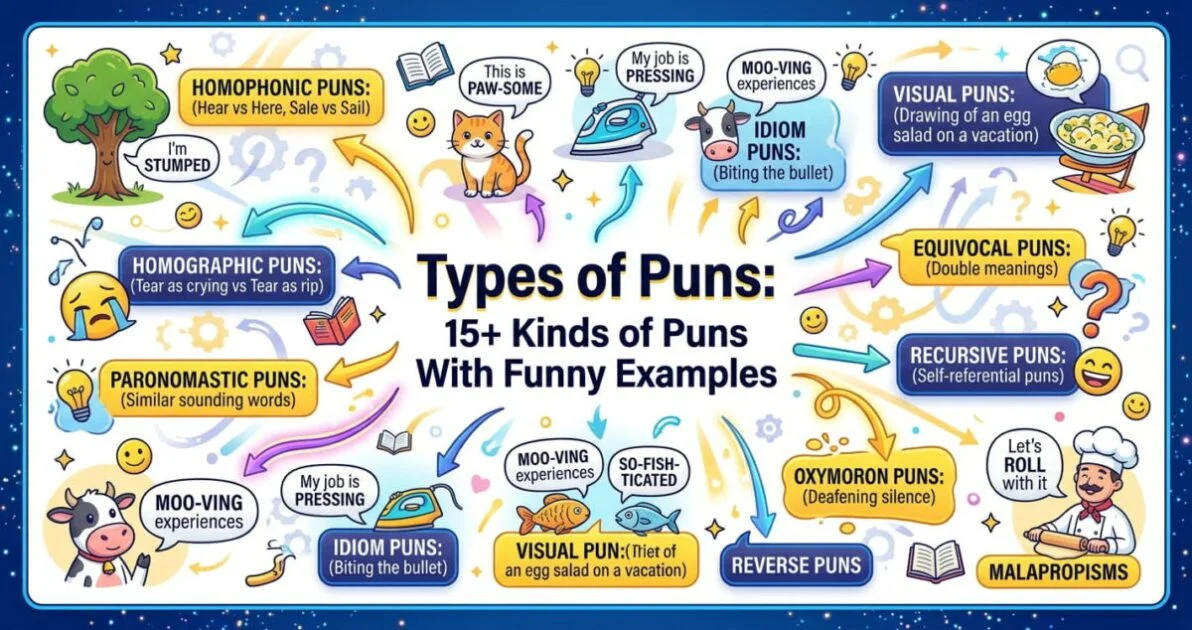
15+ Different Types of Puns
1. Homophonic Puns
Homophonic puns use words that sound the same or very similar but have different meanings or spellings.
They are particularly effective because the listener hears one meaning before realizing another meaning is intended.
Fresh examples:
- The bee’s favorite hairstyle? A buzz cut.
- I wanted to become a knight, but I couldn’t get the armor right.
- The farmer was outstanding in his field of wheat.
- Our electrician friend has a shocking personality.
Homophonic puns are among the most common forms of everyday wordplay.
2. Homographic Puns
A homographic pun uses a word that is spelled the same but can have different meanings.
The spelling stays the same, but the context changes how we understand the word.
Fresh examples:
- The baseball player went to the store for a new bat.
- The seal performed beautifully, then signed the contract.
- The artist drew a picture of a crane lifting a crane.
- The duck had a bill but absolutely no invoices.
The humor comes from one spelling opening the door to two different meanings.
3. Homonym Puns
Homonym puns exploit words that share a spelling or pronunciation but have different meanings.
Fresh examples:
- The palm reader couldn’t stop working with her hands.
- The mouse loved the computer because it finally found a house-sized screen.
- The pitcher had no idea whether to throw the ball or pour the lemonade.
- The barkeeper was great with trees but terrible with drinks.
Homonym puns work best when the sentence naturally supports both meanings.
4. Double-Meaning Puns
A double-meaning pun uses a word or phrase that can be interpreted in two different ways.
Fresh examples:
- The librarian had a novel approach to every problem.
- The chef had a lot on his plate this week.
- The gardener finally turned over a new leaf.
- The tailor made a few cutting remarks.
The reader initially follows one interpretation before discovering another.
5. Compound Puns
Compound puns combine multiple words or wordplay elements to create a humorous expression.
Fresh examples:
- The vegetable band was looking for a good beet.
- The potato became famous because it was a real couch spud.
- The mushroom was invited everywhere because he was such a fun guy.
- The baker was feeling crumby after a difficult morning.
Compound puns are especially popular in food, animal, and seasonal humor.
6. Visual Puns
A visual pun combines an image or physical situation with words to create the joke.
For example, imagine a picture of a pencil lying completely flat with the caption:
This pencil has lost its point.
The visual reinforces the literal meaning of the phrase.
More fresh visual pun ideas:
- A picture of a broken clock labeled “It’s having a hard time.”
- A photograph of a potato wearing sunglasses captioned “Spuddenly famous.”
- A picture of a book standing on a scale captioned “A weighty read.”
- A picture of a tired-looking battery captioned “Running on low expectations.”
Visual puns are particularly effective for memes, posters, advertisements, and social media.
7. Idiom-Based Puns
These puns take a familiar idiom and give it a literal or unexpected twist.
Fresh examples:
- The photographer really knows how to focus on the bright side.
- The baker decided to rise above the competition.
- The gardener needed to get to the root of the problem.
- The musician finally struck the right chord with everyone.
Because the original expressions are familiar, readers quickly recognize the twist.
8. Literal Puns
A literal pun takes a figurative expression and interprets it literally.
Fresh examples:
- The football coach told his team to keep their heads in the game, so they brought helmets to lunch.
- The detective wanted to break the case, so he brought a hammer.
- The student was told to hit the books, so he apologized to the library.
- The manager asked everyone to stay on track, so they moved their meeting to a railway station.
The joke comes from treating a nonliteral expression as if it were a real physical instruction.
9. Malapropism Puns
A malapropism occurs when someone accidentally uses a word that sounds similar to the intended word but has a completely different meaning.
Fresh examples:
- The chef was a real humanitarian—he gave everyone extra human-shaped cookies.
- The student wanted to become a vegetarian because she loved vegetables, especially vegetarians.
- The mayor promised to fight urban pollution with great enthusiasm and several confusions.
- He said the new restaurant had a very prestigious menu—apparently, he meant delicious.
Malapropisms are funny because the wrong word creates an unexpected mental image.
10. Portmanteau Puns
A portmanteau blends parts of two words to create a new word.
Some everyday examples include:
- Breakfast + lunch = brunch
- Smoke + fog = smog
- Motor + hotel = motel
Puns can build on this technique to create playful new words.
Fresh examples:
- Snackcident = snack + accident — when you accidentally eat the entire bag.
- Bookaholic = book + alcoholic — someone hopelessly addicted to reading.
- Chillax = chill + relax — the official language of doing absolutely nothing.
- Workcation = work + vacation — when your laptop refuses to take a holiday.
Portmanteau wordplay is useful when you want to invent a catchy and memorable expression.
11. Typographical Puns
Typographical puns play with letters, punctuation, spacing, or the written appearance of words.
Fresh examples:
- I’m a big fan of punctuation.
- Let’s give them a round of a-paws.
- You’re pawsitively amazing.
- This sentence is going places—it’s got a lot of space.
These puns often work particularly well in written content because the visual form of the word contributes to the joke.
12. Semantic Puns
A semantic pun relies on a word having multiple related or unrelated meanings.
Fresh examples:
- The history teacher loved telling stories because he had a lot of dates.
- The photographer had a negative attitude toward film.
- The gardener’s career really took root.
- The scientist had a solution to every problem.
The humor comes from switching between different meanings of the same word.
13. Phonetic Puns
Phonetic puns depend primarily on pronunciation. A word or phrase sounds like another expression, even though its spelling may be completely different.
Fresh examples:
- The ocean is really shore of itself.
- The sheep told a baaad joke at dinner.
- The horse opened a neighborhood neigh-borhood watch.
- The cat had a purr-fect response.
Phonetic puns are especially common in animal jokes because animal sounds provide plenty of opportunities for playful substitutions.
14. Paronymic Puns
Paronymic puns use words that sound or look similar but have different meanings.
The words aren’t necessarily identical in sound, which gives the writer more flexibility.
Fresh examples:
- The magician had a spell-binding career.
- The cyclist was tired of all the wheel drama.
- The chef’s career was really cooking.
- The mathematician had a calculating personality.
The similarity between words or expressions creates the connection.
15. Reversal Puns
A reversal pun changes the expected relationship between words or ideas to create an unexpected meaning.
Fresh examples:
- I told my suitcase there would be no vacation this year. Now I’m dealing with emotional baggage.
- The calendar’s days are numbered, and it knows it.
- The elevator broke down, so everyone had to take steps to solve the problem.
- The marathon runner couldn’t stop because he was already running out of excuses.
These jokes often take an expected phrase and turn its logic around.
16. Recursive Puns
A recursive pun refers back to itself or depends on an earlier part of the joke to make sense.
These are usually more complex than simple wordplay.
Fresh example:
I wrote a joke about a recursive pun, but you’ll have to read the joke about the recursive pun before you understand this one.
Another playful example:
This pun explains itself, but only after you understand why it needs explaining.
Recursive puns are more common in programming, mathematics, literature, and geek humor.
17. Contextual Puns
A contextual pun becomes funny because of the particular situation in which a word is used.
The same sentence might not be funny without the surrounding context.
Fresh examples:
- The gardener was promoted because he had excellent growth potential.
- The dentist became a successful manager because he knew how to handle the root issues.
- The chef never panicked because he always knew how to handle the heat.
- The astronaut was a great employee because he always went above and beyond.
The profession or situation gives the word its second humorous meaning.
Types of Puns at a Glance
| Pun Type | What It Uses | Fresh Example |
| Homophonic | Similar sounds | “Knight” / “night” |
| Homographic | Same spelling | “Bat” |
| Homonym | Same word form, different meaning | “Pitcher” |
| Double Meaning | Two interpretations | “A lot on his plate” |
| Compound | Multiple wordplay elements | “Couch spud” |
| Visual | Image + language | “Lost its point” |
| Idiom-Based | Familiar expressions | “Rise above” |
| Literal | Literal interpretation | “Hit the books” |
| Malapropism | Similar-sounding wrong word | Deliberate word substitution |
| Portmanteau | Blended words | “Snackcident” |
| Typographical | Letters/formatting | “A-paws” |
| Semantic | Multiple meanings | “Dates” |
| Phonetic | Pronunciation | “Neigh-borhood” |
| Paronymic | Similar words | “Spell-binding” |
| Reversal | Unexpected logical twist | “Emotional baggage” |
| Recursive | Self-reference | Recursive joke |
| Contextual | Situation-specific meaning | “Handle the heat” |
What Is the Most Popular Type of Pun?
There isn’t one official “most popular” type of pun. However, homophonic, double-meaning, phonetic, and idiom-based puns are especially common because they are easy to understand and can be adapted to almost any topic.
For example:
The baker kneaded a vacation.
The word “kneaded” sounds like “needed,” while also connecting naturally with baking. The joke is short, understandable, and immediately tied to the subject.
Why Are There So Many Types of Puns?
Language gives comedians and writers countless opportunities for wordplay. A single word can have several meanings, two words can sound identical, an expression can be interpreted literally, or a spelling change can create an entirely new idea.
That’s why puns aren’t limited to one formula.
Sound → homophonic and phonetic puns
Meaning → semantic and double-meaning puns
Spelling → typographical puns
Phrases → idiom-based and literal puns
Images → visual puns
Word combinations → compound and portmanteau puns
Once you understand these patterns, creating your own puns becomes much easier.
How to Make a Good Pun
Want to create your own clever wordplay? Try these simple steps.
1. Pick a Topic
Start with something familiar:
- Animals
- Food
- Sports
- School
- Work
- Technology
- Travel
- Holidays
2. Make a Word List
Write down words connected with your topic.
For example, for coffee:
bean, brew, roast, mug, grounds, cup, latte, steam
3. Look for Multiple Meanings
Ask yourself:
- Does this word sound like another word?
- Does it have another meaning?
- Can I split it into two words?
- Is it part of a common phrase?
- Can I take that phrase literally?
4. Twist a Familiar Expression
Take something people already know and give it a new ending.
5. Keep the Punchline Short
A good pun usually doesn’t need a long explanation. The faster the reader recognizes the twist, the stronger the joke tends to feel.
Pun vs. Wordplay: What’s the Difference?
Wordplay is the broader category of clever language manipulation. It includes puns but can also involve anagrams, spoonerisms, rhymes, riddles, word reversals, and other linguistic techniques.
A pun specifically uses similarities or multiple meanings in words or phrases to create a humorous or clever effect.
Think of it this way:
Wordplay = the big umbrella.
Puns = one popular type underneath it.
Final Thoughts
There are many types of puns, and each one uses language in a slightly different way. Some rely on pronunciation, some on multiple meanings, while others twist idioms, spelling, visual cues, or familiar phrases.
The easiest way to master puns is to pay attention to words that have more than one meaning or sound like something else. Once you start spotting those opportunities, you’ll quickly discover that almost any topic can become the setup for a clever joke.
And remember: if your first pun isn’t funny, don’t worry. Give it another word.
Frequently Asked Questions About Types of Puns
How many types of puns are there?
There is no universally agreed number. Different writers and linguists classify puns differently, but common categories include homophonic, homographic, semantic, phonetic, visual, double-meaning, idiom-based, literal, and portmanteau puns.
What are the main types of puns?
Some of the most commonly discussed types include homophonic, homographic, homonym, semantic, phonetic, double-meaning, visual, literal, idiom-based, and compound puns.
What is an easy example of a pun?
A simple example is:
The baker kneaded a break.
“Kneaded” sounds like “needed,” while “break” relates to taking time off. The two meanings create the wordplay.
Are puns always jokes?
No. Puns can be used in advertising, headlines, book titles, brand names, captions, poems, signs, riddles, and everyday conversation. They don’t always have to produce a traditional joke.
What makes a pun funny?
A pun usually becomes funny when the reader expects one meaning but suddenly recognizes another. The surprise, ambiguity, and clever connection create the humorous effect.
Are puns and wordplay the same?
No. A pun is a form of wordplay, but wordplay includes many techniques that aren’t technically puns.

William is a Master’s degree holder in English Language and Literature, a passionate word enthusiast, and the founder of PunandPuns.com. He loves exploring creative wordplay and sharing humorous content that brings joy, laughter, and a fresh perspective to everyday language.


