This article will vividly define a difference betwwn puns and non puns jokes as humor comes in many forms, but two of the most commonly confused types are puns and non-pun jokes. While both are designed to make people laugh, they achieve that goal in very different ways. Some jokes rely on clever wordplay, while others depend on funny situations, unexpected twists, or surprising punchlines. This article will clear all differences between pun and non-pun jokes.
Understanding the difference between a pun and a non-pun joke can help you appreciate comedy on a deeper level. Whether you’re a fan of witty one-liners, dad jokes, stand-up comedy, or funny social media captions, knowing how these humor styles work will make it easier to identify and create them yourself.
In this guide, you’ll learn what puns are, what non-pun jokes are, how they differ, and why people enjoy both forms of humor. You’ll also find plenty of examples that clearly demonstrate the key differences. By the end of this article, you’ll never confuse a pun with a regular joke again.
What Is a Pun?
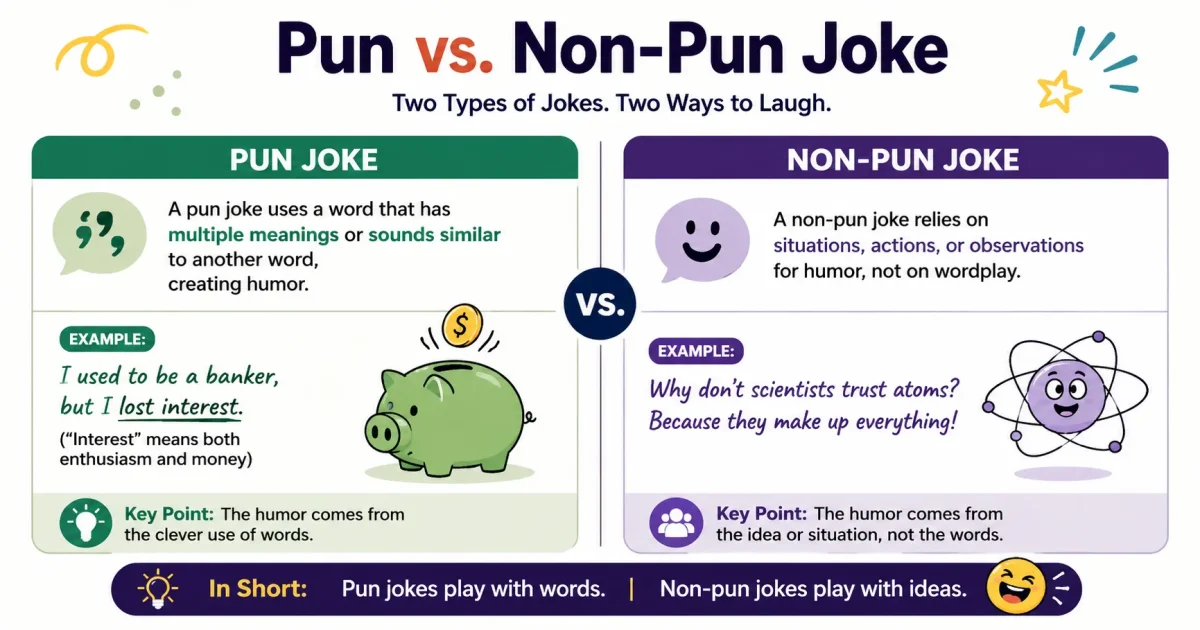
A pun is a type of joke that uses wordplay to create humor. The comedy comes from words that have multiple meanings or words that sound alike but have different meanings.
Puns are often short, clever, and designed to make the listener think for a moment before understanding the joke.
Example 1
The painter never feared failure because every mistake was just another stroke of luck.
“Stroke” refers to a brushstroke and an event of chance.
Example 2
Time flies like an arrow. Fruit flies like a banana.
The humor comes from the different meanings of the word “flies.”
Key Characteristics of Puns
- Depend on wordplay
- Often involve double meanings
- Usually short and clever
- Create an “aha” moment
- Common in dad jokes and captions
What Is a Non-Pun Joke?
A non-pun joke creates humor without relying on wordplay. Instead, it uses situations, observations, exaggeration, irony, or an unexpected punchline.
The joke is funny because of what happens, not because of how words are used.
Example 1
Why don’t skeletons fight each other?
Because they don’t have the guts.
Example 2
Why did the scarecrow win an award?
Because he was outstanding in his field.
Although this joke contains a slight double meaning, the humor mainly comes from the funny image created by the situation.
Key Characteristics of Non-Pun Jokes
- Focus on situations
- Depend on punchlines
- Often tell a mini story
- Easier to understand
- Common in stand-up comedy
Difference Between Pun and Non-Pun Joke at a Glance
| Feature | Pun | Non-Pun Joke |
|---|---|---|
| Uses wordplay | Yes | No |
| Depends on double meanings | Usually | Rarely |
| Length | Usually short | Short or long |
| Main source of humor | Language | Situation |
| Requires interpretation | Often | Less often |
| Popular in | Dad jokes, captions | Stand-up, storytelling |
The biggest difference is simple:
Puns are funny because of words.
Non-pun jokes are funny because of situations.
How Puns Work
Puns rely on language tricks. They often use:
Homophones
Words that sound alike but have different meanings.
Example:
I scream, you scream, we all scream for ice cream.
Homonyms
Words with multiple meanings.
Example:
A bicycle can’t stand on its own because it is two-tired.
Double Meanings
Example:
The calendar’s days are numbered.
The phrase has both a literal and figurative meaning.
How Non-Pun Jokes Work
Non-pun jokes create laughter through surprise and storytelling.
Setup and Punchline
Every traditional joke has two parts:
- Setup
- Punchline
Example:
Why did the chicken cross the road?
To get to the other side.
Unexpected Twists
The audience expects one outcome but receives another.
Relatable Situations
Many non-pun jokes are based on everyday experiences.
Example:
My wallet is like an onion.
Opening it makes me cry.
15 Examples of Puns
- I know a lot of jokes about retired people, but none of them work.
- I used to be addicted to soap, but I’m clean now.
- I wondered why the baseball was getting bigger. Then it hit me.
- I used to play piano by ear, but now I use my hands.
- I stayed up all night wondering where the sun went. Then it dawned on me.
- The magician drove down the road and turned into a driveway.
- Broken pencils are pointless.
- A boiled egg every morning is hard to beat.
- I’m reading a book about anti-gravity. It’s impossible to put down.
- The shovel was a groundbreaking invention.
- The bakery burned down. Business is toast.
- The scarecrow got promoted because he was outstanding in his field.
- I have a fear of speed bumps, but I’m slowly getting over it.
- A bicycle can’t stand alone because it’s two-tired.
- The electrician had a shocking personality.
15 Examples of Non-Pun Jokes
- Why don’t scientists trust atoms? Because they make up everything.
- Why did the chicken join a band? Because it had drumsticks.
- What do you call a bear with no teeth? A gummy bear.
- Why did the golfer bring two pairs of pants? In case he got a hole in one.
- What do you call fake spaghetti? An impasta.
- Why did the cookie visit the doctor? It felt crummy.
- Why was six afraid of seven? Because seven ate nine.
- Why did the tomato blush? It saw the salad dressing.
- What do you call a sleeping bull? A bulldozer.
- Why did the computer get cold? It left its Windows open.
- Why was the broom late? It swept in.
- Why don’t eggs tell secrets? They might crack.
- Why did the coffee file a police report? It got mugged.
- Why did the student eat his homework? The teacher said it was a piece of cake.
- Why did the belt get arrested? It held up a pair of pants.
Why People Enjoy Puns
Puns have remained popular for centuries because they challenge the brain while delivering humor. When someone hears a pun, they often need a moment to recognize the double meaning or wordplay. That tiny mental puzzle creates a satisfying “aha!” moment that makes the joke memorable.
People enjoy puns because they:
- Encourage creative thinking
- Make language more entertaining
- Create memorable punchlines
- Work well in conversations
- Are perfect for social media captions
Many businesses, comedians, and marketers use puns because they are catchy and easy to remember.
Example
“I used to be a banker, but I lost interest.”
The humor comes from the double meaning of the word “interest.”
Why People Enjoy Non-Pun Jokes
Unlike puns, non-pun jokes don’t require wordplay. Instead, they create laughter through storytelling, surprise, exaggeration, or relatable situations.
Non-pun jokes are often easier for a wider audience to understand because they don’t depend on specific language tricks.
People enjoy non-pun jokes because they:
- Feel more natural
- Tell funny stories
- Create unexpected twists
- Are easier to understand
- Work across different cultures
Example
A man walks into a library and asks for a burger.
The librarian says, “Sir, this is a library.”
The man whispers, “Sorry, can I have a burger?”
The humor comes from the situation, not wordplay.
Which Is Funnier: Puns or Non-Pun Jokes?
There is no universal winner because humor is subjective.
Some people love puns because they appreciate clever language and wordplay. Others prefer traditional jokes because they create stronger visual images and tell more engaging stories.
Puns Are Better For:
- Wordplay lovers
- Social media captions
- Greeting cards
- Dad jokes
- Quick laughs
Non-Pun Jokes Are Better For:
- Storytelling
- Stand-up comedy
- Group conversations
- Comedy shows
- Longer humor formats
The best comedians often combine both styles.
Common Mistakes People Make When Identifying Puns
Many people confuse puns with regular jokes. Here are the most common mistakes.
Mistake 1: Assuming Every Joke Is a Pun
Not all jokes use wordplay.
Example:
Why did the cookie go to the doctor?
Because it felt crummy.
This is a joke, but not a true pun.
Mistake 2: Confusing Wordplay With Storytelling
If the humor comes from a funny situation rather than a word’s meaning, it’s usually a non-pun joke.
Mistake 3: Thinking Puns Must Be Funny
Some puns are intentionally groan-worthy.
That’s why people often call them “dad jokes.”
Mistake 4: Ignoring Double Meanings
A true pun almost always relies on a word having more than one meaning.
More Examples of Puns
These examples highlight how puns depend on language, double meanings, and clever wordplay. Each joke uses words in a creative way to produce humor.
16.
The bicycle couldn’t stand up because it was two-tired.
17.
The dentist had a filling experience.
18.
The musician got into treble.
19.
The bakery owner kneaded a vacation.
20.
The fisherman was hooked on his hobby.
21.
The clock factory workers worked around the clock.
22.
The candle shop burned through its inventory.
23.
The gardener rooted for his plants.
24.
The librarian was completely booked.
25.
The chef couldn’t beet his competition.
26.
The photographer developed a good reputation.
27.
The tailor was suited for the job.
28.
The electrician was shocked by the news.
29.
The painter brushed off criticism.
30.
The actor always played his part.
These examples show how puns use language itself as the source of humor, often creating a clever “double meaning” effect.
More Examples of Non-Pun Jokes
Unlike puns, these jokes rely on funny situations, surprising punchlines, and relatable scenarios rather than wordplay.
16.
Why don’t oysters donate to charity?
Answer: Because they’re shellfish.
17.
Why did the math teacher wear sunglasses?
Answer: Because her students were so bright.
18.
Why did the golfer bring an extra sock?
Answer: In case he got a hole in one.
19.
Why was the computer tired?
Answer: It had too many tabs open.
20.
Why don’t scientists trust stairs?
Answer: They’re always up to something.
21.
Why did the tomato turn red?
Answer: Because it saw the salad dressing.
22.
Why did the student bring a ladder to school?
Answer: Because he wanted to go to high school.
23.
Why did the frog take the bus?
Answer: His car got toad away.
24.
Why did the coffee call the police?
Answer: It got mugged.
25.
Why was the broom late?
Answer: It swept in.
26.
Why don’t eggs tell jokes?
Answer: They’d crack each other up.
27.
Why did the scarecrow get promoted?
Answer: Because he did a great job.
28.
Why did the cookie cry?
Answer: Its mother was a wafer too long.
29.
Why did the chicken join a band?
Answer: Because it had drumsticks.
30.
Why did the pencil lose the race?
Answer: It wasn’t sharp enough.
These non-pun jokes create humor through funny situations, surprise endings, and classic punchlines rather than relying on wordplay.
It wasn’t sharp enough.
Real-Life Uses of Puns
Puns are commonly used in:
- Advertising slogans
- Greeting cards
- Social media captions
- Blog headlines
- Business names
- Brand marketing
Examples include:
- “Olive You” for food-themed gifts
- “Lettuce Celebrate” for party invitations
- “You’re One in a Melon” for friendship cards
Because puns are memorable, they are often used to increase engagement and brand recognition.
Real-Life Uses of Non-Pun Jokes
Non-pun jokes are common in:
- Stand-up comedy
- Sitcoms
- Funny stories
- Movies
- Workplace humor
- Public speaking
They help speakers connect with audiences through relatable experiences rather than clever wordplay.
Conclusion
Understanding the difference between a pun and a non-pun joke can help you appreciate humor in all its forms. While puns rely on clever wordplay, double meanings, and linguistic creativity, non-pun jokes focus on situations, storytelling, and surprise punchlines.
Neither style is better than the other. Some people enjoy the cleverness of a well-crafted pun, while others prefer the straightforward laughter that comes from a traditional joke. In reality, the best humor often combines elements of both.
The next time you hear a joke, take a moment to ask yourself what makes it funny. Is it the words themselves, or is it the situation behind them? Once you understand the difference between pun and non-pun joke styles, you’ll be able to spot the techniques comedians, writers, and marketers use every day.
Whether you love clever wordplay or classic punchlines, one thing is certain: laughter never goes out of style.
Frequently Asked Questions
What is the main difference between a pun and a non-pun joke?
A pun creates humor through wordplay, double meanings, or similar-sounding words. A non-pun joke creates humor through situations, storytelling, observations, or unexpected punchlines.
Is every dad joke a pun?
No. Many dad jokes are puns, but some rely on simple punchlines or funny situations rather than wordplay.
Are puns considered intelligent humor?
Many people view puns as a form of clever humor because they require the audience to recognize multiple meanings within words or phrases.
Which type of humor is more popular?
Both are popular. Puns often perform well online and in written content, while non-pun jokes tend to work better in conversations and stand-up comedy.
Can a joke be both a pun and a non-pun joke?
Yes. Some jokes combine wordplay with a funny situation, making them a hybrid form of humor.

William is a Master’s degree holder in English Language and Literature, a passionate word enthusiast, and the founder of PunandPuns.com. He loves exploring creative wordplay and sharing humorous content that brings joy, laughter, and a fresh perspective to everyday language.


