Language has a funny way of bending its own rules, and few examples prove that better than pun vs idiom. Both twist words in clever ways, yet they work toward completely different goals. If you’ve ever mixed up a pun with an idiom, you’re far from alone.
Understanding the difference between a pun and an idiom isn’t just useful for English learners. It sharpens your writing, boosts your humor, and helps you catch meanings that go beyond the literal words on the page.
What Is a Pun?
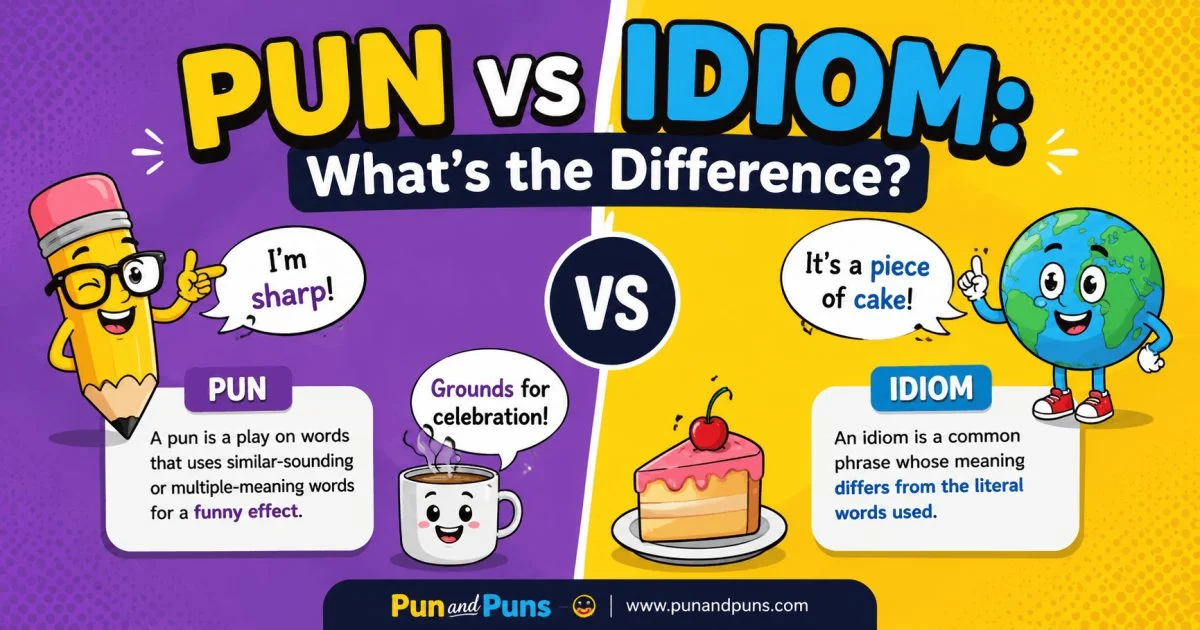
A pun is a play on words that relies on multiple meanings or similar-sounding words to create humor or wit. It often catches people off guard, which is exactly why it works so well in jokes, headlines, and casual conversation.
How Puns Work
Puns typically exploit one of two things:
- Homophones — words that sound alike but have different meanings, like “flower” and “flour.”
- Polysemy — a single word with multiple related meanings, like “bright” meaning both intelligent and full of light.
When a writer uses these overlaps intentionally, the result is a small burst of surprise. That surprise is what makes a pun land as clever rather than confusing.
Examples of Puns
- “I used to be a banker, but I lost interest.”
- “The gardener quit because his heart wasn’t in it, but his soul was still growing on him.”
- “I stayed up all night wondering where the sun went, then it dawned on me.”
- “The baker stopped making donuts because he was tired of the hole thing.”
- “A bicycle can’t stand on its own because it’s two-tired.”
Each example uses a double meaning to create a small twist. The humor comes from the moment your brain processes both meanings at once.
What Is an Idiom?
An idiom is a fixed expression whose meaning cannot be understood by looking at the individual words alone. Native speakers use idioms constantly, often without even noticing how strange the phrases sound when taken literally.
How Idioms Work
Idioms function as a single unit+ of meaning. You can’t swap out words or rearrange them without losing the intended sense. This is what linguists call “non-compositionality,” meaning the phrase’s meaning doesn’t come from adding up its parts.
For example, “kick the bucket” has nothing to do with kicking or buckets. It simply means to die. Someone unfamiliar with English idioms would have no way to guess that meaning from the words themselves.
Examples of Idioms
- “Break the ice” — to ease tension in a social situation.
- “Under the weather” — feeling sick.
- “Spill the beans” — to reveal a secret.
Idioms like these are memorized as whole phrases rather than built word by word. That’s part of what makes them tricky for language learners.
Pun vs Idiom: Key Differences
While both puns and idioms bend the usual rules of language, they serve very different purposes and follow different internal logic.
Purpose
- A pun exists to entertain, surprise, or add wit.
- An idiom exists to communicate a specific, agreed-upon meaning efficiently.
Literal Meaning
- Puns depend on literal meaning being present and recognizable, since the humor comes from noticing two meanings at once.
- Idioms deliberately abandon literal meaning altogether in favor of a figurative one.
Flexibility
- Puns are often invented on the spot and can be highly creative or situational.
- Idioms are fixed expressions passed down through common usage, and changing the wording usually breaks the phrase.
Predictability
- Puns are unpredictable by design; the surprise is the point.
- Idioms are predictable once learned, since native speakers already know what they mean.
Why People Confuse Puns and Idioms
Both puns and idioms fall under the broader umbrella of figurative language, which is likely why they get mixed up. They also share a few surface-level traits.
- Both can appear in casual speech and writing.
- Both often confuse non-native speakers.
- Both rely on shared cultural or linguistic knowledge.
The key distinction to remember is this: a pun plays with meaning to create humor, while an idiom replaces literal meaning with an agreed-upon figurative one.
How to Use Puns and Idioms Effectively
Knowing the difference is one thing, but using each correctly in your own writing or speech takes a bit of practice.
Tips for Using Puns
- Keep the double meaning clear enough that readers can catch it quickly.
- Use puns sparingly so they retain their surprise factor.
- Match the tone of your pun to your audience, since not every setting welcomes wordplay.
Tips for Using Idioms
- Learn idioms in context rather than word by word.
- Avoid translating idioms literally into another language, since the meaning rarely survives the translation.
- Use idioms naturally in conversation to sound more fluent, but don’t overload a single sentence with too many at once.
Common Mistakes to Avoid
- Assuming an idiom’s meaning based on its literal words.
- Forcing a pun where the double meaning isn’t clear to the audience.
- Mixing metaphors and idioms incorrectly, which can confuse the intended message.
- Overusing puns in professional writing, where clarity usually matters more than wit.
Avoiding these pitfalls helps both your humor and your communication land the way you intend.
Final Thoughts
Puns and idioms both add color and personality to language, but they do so in different ways. A pun surprises you with a clever twist on meaning, while an idiom quietly carries a meaning of its own that has nothing to do with its literal words. Once you can tell them apart, both become powerful tools for clearer, more expressive communication.
Frequently Asked Questions
Is a pun a type of idiom?
No, a pun is not a type of idiom. Puns rely on wordplay and multiple meanings for humor, while idioms are fixed expressions with figurative meanings unrelated to wordplay.
Can a phrase be both a pun and an idiom?
It’s rare, but some expressions can blur the line if they started as puns and later became fixed phrases through repeated use. In general, though, the two categories pun vs idiom remain distinct.
Why are idioms hard for language learners?
Idioms are difficult because their meaning can’t be figured out from the individual words. Learners have to memorize each idiom as a whole phrase along with its context.
Do puns exist in every language?
Most languages have some form of wordplay, though the specific puns depend on that language’s sounds and vocabulary. A pun that works in English often won’t translate directly into another language.
What’s an easy way to spot a pun?
Look for a word or phrase that could be interpreted two different ways at once. If noticing that double meaning makes you smile or groan, it’s likely a pun.
Are idioms considered formal or informal language?
Idioms can appear in both formal and informal contexts, though many feel more natural in everyday conversation. Some idioms carry a casual tone, while others are common even in professional writing.
How can I improve my understanding of idioms?
Reading widely, watching shows in the target language, and paying attention to context are all effective ways to learn idioms naturally. Keeping a personal list of new idioms with their meanings and example sentences also helps reinforce them over time.

William is a Master’s degree holder in English Language and Literature, a passionate word enthusiast, and the founder of PunandPuns.com. He loves exploring creative wordplay and sharing humorous content that brings joy, laughter, and a fresh perspective to everyday language.


