Words can be funny, clever, and surprisingly tricky. Understanding pun vs double entendre helps you see why some expressions create a laugh through wordplay while others work because they carry two possible meanings.
Although puns vs double entendres sometimes overlap, they are not exactly the same thing. The key difference is how the humor or cleverness is created—and what the listener is expected to notice.
What Is a Pun?
A pun is a form of wordplay that uses a word or phrase with multiple meanings, similar-sounding words, or words with related meanings to create a humorous or clever effect.
Puns often depend on ambiguity. The reader or listener recognizes the connection between two meanings or sounds, and that unexpected connection creates the joke.
For example:
I wondered why the baseball kept getting bigger. Then it hit me.
The phrase “hit me” can mean physically hitting someone, but it can also mean suddenly understanding something. The humor comes from the two interpretations.
Common Types of Puns
Puns can work in several ways.
- Homophonic puns: Use words that sound alike but have different meanings, such as “flour” and “flower.”
- Homographic puns: Use words that are spelled the same but have different meanings, such as “bark” from a tree and “bark” from a dog.
- Semantic puns: Play with different meanings or interpretations of a word.
- Compound puns: Combine several word meanings or sound similarities.
- Visual puns: Use an image together with wording to create a second interpretation.
A good pun does not necessarily need a sentence with two complete interpretations. Sometimes a single clever word connection is enough.
What Is a Double Entendre?
A double entendre is an expression that has two different interpretations, usually with one meaning being straightforward and another being humorous, suggestive, ironic, or unexpected.
The phrase literally comes from French and is commonly used in English to describe language with a double meaning.
For example:
The baker said his business was on a roll.
The obvious meaning relates to baked rolls. The second interpretation comes from the expression “on a roll,” meaning to experience continued success.
This example can also function as a pun because the humor depends on a word having connected meanings. However, a double entendre places more emphasis on the existence of two interpretations.
What Makes a Double Entendre Different?
A double entendre generally requires the audience to recognize two possible readings of the same statement.
One meaning may be:
- Literal
- Innocent
- Ordinary
- Surface-level
The other may be:
- Figurative
- Humorous
- Suggestive
- Ironic
- Unexpected
Importantly, a double entendre does not have to be sexual. Although suggestive double meanings are common, the term also applies to innocent forms of ambiguity.
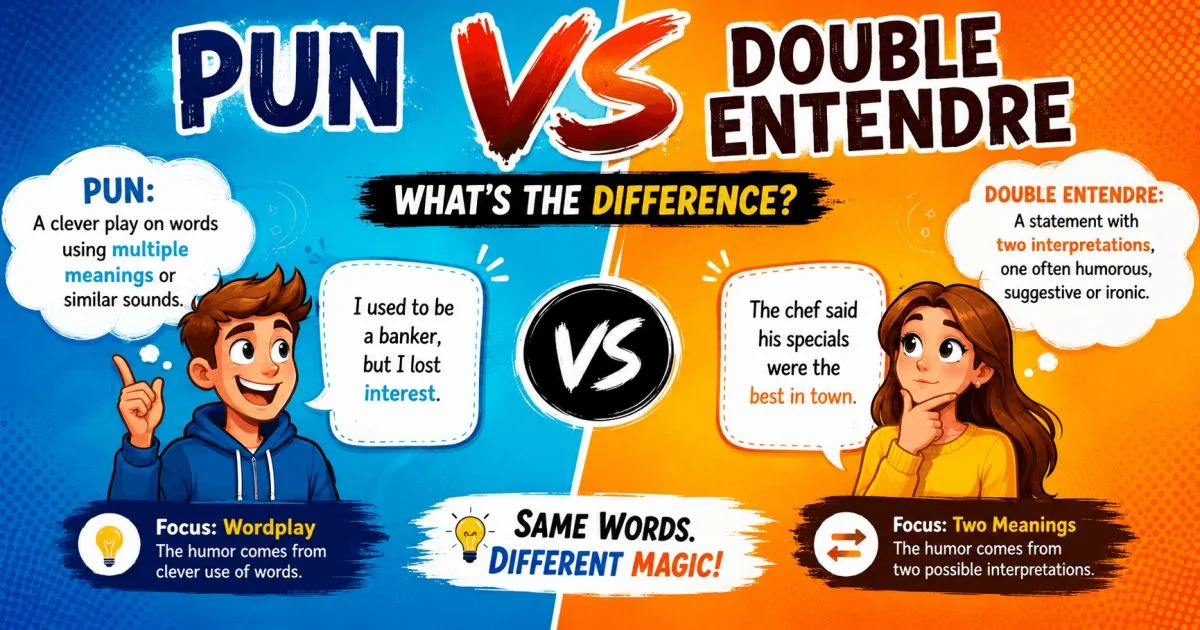
Pun vs Double Entendre: The Main Difference
The simplest way to understand the distinction is this:
A pun is wordplay; a double entendre is a statement with two interpretations.
A pun usually focuses on a clever relationship between words, sounds, spellings, or meanings. A double entendre focuses on a phrase or statement that can reasonably be understood in two different ways.
For example:
I used to be a banker, but I lost interest.
This is primarily a pun. “Interest” can refer to money earned from banking and also to curiosity or enthusiasm.
Now consider:
The fisherman was hooked.
This can have a literal meaning involving a fishhook and a figurative meaning describing someone’s strong interest or attraction. Because the expression supports two interpretations, it can also be described as a double entendre.
The categories can overlap, which is why the terms are sometimes confused.
Pun vs Double Entendre Examples
Looking at examples makes the difference much easier to recognize.
Example 1: Classic Pun
The bicycle couldn’t stand on its own because it was two-tired.
“Two-tired” sounds like “too tired.”
The joke relies on a sound-based wordplay mechanism, making it a straightforward pun.
Example 2: Double Meaning
The musician had a lot of strings attached.
“Strings” can refer literally to musical instrument strings and figuratively to conditions, obligations, or restrictions.
The humor comes from the two meanings of the phrase.
Example 3: A Pun That Is Also a Double Entendre
The gardener had a growing business.
“Growing” relates to plants while also describing a business that is becoming more successful.
This works as a pun because of the wordplay and as a double entendre because the statement supports two interpretations.
Example 4: Another Pun
I wanted to become a calendar maker, but my days were numbered.
“Days were numbered” has an ordinary idiomatic meaning while also connecting directly to a calendar.
The unexpected connection creates the punchline.
Are Puns and Double Entendres the Same?
No. Puns and double entendres are related forms of wordplay, but they are not identical.
A pun can be based primarily on sound similarity without requiring an entire sentence to have two interpretations.
A double entendre, meanwhile, depends on an expression being understood in two ways. Those meanings can come from ambiguity, figurative language, literal language, or wordplay.
The easiest distinction is:
Pun = clever wordplay.
Double entendre = two possible meanings.
Sometimes one joke qualifies as both.
How Puns Work
Puns usually create humor by making the audience notice an unexpected relationship between words.
The process often looks like this:
- The audience hears or reads a familiar word.
- The brain initially interprets it one way.
- Another meaning or sound becomes relevant.
- The two ideas connect unexpectedly.
- The surprise creates the humorous effect.
Consider:
I tried writing a joke about gravity, but it never landed.
“Put down” can mean physically place a book somewhere and can also mean stop reading it.
The joke works because the literal situation collides with the familiar expression.
How Double Entendres Work
Double entendres usually depend on ambiguity.
The speaker creates a statement that can be interpreted in two different ways. The audience recognizes both readings, and the contrast between them produces humor, irony, or cleverness.
A double entendre can therefore be subtle. Sometimes the second meaning is obvious immediately; other times, the audience has to think about the sentence before the second interpretation becomes clear.
This makes double entendres particularly useful in comedy, advertising, literature, headlines, and everyday conversation.
Can a Pun Be a Double Entendre?
Yes.
A single expression can qualify as both a pun and a double entendre when it uses wordplay to produce two distinct interpretations.
For example:
The baker’s career was really taking off.
The phrase “taking off” can suggest progress or success, while the context may give it another literal or figurative interpretation.
In these overlapping cases, pun describes the wordplay technique, while double entendre describes the presence of two meanings.
That distinction is useful when analyzing jokes.
Can a Double Entendre Be a Pun?
Sometimes, but not always.
A double entendre can depend on two meanings without relying on similar sounds, spelling tricks, or particularly clever wordplay.
For example, an ordinary phrase can become a double entendre because the surrounding context gives it an unexpected second interpretation.
So, while many double entendres contain puns, the two concepts should not automatically be treated as synonyms.
The Role of Context
Context is one of the biggest factors separating an ordinary statement from a clever double meaning.
Consider the word “charged.”
It can relate to:
- Asking someone to pay money
- Giving an electrical object energy
- Accusing someone of an offense
- Moving forward aggressively
The surrounding sentence determines which interpretation the audience notices.
A clever writer can deliberately provide enough context to make two meanings possible. That is where ambiguity becomes a useful storytelling or comedic technique.
Pun vs Double Entendre vs Wordplay
These terms are connected, but they describe different levels of language.
Wordplay
Wordplay is the broad category.
It includes creative manipulation of words, sounds, meanings, spelling, grammar, and expressions.
Pun
A pun is a specific type of wordplay that creates an effect through multiple meanings, similar sounds, or related linguistic features.
Double Entendre
A double entendre is an expression that supports two interpretations, often with one meaning being less obvious than the other.
Think of the relationship like this:
Wordplay → broad category
Pun → one type of wordplay
Double entendre → an expression built around two interpretations
Because categories can overlap, a joke may fit more than one description.
Pun vs Double Entendre vs Double Meaning
The phrase double meaning is broader than double entendre.
A sentence has a double meaning when it can reasonably be interpreted in two ways. A double entendre is a particular expression or rhetorical device that deliberately exploits that ambiguity.
For example, an advertisement might use an innocent phrase that also has a playful second interpretation. That would be a double entendre, while “double meaning” simply describes the linguistic feature.
In everyday conversation, people often use these terms loosely, but literary and linguistic analysis benefits from keeping the distinctions clear.
Why Do People Find These Devices Funny?
Both puns and double entendres often rely on surprise.
People expect language to communicate one clear idea. When a phrase suddenly reveals another interpretation, the unexpected shift can produce amusement.
Other factors can contribute to the humor:
- Surprise
- Ambiguity
- Timing
- Context
- Familiar expressions
- Unexpected associations
- Cultural knowledge
- Clever phrasing
The same joke may work brilliantly for one audience and fall flat for another because humor depends partly on shared language and context.
How to Tell Whether Something Is a Pun or Double Entendre
When you encounter a clever sentence, ask yourself a few questions.
1. Is the joke based mainly on a word?
If the humor comes from a word having different meanings or sounding like another word, it is probably a pun.
2. Does the entire expression have two interpretations?
If the sentence can naturally be understood in two different ways, it may be a double entendre.
3. Are both meanings important?
If the joke depends on the audience noticing both meanings, double entendre is a strong description.
4. Do the categories overlap?
If the sentence uses wordplay and creates two interpretations, it can reasonably be both.
This approach is more useful than trying to force every joke into a single category.
How Writers Use Puns and Double Entendres
Writers use these techniques for more than simple jokes.
They can make content:
- More memorable
- More entertaining
- More concise
- More playful
- More thought-provoking
- More engaging
Puns are especially common in headlines, names, captions, advertisements, comedy, and social media.
Double entendres can create a second layer of meaning without explaining the joke directly. This allows readers to discover the additional meaning themselves.
Tips for Creating Better Puns
If you want to write your own puns, start with a word that has several meanings.
Look for Words With Multiple Meanings
Words such as “current,” “match,” “light,” “bark,” “scale,” and “pitch” can lead to multiple interpretations.
Think About Similar Sounds
Homophones can create strong pun opportunities.
For example:
- Flour / flower
- Sea / see
- Sole / soul
- Night / knight
- Pair / pear
Combine Literal and Figurative Meanings
Idioms are excellent sources of pun ideas because they already contain figurative language.
A phrase can become funny when its literal meaning is suddenly introduced into the situation.
Keep the Punchline Clear
A clever pun should not require a paragraph of explanation.
If readers cannot identify the connection after a moment of thought, simplify the wording.
Tips for Creating Double Entendres
Creating an effective double entendre requires more than finding a word with multiple meanings.
Start With an Ambiguous Phrase
Choose an expression that naturally supports two interpretations.
Build Context Around Both Meanings
The surrounding sentence should make both readings plausible.
Avoid Forcing the Second Meaning
If the second interpretation requires an unnatural explanation, the joke will usually feel awkward.
Let the Audience Discover It
A strong double entendre often works best when the writer does not explain the second meaning immediately.
The moment of realization is part of the appeal.
Common Mistakes When Confusing Puns and Double Entendres
A few misunderstandings appear frequently.
Mistake 1: Calling Every Double Meaning a Pun
Not every sentence with two meanings is necessarily a pun. A pun usually involves deliberate wordplay.
Mistake 2: Assuming Double Entendres Are Always Sexual
They can be suggestive, but they do not have to be. Double meanings can be completely innocent.
Mistake 3: Treating the Terms as Perfect Synonyms
They overlap, but they describe different characteristics.
Mistake 4: Ignoring Context
A word may have several dictionary definitions without creating a joke. The surrounding context determines whether those meanings actually produce a clever effect.
Why This Difference Matters
Understanding the distinction is useful if you write jokes, captions, headlines, advertisements, stories, or social media content.
Knowing whether you are using a pun or a double entendre also helps you understand why a particular line works. Instead of simply recognizing that something is funny, you can identify the linguistic mechanism behind the humor.
For anyone interested in wordplay, this distinction is one of the foundations of understanding how language can create surprise.
Quick Comparison
Here is the simplest way to remember the difference:
- Wordplay: The broad category of clever language techniques.
- Pun: Wordplay based on multiple meanings, similar sounds, spelling, or related linguistic features.
- Double entendre: An expression deliberately capable of being understood in two ways.
- Double meaning: A broad description of language that has two possible interpretations.
The most important point is that a pun and a double entendre can overlap. One joke can legitimately be both.
Conclusion
The easiest way to remember pun vs double entendre is that a pun focuses on clever wordplay, while a double entendre focuses on two possible interpretations. The two can overlap when wordplay creates a phrase with two meaningful readings. Once you understand the difference, you’ll start spotting the clever mechanics behind jokes, headlines, captions, and everyday expressions.
Frequently Asked Questions
1. What is the difference between a pun and a double entendre?
A pun is a form of wordplay that often uses multiple meanings or similar sounds to create humor. A double entendre is an expression with two possible interpretations, often deliberately designed to make the audience notice both.
2. Can a pun also be a double entendre?
Yes. When a pun creates two distinct interpretations of an expression, it can also function as a double entendre.
3. Are double entendres always sexual?
No. Sexual or suggestive examples are common, but double entendres can be completely innocent. Any deliberately constructed expression with two meaningful interpretations can qualify.
4. Is a double entendre the same as a double meaning?
They are closely related but not identical. “Double meaning” is a broad description, while “double entendre” generally refers to an expression that deliberately exploits two interpretations.
5. What is an example of a simple pun?
“I used to be a banker, but I lost interest” is a simple pun because “interest” refers both to financial interest and personal curiosity or enthusiasm.
6. Why are puns considered wordplay?
Puns manipulate relationships between words, sounds, spellings, or meanings to create a clever effect. That deliberate manipulation makes them a classic form of wordplay.
7. How can I identify a double entendre?
Ask whether the same expression can naturally be understood in two different ways. If both interpretations are intentional and contribute to the humor or meaning, you are likely looking at a double entendre.

William is a Master’s degree holder in English Language and Literature, a passionate word enthusiast, and the founder of PunandPuns.com. He loves exploring creative wordplay and sharing humorous content that brings joy, laughter, and a fresh perspective to everyday language.


