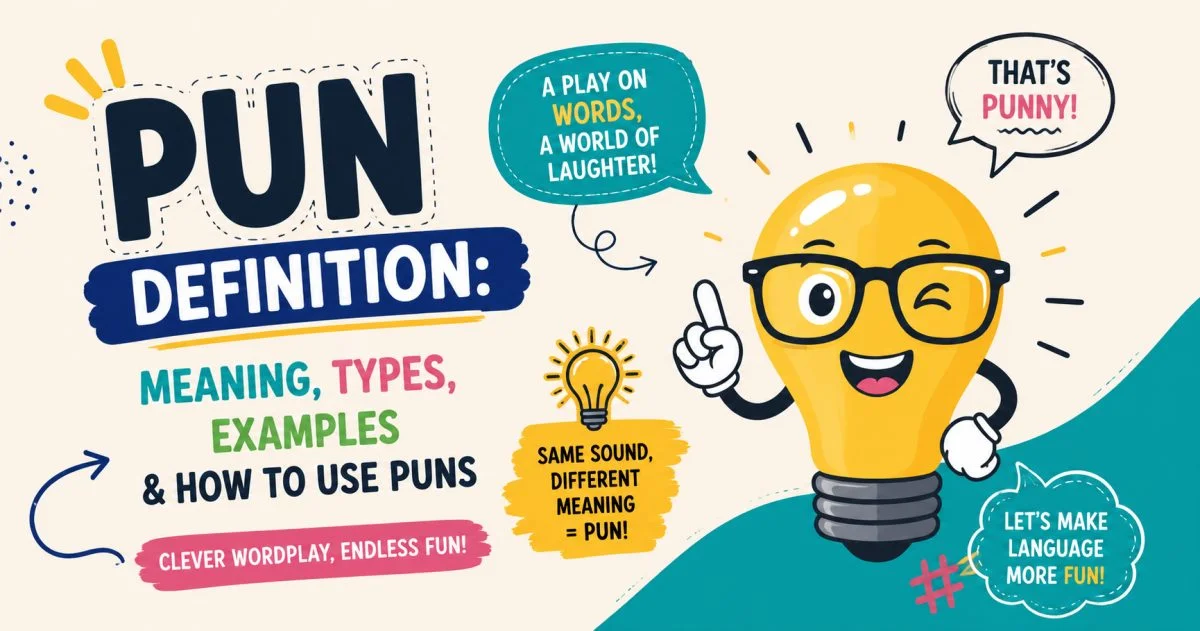
Puns have entertained people for centuries, making conversations, books, advertisements, and social media posts more memorable. If you’ve ever wondered about the pun definition, you’re in the right place. A pun is more than just a clever joke—it is a creative form of wordplay that uses multiple meanings or similar-sounding words to create humor or add depth to language.
Pun Definition
A pun is a form of wordplay that uses multiple meanings, similar sounds, or different interpretations of words to create humor, surprise, or a clever effect. In simple terms, a pun is a play on words.
What Does Pun Mean?
The word pun refers to a clever use of language in which a word or phrase is used in a way that creates two possible meanings or connects words with similar sounds. The two meanings may be literal and figurative, or they may come from different words that sound alike.
For example:
The bicycle couldn’t stand because it was two-tired.
The word “tired” sounds like “tyred”, referring to the bicycle’s tires. The humor comes from connecting the ordinary meaning of “tired” with the physical parts of a bicycle.
How Do You Define a Pun?
To define a pun simply, it is a play on words that creates a humorous or clever effect by exploiting meaning, sound, spelling, or context.
A pun does not always have to be a traditional joke. It can appear in a single sentence, headline, book title, advertisement, conversation, social media caption, or piece of literature.
Pun Definition in Simple Words
In simple words, a pun is a clever play on words that makes you think about a word or phrase in more than one way.
For example:
I wondered why the baseball was getting bigger. Then it hit me.
Here, “hit me” has two interpretations: something suddenly becomes clear to the speaker, while a baseball can literally hit someone.
Dictionary-Style Pun Definition
Pun (noun): A type of wordplay that uses multiple meanings, similar sounds, or different interpretations of words to produce humor, cleverness, or emphasis.
Plural: puns
Related term: wordplay
Example: The baker kneaded a vacation.
In this example, “kneaded” sounds like “needed,” creating a connection between baking and the ordinary expression “needed a vacation.”
Why Are Puns So Popular?
Puns are popular because they reward people for recognizing hidden meanings. When readers or listeners understand the wordplay, they experience a small moment of surprise that often leads to laughter.
There are several reasons why puns remain timeless:
- They are easy to remember.
- They encourage creative thinking.
- They make conversations more enjoyable.
- They work across many forms of writing.
- They add personality to speeches, advertisements, and social media captions.
Because puns rely on language rather than complex storytelling, they can entertain people of all ages.
Pun Definition Explained
Although people often think of puns as simple jokes, linguists and literary experts recognize them as an important rhetorical device. They demonstrate how flexible language can be and how words often carry more than one meaning.
Understanding the pun definition from different perspectives provides a deeper appreciation of why this form of wordplay has remained popular for thousands of years.
Dictionary Definition of a Pun
Most dictionaries define a pun as a humorous use of words that exploits different meanings or similar sounds.
In simple terms, a pun happens when one word—or two similar words—creates two interpretations at the same time. The humor comes from the reader or listener discovering both meanings.
For example:
“The fisherman knew all the best schools.”
The word “schools” refers both to groups of fish and educational institutions. The sentence becomes amusing because both meanings are possible.
Literary Definition of a Pun
In literature, a pun is considered a stylistic device used to add wit, symbolism, or dramatic effect.
Writers often use puns to:
- Reveal a character’s intelligence.
- Add hidden meanings.
- Make dialogue more memorable.
- Create irony.
- Entertain readers while reinforcing themes.
Classic authors frequently included puns because they engage readers on multiple levels. Sometimes the humorous meaning appears immediately, while other interpretations become clear only after careful reading.
Modern Meaning of a Pun
Today, puns are found almost everywhere.
They appear in:
- Social media captions
- Brand slogans
- Advertising campaigns
- Newspaper headlines
- Movie titles
- Greeting cards
- Classroom activities
- Podcasts
- Stand-up comedy
- Everyday conversations
Modern puns often combine popular culture, trending topics, and everyday experiences to create relatable humor. Their ability to spread quickly online has made them even more popular in the digital age.
The History and Origin of Puns
Puns are among the oldest known forms of humor. Historians have found examples of wordplay in ancient Egyptian writings, Sanskrit literature, Chinese poetry, Greek philosophy, and Roman plays.
Long before modern comedy existed, storytellers used puns to entertain audiences while making important ideas easier to remember. Because spoken language was central to early civilizations, clever wordplay became a valuable storytelling tool.
Over time, puns evolved alongside languages, adapting to new words, pronunciations, and cultural references.
Where Did Puns Come From?
The exact origin of puns is impossible to pinpoint because they developed naturally wherever language existed.
Whenever people noticed that two words sounded alike or that one word carried multiple meanings, opportunities for wordplay emerged. This made puns a universal form of humor rather than an invention of any single culture.
Ancient texts from around the world show that people have enjoyed clever language for thousands of years.
Famous Writers Who Used Puns
Many celebrated authors used puns to entertain readers and enrich their writing.
Some of the best-known examples include:
- William Shakespeare, whose plays contain hundreds of puns that add humor and deepen character interactions.
- Geoffrey Chaucer, who incorporated wordplay into medieval English storytelling.
- Oscar Wilde, known for his witty dialogue and clever language.
- Lewis Carroll, whose imaginative writing is filled with playful linguistic twists.
- James Joyce, who experimented with multiple layers of meaning through innovative wordplay.
Their work demonstrates that puns are far more than simple jokes—they can also serve as powerful literary devices that reward attentive readers.
What Makes Something a Pun?
Not every funny sentence is a pun. A pun specifically depends on the way words are used, understood, pronounced, or interpreted.
A sentence is usually considered a pun when it has one or more of these characteristics:
- Multiple meanings: One word has two or more relevant meanings.
- Similar sounds: Two words sound alike or nearly alike but have different meanings or spellings.
- Different interpretations: A sentence can be understood in more than one way.
- Word-based humor: The humor comes primarily from language rather than from a situation or story.
- A clever connection: Two meanings or words are deliberately connected to create an unexpected effect.
For example:
The bicycle couldn’t stand because it was two-tired.
This works as a pun because “two-tired” sounds like “too tired,” while also referring to the bicycle having two tires.
What Is Not a Pun?
A funny sentence is not automatically a pun. A joke can be funny because of a situation, character, story, surprise, or punchline without manipulating the meaning or sound of words.
This distinction helps explain why puns are a type of wordplay, while jokes are a broader form of humor.
Different Types of Puns
Not every pun follows the same formula. Writers have developed many different styles of wordplay, each with its own unique charm. Understanding these varieties will help you appreciate puns more deeply and create your own with greater confidence.
1. Homophonic Puns
Homophonic puns use words that sound alike but carry different meanings.
Examples
- The sailor wanted to sea the world.
- The pear made the perfect pair for dessert.
- The deer wished everyone a happy new year.
These puns are especially popular in spoken conversations because pronunciation is the key to understanding the joke.
2. Homographic Puns
Homographic puns use a single word that has two or more meanings.
Examples
- The crane watched another crane lift steel beams.
- The leaves decided it was time to leave.
- The referee couldn’t object to the object.
The reader enjoys discovering which meaning applies in each part of the sentence.
3. Compound Puns
Compound puns combine two or more separate puns in one sentence.
Examples
- The baker loafed around because business was on a roll.
- The gardener planted jokes that continued to grow on people.
- The musician struck the right chord and tuned into success.
These require a little more creativity but often produce stronger humor.
4. Visual Puns
Visual puns communicate wordplay through images instead of words alone.
Examples include:
- A clock wearing running shoes with the caption “Time flies.”
- A computer wearing glasses labeled “Smart Device.”
- A lemon lifting weights titled “Concentrate.”
Visual puns are widely used in advertising, comics, memes, and greeting cards.
5. Recursive Puns
Recursive puns require the audience to understand one pun before recognizing another hidden joke.
These layered jokes reward readers who enjoy more advanced wordplay.
Example
The puzzle expert couldn’t piece together why people found his puzzles puzzling.
Recursive puns often become funnier after a second reading.
6. Tom Swifties
Tom Swifties combine dialogue with adverbs that create the punchline.
Examples
- “I’m reading about electricity,” Tom said brightly.
- “I dropped my ice cream,” Tom said coldly.
- “This ladder is unstable,” Tom said shakily.
These puns depend on the relationship between what is said and how it is said.
7. Double Entendre
A double entendre intentionally allows a sentence to have two meanings.
Sometimes both meanings are innocent, while in other cases one meaning is humorous or suggestive.
Examples
- The actor always knew how to steal the scene.
- She left everyone hanging with her cliffhanger ending.
- The magician had plenty of tricks up his sleeve.
This type of wordplay is often found in literature, films, and advertising.
8. Spoonerisms
A spoonerism swaps the beginning sounds of nearby words.
The result is often humorous and unexpected.
Examples
- A blushing crow instead of crushing blow
- Well-boiled icicle instead of well-oiled bicycle
- You hissed all my mystery lectures instead of You missed all my history lectures
These playful mistakes have entertained audiences for generations.
9. Malapropisms
Malapropisms occur when someone accidentally uses a similar-sounding word in place of the correct one.
While usually unintentional, writers sometimes use them for comic effect.
Examples
- He’s the pineapple of success. (instead of pinnacle)
- The patient needed a prescription of patience.
- She has a contagious smile and an infectious personality.
These language slips often become memorable because they sound almost correct.
10. Antanaclasis
Antanaclasis repeats the same word while changing its meaning.
This technique creates elegant and memorable wordplay.
Examples
- The coach couldn’t coach without coaching experience.
- Time flies like an arrow, but fruit flies like bananas.
- The light lightened the room.
Because the repeated word changes meaning, readers experience an unexpected twist.
Which Type of Pun Is the Most Common?
Among all categories, homophonic puns are the most widely used because they are easy to understand and work naturally in everyday conversation.
However, homographic puns are especially popular in literature, while visual puns dominate social media, memes, and advertising campaigns.
Professional writers often combine multiple types of puns to create richer, more memorable humor.
Tips for Recognizing Different Types of Puns
If you’re unsure whether a sentence contains a pun, ask yourself these questions:
- Does one word have more than one meaning?
- Do two words sound alike but mean different things?
- Does the sentence make sense in two different ways?
- Is there a hidden joke based on language rather than the situation?
- Would the sentence lose its humor if one word were replaced?
Answering “yes” to any of these questions usually indicates that you’ve found a pun.
Pun Examples with Meanings
The best way to understand puns is to see them in action. A clever pun combines language and creativity, encouraging readers to think beyond the obvious meaning of a word. Below are fresh, original examples from different categories to help you recognize how puns work in everyday communication.
Food Pun Examples
Food puns are among the most popular because they use familiar ingredients and meals to create humorous wordplay.
Examples
- The chef couldn’t keep a secret because he always spilled the beans.
Meaning: “Spilled the beans” means revealing confidential information, while beans are also a common food.
- The cookie felt crumby after losing the baking contest.
Meaning: “Crumby” describes both the texture of a cookie and feeling unhappy.
- The orange refused to argue because it didn’t want the conversation to become too juicy.
Meaning: “Juicy” refers to fruit as well as interesting gossip.
- The popcorn became famous overnight because everyone thought it was popping with talent.
Meaning: “Popping” describes popcorn and also something becoming trendy.
- The pizza always brought friends together because everyone found it easy to warm up to.
Meaning: “Warm up” refers to temperature and becoming friendly.
Animal Pun Examples
Animal puns are fun, family-friendly, and often appear in greeting cards, children’s books, and social media captions.
Examples
- The owl earned excellent grades because it was naturally wise.
Meaning: Owls symbolize wisdom, making the sentence work on two levels.
- The bee stayed busy because business was buzzing.
Meaning: “Buzzing” refers to a bee’s sound and an exciting atmosphere.
- The turtle finally came out of its shell after making new friends.
Meaning: “Coming out of your shell” means becoming more confident.
- The dolphin always made waves wherever it performed.
Meaning: “Making waves” means attracting attention while also describing movement in water.
- The fox always had a clever solution hidden in its tail.
Meaning: Foxes are traditionally associated with intelligence and cleverness.
Love Pun Examples
Love puns make messages, greeting cards, and Valentine’s Day captions more memorable.
Examples
- You have a pizza my heart.
Meaning: A playful twist on “piece of my heart.”
- Our friendship is mint to last forever.
Meaning: “Mint” sounds like “meant.”
- I’m totally stuck on you like glue.
Meaning: Uses the literal property of glue to describe emotional attachment.
- You make every day brighter than sunshine.
Meaning: Compares someone’s presence to light and happiness.
- We’re the perfect pear.
Meaning: “Pear” replaces “pair,” creating a sweet romantic pun.
Workplace Pun Examples
Professional environments can also benefit from lighthearted wordplay when used appropriately.
Examples
- 1. The accountant finally balanced work and life.
Meaning: “Balanced” refers to accounting and personal well-being.
- The programmer always had a positive outlook because every problem had a solution.
Meaning: A programming solution and solving life challenges.
- The architect built a solid reputation.
Meaning: “Built” applies literally to construction and figuratively to success.
- The photographer developed a great career.
Meaning: “Developed” refers to photographs and professional growth.
- The librarian always knew how to check people out.
Meaning: “Check out” refers to borrowing books and noticing someone.
School Pun Examples
Educational puns make learning enjoyable and help students remember language concepts.
Examples
- The history teacher always made the past present.
Meaning: “Present” refers to teaching history in an engaging way.
- The science class had great chemistry.
Meaning: Refers to both the subject and strong relationships.
- The math student multiplied every opportunity.
Meaning: Uses mathematical terminology as motivation.
- The geography class never lost direction.
Meaning: Connects maps with life guidance.
- The music teacher always struck the right note.
Meaning: Refers to musical notes and making a positive impression.
Pun vs. Joke: What’s the Difference?
A pun can be a joke, but not every joke is a pun.
The main difference is how the humor is created. A pun depends primarily on the meaning, sound, spelling, or interpretation of words. A joke may instead depend on a story, situation, character, surprise, or punchline.
|
Pun |
Joke |
|
Relies mainly on wordplay |
May rely on a story or situation |
|
Often uses multiple meanings or similar sounds |
Can use many different humor techniques |
|
Can be just one sentence |
Often has a setup and punchline |
|
Is a form of wordplay |
Is a broader form of humor |
For example:
I used to be a baker, but I couldn’t make enough dough.
This is a pun because “dough” refers to both money and the mixture used in baking.
For a deeper comparison, see our guide to the difference between a pun and a non-pun joke.
Pun vs. Double Entendre
A double entendre is an expression with two interpretations, often with one meaning being less obvious than the other. A pun can use a double meaning, but the two concepts are not always identical.
The key idea is that puns focus on wordplay, while double entendres focus on deliberate ambiguity between two meanings.
Some expressions can be both a pun and a double entendre, depending on how the language is being used.
Puns in Literature and Popular Culture
Puns have entertained audiences for centuries. They are not limited to jokes but also enrich literature, films, advertisements, and digital content. Skilled writers use puns to add humor, emphasize themes, and make dialogue more memorable.
Puns in Classic Literature
Many classic authors used puns because they encourage readers to think beyond the literal meaning of words.
Playwrights and poets often included wordplay to:
- Develop memorable characters.
- Add humor during serious moments.
- Create hidden meanings.
- Keep audiences engaged.
- Demonstrate linguistic creativity.
These techniques remain valuable in modern storytelling.
Puns in Movies and Television
Movie writers frequently use puns in character dialogue and film titles because they are memorable and entertaining.
Examples include:
- Superhero catchphrases.
- Animated film dialogue.
- Family-friendly comedies.
- Mystery stories with clever titles.
- Fantasy adventures featuring magical wordplay.
A single pun can make a scene more quotable and help audiences remember it long after the movie ends.
Puns on Social Media
Social media has introduced puns to a new generation. Short captions, memes, and hashtags often rely on wordplay because they quickly capture attention.
Popular uses include:
- Instagram captions.
- TikTok video descriptions.
- X (Twitter) jokes.
- Facebook posts.
- Pinterest graphics.
- Business marketing campaigns.
Brands also use puns to make advertisements more engaging and easier to remember.
Why Examples Make Learning Puns Easier
Reading definitions is helpful, but examples show how puns work in real situations. By seeing the relationship between words and their multiple meanings, readers learn to recognize patterns and create their own wordplay.
The more examples you read, the easier it becomes to identify puns in books, conversations, advertisements, and online content. Over time, you’ll naturally begin using them to make your own writing more creative, engaging, and memorable.
Benefits of Using Puns
Puns are much more than simple jokes—they are a creative way to communicate ideas, capture attention, and make messages memorable. Whether you’re writing a blog post, delivering a speech, creating a marketing campaign, or simply chatting with friends, well-crafted puns can add personality and humor to your words. Because they encourage readers to think about language in multiple ways, puns make communication both entertaining and meaningful.
From education and literature to business and social media, puns are used across countless industries. Their versatility makes them one of the most effective forms of wordplay for engaging audiences of all ages.
1. Make Communication More Memorable
One of the greatest benefits of using puns is that they make messages easier to remember. A clever play on words stands out because it surprises the reader or listener, creating a lasting impression.
For example, a catchy slogan like “Lettuce celebrate!” is far more memorable than a plain invitation to celebrate. This is why advertisers, teachers, and public speakers often include puns in their content.
2. Add Humor to Conversations
Humor helps people connect, and puns offer a lighthearted way to make conversations more enjoyable. A well-timed pun can break the ice, ease tension, and encourage laughter without relying on offensive or complicated jokes.
Whether you’re writing a birthday card, sharing a social media caption, or talking with friends, puns can instantly brighten the mood and make interactions more enjoyable.
3. Boost Creativity
Creating a pun requires you to think beyond the obvious meaning of words. This mental exercise strengthens creative thinking by encouraging you to explore different interpretations, sounds, and expressions.
Writers, poets, comedians, and content creators often use puns to sharpen their language skills and develop fresh ideas. Over time, practicing wordplay can improve your ability to write engaging and original content.
4. Improve Writing and Storytelling
Puns add variety and personality to writing. They help authors create memorable dialogue, interesting headlines, and entertaining narratives that keep readers engaged.
In storytelling, a clever pun can reveal a character’s wit, lighten a serious scene, or emphasize an important theme. Even a single pun can make a sentence more vivid and enjoyable to read.
5. Increase Social Media Engagement
In today’s digital world, short and clever content performs well on platforms like Instagram, TikTok, Facebook, Pinterest, and X. Puns fit perfectly because they are quick to read, easy to share, and often encourage likes, comments, and reposts.
Funny captions, meme text, and pun-based hashtags can help creators reach larger audiences while giving their content a unique personality.
6. Strengthen Marketing and Branding
Businesses frequently use puns to create memorable brand names, advertising slogans, and promotional campaigns. Clever wordplay captures attention and makes a brand more recognizable.
For example, a bakery might use the slogan “We’re on a roll,” while a coffee shop could promote itself with “Espresso yourself.” These playful phrases help customers remember the business long after they’ve seen the advertisement.
7. Encourage Learning Through Fun
Teachers often use puns to make lessons more engaging and easier to remember. When students laugh while learning, they are more likely to retain information and participate in class discussions.
Educational puns are especially effective in subjects like English, science, and history, where language plays an important role in understanding concepts.
8. Improve Critical Thinking Skills
Understanding a pun requires the brain to recognize multiple meanings or similar-sounding words. This process encourages flexible thinking and strengthens language comprehension.
By analyzing how puns work, readers become more aware of vocabulary, context, and the many ways words can be interpreted.
9. Build Stronger Connections with Your Audience
Puns create a sense of shared understanding between the writer and the reader. When someone “gets” the joke, they feel included in the conversation, making the communication more personal and enjoyable.
This is one reason why bloggers, presenters, and public speakers often use puns to connect with their audiences in a friendly and approachable way.
10. Showcase Language Skills
Crafting an effective pun demonstrates creativity and a strong command of language. It shows that the writer understands vocabulary, pronunciation, and context well enough to combine them into clever wordplay.
For authors, journalists, marketers, and comedians, this ability can make their work more distinctive and engaging.
Final Thoughts on the Benefits of Using Puns
Puns are a powerful form of wordplay that combines humor, creativity, and communication. They make conversations more enjoyable, improve writing, strengthen marketing, and encourage readers to think about language in new ways.
Whether you’re writing a blog, teaching a lesson, creating social media content, or simply making someone smile, using puns thoughtfully can transform ordinary words into memorable experiences. When used naturally and in the right context, puns don’t just entertain—they leave a lasting impression.
This section is optimized for the keywords benefits of using puns, why use puns, advantages of puns, pun definition, wordplay, and creative writing, making it suitable for both search engines and readers.
Are Puns Good or Bad? Pros and Cons
Puns often spark mixed reactions. Some people love them for their cleverness and humor, while others groan at even the simplest play on words. The truth is that puns are neither inherently good nor bad—their effectiveness depends on how, when, and where they are used. A well-timed pun can make a message unforgettable, but an overused or confusing one can distract readers or listeners.
Whether you’re writing a blog, giving a presentation, creating marketing content, or having a casual conversation, understanding the advantages and disadvantages of puns can help you use them more effectively.
Pros of Using Puns
1. They Make Content More Memorable
Puns grab attention because they surprise the audience with an unexpected twist. This makes headlines, slogans, and conversations easier to remember than plain statements.
For example, a gardening blog titled “Growing Success from the Ground Up” is more engaging than a generic title about gardening tips.
2. They Add Humor Naturally
One of the biggest strengths of puns is their ability to create lighthearted humor without relying on long jokes. A clever pun can instantly make a conversation, article, or social media post more enjoyable.
Because puns are generally family-friendly, they appeal to readers of all ages.
3. They Encourage Creative Thinking
Writing or understanding a pun requires looking beyond the obvious meaning of words. This promotes creativity and helps people appreciate the flexibility of language.
For writers and students, creating puns is an enjoyable way to strengthen vocabulary and improve language skills.
4. They Improve Audience Engagement
People are more likely to interact with content that entertains them. Funny blog titles, witty captions, and clever advertisements often receive more shares, comments, and reactions because they stand out.
This is why many brands and content creators include puns in their marketing strategies.
5. They Add Personality to Writing
Puns can make your writing sound more conversational and unique. Instead of presenting information in a dry or formal way, they help create a friendly tone that keeps readers interested.
Used sparingly, puns can make articles, speeches, and presentations more enjoyable without reducing their professionalism.
Cons of Using Puns
1. Not Everyone Understands Them
Puns often rely on pronunciation, cultural references, or multiple meanings. If the audience misses the wordplay, the intended humor may be lost.
This is especially common when communicating with people who speak different languages or come from different cultural backgrounds.
2. Too Many Puns Can Become Repetitive
While an occasional pun adds charm, using too many in one piece of writing can overwhelm readers. If every sentence contains a joke, the content may feel forced or distracting.
A balanced approach keeps the humor fresh and effective.
3. They May Not Suit Every Situation
Puns are excellent for entertainment, advertising, and casual conversations, but they may not be appropriate in serious contexts.
Formal reports, legal documents, academic research, or sensitive discussions usually require clear and straightforward language instead of playful wordplay.
4. Some Puns Feel Forced
Not every play on words is clever. If a pun is too complicated or unnatural, readers may find it confusing rather than funny.
The best puns fit naturally into the sentence and enhance the message instead of interrupting it.
5. They Can Distract from the Main Message
When a pun becomes the focus, readers may remember the joke but forget the information you’re trying to communicate.
This is why effective writers use puns to support their message rather than replace it.
When Should You Use Puns?
Puns work best when they match your audience and purpose. Consider using them in:
- Blog titles and article headings
- Social media captions
- Greeting cards and invitations
- Brand slogans and advertisements
- Classroom activities and educational content
- Speeches and presentations
- Casual conversations and friendly messages
In these situations, puns can make communication more engaging while helping your message stand out.
When Should You Avoid Puns?
Although puns are entertaining, there are times when clarity should come first. It’s generally better to avoid them in:
- Legal or contractual documents
- Medical or emergency communications
- Formal business policies
- Academic research papers
- Sensitive announcements or condolences
In these cases, direct and precise language is usually more appropriate than wordplay.
Finding the Right Balance
The secret to using puns successfully is moderation. A single clever pun can make an article, conversation, or advertisement memorable, but too many can reduce readability and weaken your overall message.
Think of puns as seasoning in a recipe—they enhance the final result when used thoughtfully, but they shouldn’t overpower the main content.
Final Verdict: Are Puns Good or Bad?
Puns are a valuable form of wordplay that can make communication more creative, engaging, and memorable. They encourage laughter, stimulate critical thinking, and help writers connect with their audiences in a unique way.
However, like any writing technique, puns are most effective when used with purpose. Choosing the right moment, understanding your audience, and keeping the humor natural will ensure that your puns enhance your message rather than distract from it. When used wisely, puns are more than just clever jokes—they’re a powerful tool for creative communication.
Conclusion
Understanding the pun definition is the first step toward appreciating one of the most creative forms of wordplay in the English language. From their rich history and different types to real-life examples and practical uses, puns demonstrate how a simple twist of language can make communication more engaging, memorable, and enjoyable. Whether you’re a student, writer, teacher, marketer, or humor enthusiast, learning how puns work can help you express ideas with greater creativity and confidence.
Puns are far more than clever jokes—they are a timeless literary device that blends humor, intelligence, and imagination. By using puns thoughtfully and in the right context, you can enhance conversations, strengthen your writing, create memorable marketing messages, and entertain your audience. Now that you know the meaning, types, and techniques behind puns, you’re ready to recognize them everywhere and even create your own original wordplay.
Frequently Asked Questions (FAQs)
What is a pun in simple words?
A pun is a play on words that uses multiple meanings, similar sounds, or different interpretations to create a humorous or clever effect.
What does pun mean?
A pun means a form of wordplay in which words are deliberately used to create more than one meaning or connect words with similar sounds. Puns can make language humorous, memorable, or thought-provoking.
What is the definition of a pun?
The definition of a pun is a type of wordplay that exploits multiple meanings, similar sounds, spelling, or interpretations of words to create humor or a clever effect.
How do you define a pun?
You can define a pun as a clever play on words that creates an unexpected connection between two meanings, sounds, or interpretations.
Is a pun a joke?
A pun can be used as a joke, but a pun and a joke are not exactly the same thing. A pun is based primarily on wordplay, while a joke can rely on a situation, story, surprise, or punchline.
Is a pun a type of wordplay?
Yes. A pun is a specific type of wordplay. Wordplay is the broader category that includes puns and other creative uses of language.
What is an example of a pun?
“The bicycle couldn’t stand because it was two-tired” is an example of a pun. The phrase “two-tired” sounds like “too tired” while referring to the bicycle’s two tires.
Why are puns funny?
Puns can be funny because they create an unexpected connection between two meanings or sounds. The audience first understands one meaning and then recognizes the second interpretation.
What are the main types of puns?
Common types include homophonic puns, homographic puns, compound puns, visual puns, recursive puns, and other forms of linguistic wordplay. Some related techniques include spoonerisms, malapropisms, and double entendres.
What is the difference between a pun and wordplay?
Wordplay is the broader category of creative language manipulation, while a pun is one particular type of wordplay that commonly uses multiple meanings or similar sounds.

William is a Master’s degree holder in English Language and Literature, a passionate word enthusiast, and the founder of PunandPuns.com. He loves exploring creative wordplay and sharing humorous content that brings joy, laughter, and a fresh perspective to everyday language.


